






- Trending
- Comments
- Latest

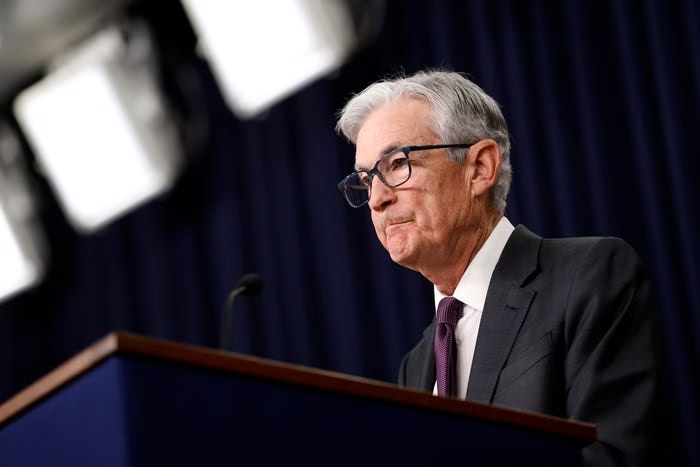
The Federal Reserve voted 11–1 to hold interest rates at 3.5% to 3.75% at its March 17–18 meeting, but the more consequential detail buried in the minutes is this: officials debated not just when to cut, but whether a rate hike might still be necessary.
With inflation unresolved, the labour market showing signs of stress, and the Middle East conflict now disrupting global oil supply, the Fed is navigating one of the most genuinely uncertain policy environments in recent memory.
The latest minutes expose a growing rift inside the Federal Reserve. While many officials signaled that a Fed rate cut could eventually become appropriate, others warned against premature easing.
“Many participants judged that, in time, it would likely become appropriate to lower the target range… if inflation were to decline in line with expectations,” the minutes stated.
However, policymakers also stressed that the timing of any Fed rate cut remains highly uncertain.
Ongoing geopolitical instability—particularly in the Middle East—has complicated forecasts, making it “too early” to determine the economic impact.
Inflation remains the biggest obstacle to a Fed rate cut. Despite some signs of easing, price pressures have not cooled enough to give policymakers confidence.
According to Jerome Powell, the central bank is committed to a data-driven approach. While Powell has repeatedly emphasized patience, he has also warned against loosening policy too soon.
This cautious tone underscores why a Fed rate cut is not guaranteed—even as markets continue to price in potential easing.
In a surprising twist, officials discussed not just the possibility of a Fed rate cut, but also the risk of further tightening.
“Some participants judged that there was a strong case for a two-sided description,” the minutes revealed, suggesting that rate hikes could still be on the table if inflation remains elevated.
This dual-path outlook highlights the complexity of the current environment.
A Fed rate cut could boost growth and liquidity—but acting too soon risks reigniting inflation.
Beyond inflation, the labor market is emerging as a critical factor in the Fed-rate cut debate.
Officials flagged slowing job growth and increasing vulnerability to external shocks.
The minutes noted that employment conditions “appeared vulnerable,” raising concerns about how the economy would withstand further geopolitical or financial stress.
A weakening labor market could accelerate calls for a Fed rate cut, especially if unemployment begins to rise. For crypto investors, the Fed rate cut narrative carries significant implications.
Lower interest rates typically increase liquidity, making risk assets like Bitcoin and altcoins more attractive. Historically, every Fed-rate cut cycle has acted as a tailwind for digital assets.
The last adjustment came on December 10, 2025, when the Fed trimmed rates by 25 basis points—triggering renewed optimism across crypto markets.
As expectations shift, traders are closely monitoring signals from policymakers for any indication of an imminent Fed rate cut.
Data from CME Group paints a cautious picture. Markets currently assign a 75.6% probability that rates will remain unchanged by December.
The likelihood of a Fed-rate cut stands at 20.4%, while the chance of a hike is just 2.4%.
These figures highlight lingering skepticism despite ongoing speculation around a Fed-rate cut.
All eyes now turn to the next Federal Reserve meeting scheduled for April 28–29. Policymakers are expected to reassess inflation trends, labor data, and geopolitical developments.
The path forward remains uncertain—but one thing is clear: the Fed-rate cut debate is far from settled.
As global risks intensify and economic signals send mixed messages, the Federal Reserve faces one of its most complex policy decisions in years.
Whether a Fed rate cut arrives sooner or later could shape not just the U.S. economy—but the future trajectory of global markets, including crypto.



Copyright © 2025 - The Bit Gazette.

