






- Trending
- Comments
- Latest

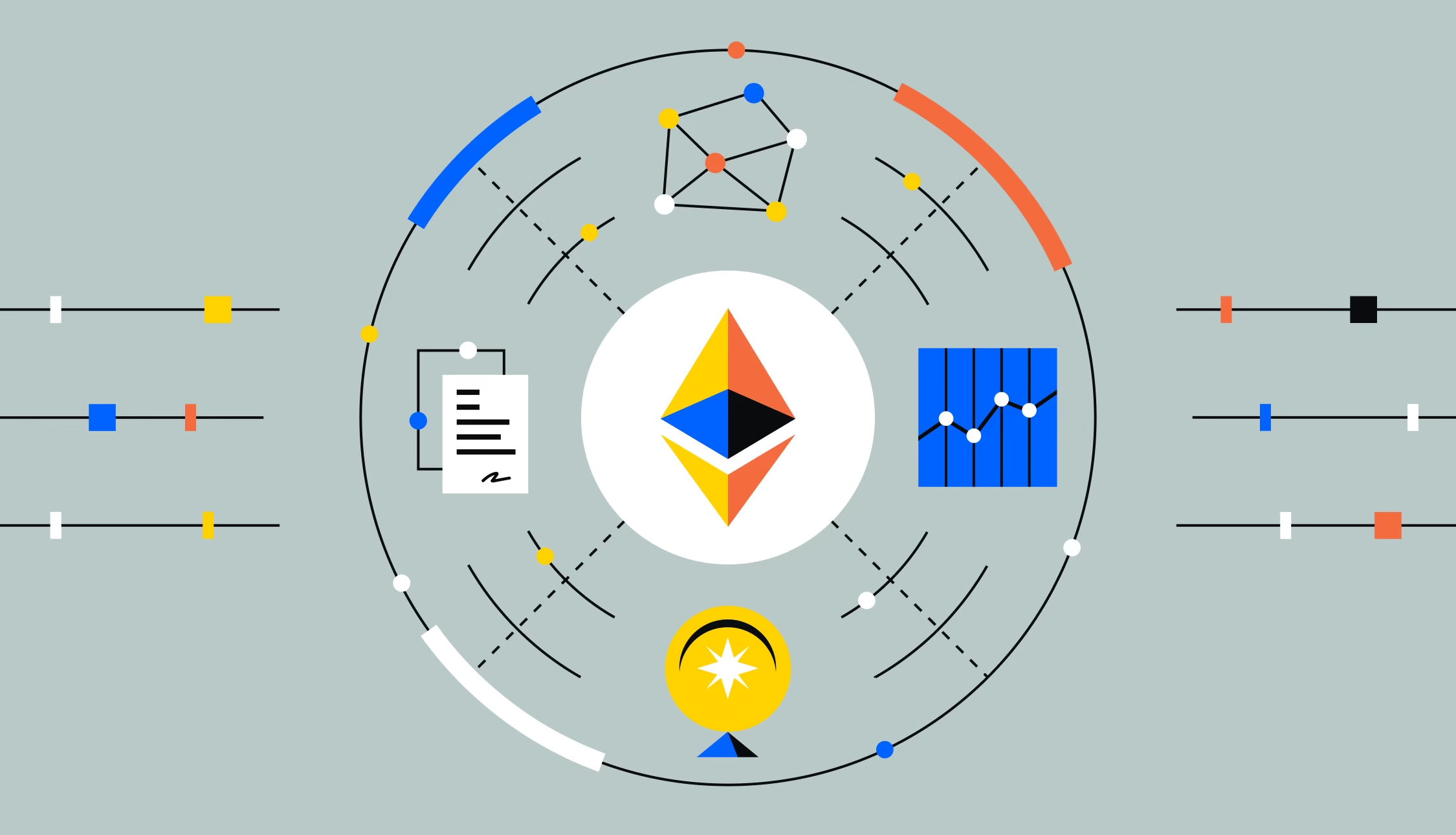
Ethereum’s scaling solution created a new problem: success. Layer 2 rollups like Arbitrum and Optimism reduced fees and sped up transactions, but they split the ecosystem into isolated islands.
A user’s tokens on Arbitrum can’t instantly trade on Optimism without a risky bridge. Fusion Rollup proposes to stitch these islands back together—pooling liquidity and letting rollups communicate as one coordinated network, rather than competing separately.
Fusion Rollup proposes a unified framework that aggregates multiple rollups, such as optimistic and zero-knowledge (ZK) rollups into a coordinated system.
The goal is to allow seamless interoperability, shared liquidity, and improved efficiency without sacrificing decentralization or security.
Fragmentation across L2 networks has made it harder to track capital flows, assess risk, and identify dominant platforms.
Fusion Rollup, if successfully implemented, could consolidate activity and create clearer market signals.
Over the past two years, Ethereum scaling has increasingly relied on Layer 2 solutions like Arbitrum, Optimism, and zkSync.
Each operates independently, with its own liquidity pools, bridges, and user base.
While this approach reduces congestion on Ethereum’s mainnet, it creates inefficiencies:
According to data from L2BEAT, billions of dollars are locked across different rollups, but not easily accessible across them in real time.
Georgios Konstantopoulos said, fragmentation is one of the biggest unsolved challenges in the rollup-centric roadmap.
Fusion Rollup aims to solve this by acting as a coordination layer, enabling rollups to share state, liquidity, and data availability more efficiently.
At its core, Fusion Rollup is not a single chain but a system architecture. It integrates multiple rollups into a shared environment where they can communicate and settle transactions collectively.
Key features include:
Instead of isolated liquidity pools, Fusion Rollup enables pooled capital accessible across participating rollups. This could improve trading efficiency and reduce slippage for decentralized exchanges.
Transactions across rollups may be ordered through a shared sequencer or coordination mechanism, reducing latency and improving cross-chain composability.
By design, Fusion Rollup minimizes reliance on traditional bridges, which have historically been a major attack vector in crypto.
Security is still anchored to Ethereum’s base layer, leveraging its consensus while allowing rollups to specialize.
For investors, Fusion Rollup represents both an opportunity and a risk.
Projects exploring similar ideas include modular blockchain initiatives and interoperability layers like Celestia and Cosmos, though their approaches differ in execution.
However, its potential to unify Ethereum’s fragmented scaling landscape makes it a development worth tracking closely.
Fusion Rollup reflects the next logical step in Ethereum’s scaling journey: moving from isolated efficiency to coordinated scalability.
If successful, it could reshape how capital flows across the crypto ecosystem and simplify the user experience.
Early awareness of infrastructure shifts often provides a strategic advantage but only if paired with careful risk assessment.
As Ethereum continues to evolve, one question remains: will the future of scaling be competitive or collaborative?



Copyright © 2025 - The Bit Gazette.

