




- Trending
- Comments
- Latest

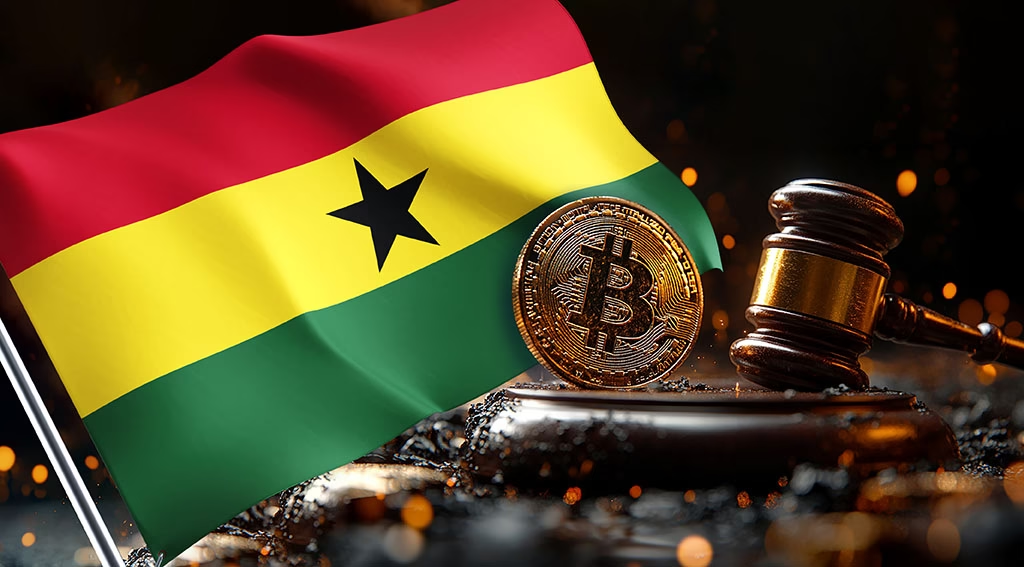
Cryptocurrency trading is now legal in Ghana after parliament approved the Virtual Asset Service Providers Bill, ending years of regulatory uncertainty and bringing the industry under central bank oversight.
Announced by the central bank governor at a public event in Accra, the law places Ghana crypto regulation under the direct supervision of the Bank of Ghana, marking a decisive shift in the country’s financial policy.
Ghana’s parliament has passed the Virtual Asset Service Providers Bill into law, creating a national framework for cryptocurrency trading and oversight. The announcement was made by Bank of Ghana (BoG) Governor Johnson Asiama, according to a report by the state-owned Daily Graphic.
“Virtual asset trading is now legal, and no one will be arrested for engaging in cryptocurrency, but we now have a framework to manage the risks involved,” — Johnson Asiama, Governor, Bank of Ghana.
The passage of the bill gives legal certainty to an industry that has operated in a grey zone for years.
Asiama noted that the timing of the law aligns with earlier central bank signals that Ghana was targeting a comprehensive crypto framework by the end of 2025, underscoring months of internal policy preparation and consultation.
Under the new legislation, the Bank of Ghana becomes the primary regulator of cryptocurrency activity, with authority to license, supervise and, where necessary, sanction crypto asset service providers (CASPs). The mandate covers consumer protection, anti-money laundering safeguards and broader financial stability concerns.
“What this means is that now we have the framework to manage it and to manage the risks that can involve that kind of activity,” Asiama said. “These are not just legal milestones; they are enablers of better policies, stronger supervision and more effective regulation.” — Johnson Asiama, Governor, Bank of Ghana.
By centralizing oversight, Ghana crypto regulation aims to reduce scams and systemic exposure without stifling innovation. The governor also emphasized that the law is designed to support financial inclusion, particularly among young people and technology-driven entrepreneurs who have been among the fastest adopters of digital assets in the country.
The legal overhaul comes as Ghana consolidates its position as one of Sub-Saharan Africa’s most active crypto markets. According to Chainalysis’ 2025 Geography of Cryptocurrency Report, Ghana ranked among the region’s top five countries by total crypto value received between July 2024 and June 2025.
The data highlights why policymakers have prioritized Ghana crypto regulation at this stage. Sub-Saharan Africa received more than $205 billion in on-chain value during the period, a 52% increase year-on-year, making it the world’s third-fastest growing crypto region after Asia-Pacific and Latin America.
While Nigeria continued to dominate regional volumes, receiving at least $92 billion in crypto value, Ghana’s inclusion in the top tier underscores the scale of domestic adoption and the urgency of formal oversight.

By legalizing trading and defining regulatory authority, Ghana has positioned itself as a jurisdiction seeking balance rather than prohibition. The law removes ambiguity around the legality of cryptocurrency while embedding risk management into the financial system.
In practical terms, Ghana crypto regulation is expected to attract more compliant investment, encourage responsible innovation and give authorities better visibility into market activity. For the general public, it promises greater consumer protection; for policymakers, a tested framework to engage with a rapidly evolving sector.
As African governments grapple with how to respond to crypto adoption, Ghana’s approach may serve as a reference point — demonstrating how regulation can coexist with growth when legal clarity and institutional oversight move in tandem.



Copyright © 2025 - The Bit Gazette.