





- Trending
- Comments
- Latest

On October 22, 2025, Google announced a breakthrough in quantum computing: a new algorithm called Quantum Echoes that the company said was 13,000 times faster than classical systems and capable of producing verifiable results.
At the time, the focus was on opportunity, drug discovery, materials science, AI. But by March 2026, Google’s tone shifted to warning: current encryption could be broken by quantum computers ‘in coming years,’ forcing Bitcoin and blockchain networks to confront an uncomfortable timeline for upgrading their security infrastructure.
On March 26, 2026, Google escalated its messaging. The company warned that current encryption systems “could easily be broken by a large-scale quantum computer in coming years,” urging organizations to begin migrating toward post-quantum cryptography.
This marked a shift from innovation to urgency.
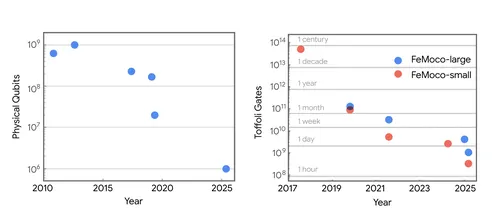
“Over the last decade, quantum computing research has reduced by orders of magnitude the estimated resources required to solve problems like breaking 2048-bit RSA encryption (left) and simulating useful molecules (right)”- Google
While experts still place the arrival of a cryptographically relevant quantum computer somewhere between the 2030s and 2050s, the concern is not just about when the technology arrives but what happens to data secured today when it does. The “store now, decry¾pt later” threat means information protected under current systems could already be at risk in the future.
The implication is straightforward: waiting is no longer a neutral decision.
Following the renewed attention on quantum risk, Changpeng Zhao addressed concerns across the crypto industry.
His position was direct: “all crypto has to do is to upgrade to Quantum-Resistant (Post-Quantum) Algorithms,” adding that there is “no need to panic.”
But his full response revealed the real issue.
“It’s hard to organize upgrades in a decentralized world,” he noted, pointing to likely disagreements over which algorithms to adopt and warning that such debates could result in forks. He also acknowledged that “new code may introduce other bugs or security issues in the short term,” and that users who self-custody assets would need to migrate funds to new wallets.
The technical path forward exists. The operational path is far less certain.
For networks like Bitcoin, the Google quantum breakthrough does not represent an immediate failure of security but it does introduce a deadline.
Bitcoin’s security model depends on cryptographic assumptions that are robust against classical computing. Quantum computing challenges those assumptions over time. The vulnerability is not constant; it emerges in specific moments—particularly when public keys are exposed during transactions.
In a sufficiently advanced quantum environment, those keys could theoretically be reversed within a limited time window, creating opportunities for interference before transactions are finalized.
Even if that scenario remains years away, the direction is now established. The Google quantum breakthrough compresses the timeline for when such risks must be addressed.
One of the most complex implications raised in this discussion involves inactive wallets, particularly those linked to Satoshi Nakamoto.
CZ framed the dilemma clearly: if those coins move, “it means he/she is still around.” If they do not, he suggested it “might be better to lock (or effectively burn) those addresses so that they don’t go to the first hacker who cracks it.”
This introduces a governance problem with no clear precedent. Identifying which addresses belong to early holders versus lost wallets is already difficult. Acting on that distinction within a decentralized system is even more challenging.
The Google quantum breakthrough does not create this issue but it makes it harder to ignore.
The timeline from 2025 to 2026 reveals a consistent pattern.
First, the Google quantum breakthrough demonstrated that quantum systems are moving toward practical use. Then, the same trajectory prompted warnings that existing encryption may not hold indefinitely. In response, crypto leaders acknowledged both the risk and the possibility of adaptation.
What has changed is not the existence of a solution, but the urgency of implementing it.
Quantum computing does not need to arrive tomorrow to affect decisions today. Its projected capability is already influencing how systems must evolve.
The Google quantum breakthrough is not the end of Bitcoin.
But it may mark the beginning of Bitcoin’s most important transition.
The countdown is not about collapse. It is about coordination how quickly decentralized systems can agree, upgrade, and guide users through change before theoretical risk becomes practical reality.
As Changpeng Zhao concluded, “crypto will stay, post quantum.”
The question now is whether it will look the same when it does.



Copyright © 2025 - The Bit Gazette.