






- Trending
- Comments
- Latest

Hong Kong and Shanghai have signed a blockchain cooperation agreement aimed at modernizing cross-border cargo trade finance, placing the Hong Kong Monetary Authority’s Project Ensemble at the center of a push to digitize trade documentation and electronic bills of lading across jurisdictions.
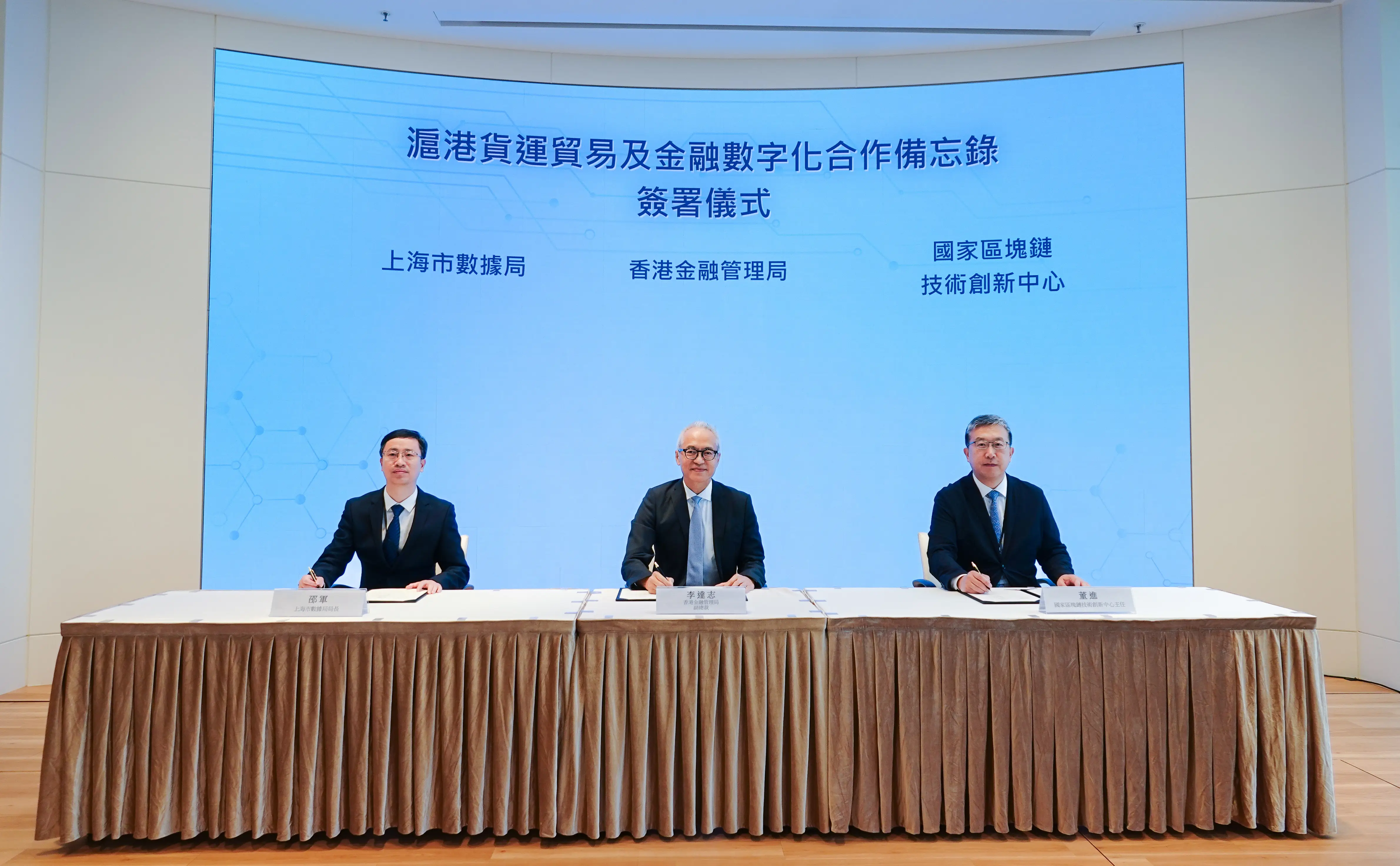
Announced Monday in Hong Kong, the memorandum of understanding brings together the Hong Kong Monetary Authority (HKMA), the Shanghai Data Bureau and the National Technology Innovation Center for Blockchain. The partnership seeks to build shared digital infrastructure linking trade documentation, electronic bills of lading and financing systems across jurisdictions.

The agreement represents a significant expansion of Project Ensemble, the HKMA’s blockchain framework, into the operational core of cargo finance — a market estimated at $1.5 trillion. By digitizing documentation and synchronizing data flows between mainland China and Hong Kong, officials aim to reduce delays, lower costs and mitigate fraud risks that continue to burden global trade transactions.
At its core, Project Ensemble is being positioned as a cross-border data and settlement bridge. Cargo finance has long relied on paper-heavy documentation, fragmented data channels and manual verification processes. These inefficiencies often slow credit approvals and cross-border settlements, increasing both operational risk and financing costs for exporters and importers.
Under the memorandum, the participating agencies will explore building a cross-border platform within the Project Ensemble framework. The system would integrate blockchain-based trade documentation, including electronic bills of lading, and connect with Hong Kong’s Commercial Data Interchange and CargoX platform to enable standardized and secure data sharing.
In a statement accompanying the announcement, the HKMA said the agreement would “formalize plans to create a shared digital platform connecting trade data, electronic bills of lading, and financing systems across jurisdictions.” — Hong Kong Monetary Authority, statement.
By embedding trade data directly into financial workflows, Project Ensemble aims to streamline how banks assess risk, verify shipments and extend trade credit. The modernization effort reflects a broader push to digitize supply chain finance, where paper-based instruments remain common despite years of technological experimentation.
The strategic significance of Project Ensemble extends beyond technical upgrades. Hong Kong has long positioned itself as a financial gateway between mainland China and global markets. By linking mainland cargo and trade data with Hong Kong’s internationally connected financial infrastructure, the initiative reinforces that intermediary role.
According to the HKMA, the parties will explore how to integrate mainland trade documentation into Hong Kong’s financial ecosystem in a compliant and standardized manner. The intention is to channel verified cargo data into financing systems that can serve both domestic Chinese exporters and international counterparties.
The HKMA said the platform would operate within the Project Ensemble architecture while leveraging Hong Kong’s Commercial Data Interchange. — Hong Kong Monetary Authority, statement.
For Shanghai authorities, participation provides a structured channel to share trade data through a regulated cross-border mechanism. For Hong Kong, Project Ensemble could deepen its relevance in mainland supply chains at a time when regional competition for financial innovation is intensifying.
Hong Kong has previously advanced blockchain experiments in areas such as tokenized green bonds and digital asset issuance. The expansion of Project Ensemble into cargo finance signals a shift from capital markets experimentation to trade “plumbing” — the back-end infrastructure that underpins day-to-day commerce.
Trade finance remains one of the least digitized segments of global finance. Discrepancies in documentation, duplicated records and fraud vulnerabilities continue to generate friction. By digitizing electronic bills of lading and synchronizing transaction data across borders, Project Ensemble seeks to embed blockchain technology into mission-critical systems rather than isolated pilots.
The memorandum states that the cooperation will explore secure data integration and shared standards across jurisdictions. — Hong Kong Monetary Authority, statement.
If implemented successfully, the initiative could provide banks with faster access to verified trade data, potentially shortening approval cycles for letters of credit and supply chain financing. It may also reduce reliance on physical documentation, lowering administrative costs for logistics firms and exporters.
The evolution of Project Ensemble reflects Hong Kong’s broader ambition to consolidate its position as China’s global financial bridge. By formalizing cooperation with Shanghai’s data and blockchain institutions, the HKMA is moving beyond exploratory trials and toward institutionalized digital rails.
The agreement does not specify a launch date for the cross-border platform, nor does it outline immediate transaction volumes. However, officials framed the memorandum as a foundational step in integrating blockchain into mainstream trade finance operations.
In doing so, Project Ensemble is being repositioned from a regulatory sandbox initiative to a potential backbone of cross-border trade modernization. The emphasis on interoperability, compliance and standardized documentation suggests authorities are aiming for scalable infrastructure rather than limited proof-of-concept projects.



Copyright © 2025 - The Bit Gazette.

