





- Trending
- Comments
- Latest

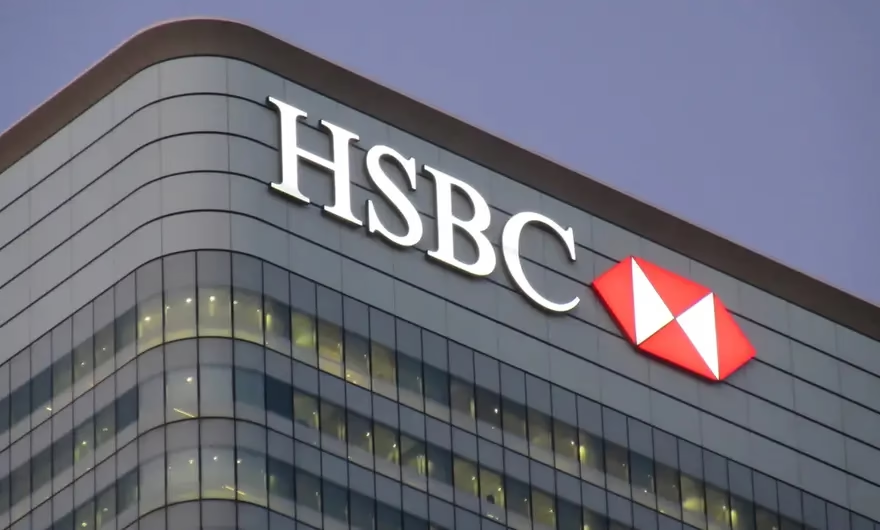
HSBC, Swift and Ant International completed a pilot program Thursday enabling real-time cross-border transfers of tokenized bank deposits between Singapore and Hong Kong.
The proof of concept tested how blockchain infrastructure can integrate with existing payment networks to reduce settlement times and costs in international transactions.
At its core, the initiative demonstrates how the HSBC Tokenized Deposit can function within current banking systems while meeting regulatory, compliance, and operational requirements—an issue closely watched by crypto investors, policy makers, and multinational firms managing global liquidity.
The proof of concept brought together three distinct components: Swift’s global financial messaging network, Ant International’s in-house blockchain technology, and the HSBC Tokenized Deposit Service.
Under this service, HSBC converts traditional bank deposits into digital tokens on a one-to-one basis, with each token representing a unit of fiat currency held on the bank’s balance sheet.
These tokenized deposits can then be transferred instantly between participating HSBC entities, operating 24 hours a day. By integrating Ant International’s blockchain with Swift’s ISO 20022 messaging framework, the pilot enabled Ant to conduct real-time treasury management between HSBC Singapore and Hong Kong.
The collaboration also introduced a common protocol co-developed by the three organizations. This framework allows corporate clients like Ant International to access tokenized deposit services without negotiating separate bilateral agreements with each banking partner.
For large multinationals, this could significantly reduce operational complexity while expanding access to regulated digital money tools anchored by the HSBC Tokenized Deposit.
ISO 20022, first introduced in 2004, is designed to standardize and enrich financial messaging data across global payment systems. However, adoption across banks accelerated only in the early 2020s.
According to a Financial Stability Board progress report released in October, cross-border payments in G20 countries have improved only marginally over the past two years, highlighting the need for deeper structural change.
By pairing ISO 20022 with blockchain-based settlement, the HSBC Tokenized Deposit pilot aims to reduce the number of intermediaries involved in international transfers and enable near-instant settlement.
The structured data format also strengthens compliance by extending HSBC’s existing anti-money laundering controls and sanctions screening into its tokenized deposit framework.
“We are excited to demonstrate how ISO 20022 data formats, when combined with new technologies like blockchain, bring significant value to the entire community,” — Shirish Wadvikar, Global Head of Payments and Cash Management, Swift.
“We are committed to shaping a future of seamless global interoperability, powered by ISO 20022’s structured data with financial institutions’ need for trust, efficiency, and regulatory consistency,” he added.
HSBC executives framed the initiative as an evolution of traditional banking rather than a replacement. Lewis Sun, HSBC’s Head of Domestic and Emerging Payments, said the project shows how banks can blend familiar services with next-generation infrastructure.
“We are giving our corporate clients more choice in how they manage liquidity globally; with the familiarity of traditional banking and the benefits of next-generation digital infrastructure,” — Lewis Sun, Head of Domestic and Emerging Payments, HSBC.
From Ant International’s perspective, the collaboration could help define industry-wide standards. Kelvin Li, General Manager of Platform Technology at Ant International, said the partners believe the work “can guide the standardization of tokenized deposits under ISO 20022.”
“We will continue to enable interoperability in global money movement together with our partners, so businesses can access more transparent, secure, and efficient cross-border payments,” — Kelvin Li, General Manager of Platform Tech, Ant International.
Beyond payments infrastructure, Ant International also announced a separate milestone in financial security. The company won first place at the NeurIPS Competition of Fairness in AI Face Detection, held in early December in San Diego, outperforming more than 2,100 submissions from 162 teams worldwide with a reported 99.8% detection rate.
“A biased AI is an insecure AI,” — Dr. Tianyi Zhang, General Manager of Risk Management and Cybersecurity, Ant International.
“Our model’s fairness prevents exploitation from deepfakes and provides reliable identity verification for all users, supporting our mission to deliver secure and inclusive financial services worldwide,” he said.
Together, these developments underline a broader trend: as banks experiment with tokenization through initiatives like the HSBC Tokenized Deposit, security, interoperability, and regulatory trust remain central to shaping the future of global finance.



Copyright © 2025 - The Bit Gazette.