






- Trending
- Comments
- Latest

According to Chainalysis’s 2026 Crypto Crime Report released on Thursday, March 5th, illicit cryptocurrency activity has become a primary tool for nation-states evading sanctions, with addresses associated with governments receiving $154 billion in 2025—a 162% increase year-over-year.
The shift marks a fundamental change in how blockchain is weaponized, moving from individual cybercrime to coordinated state financial strategy.”
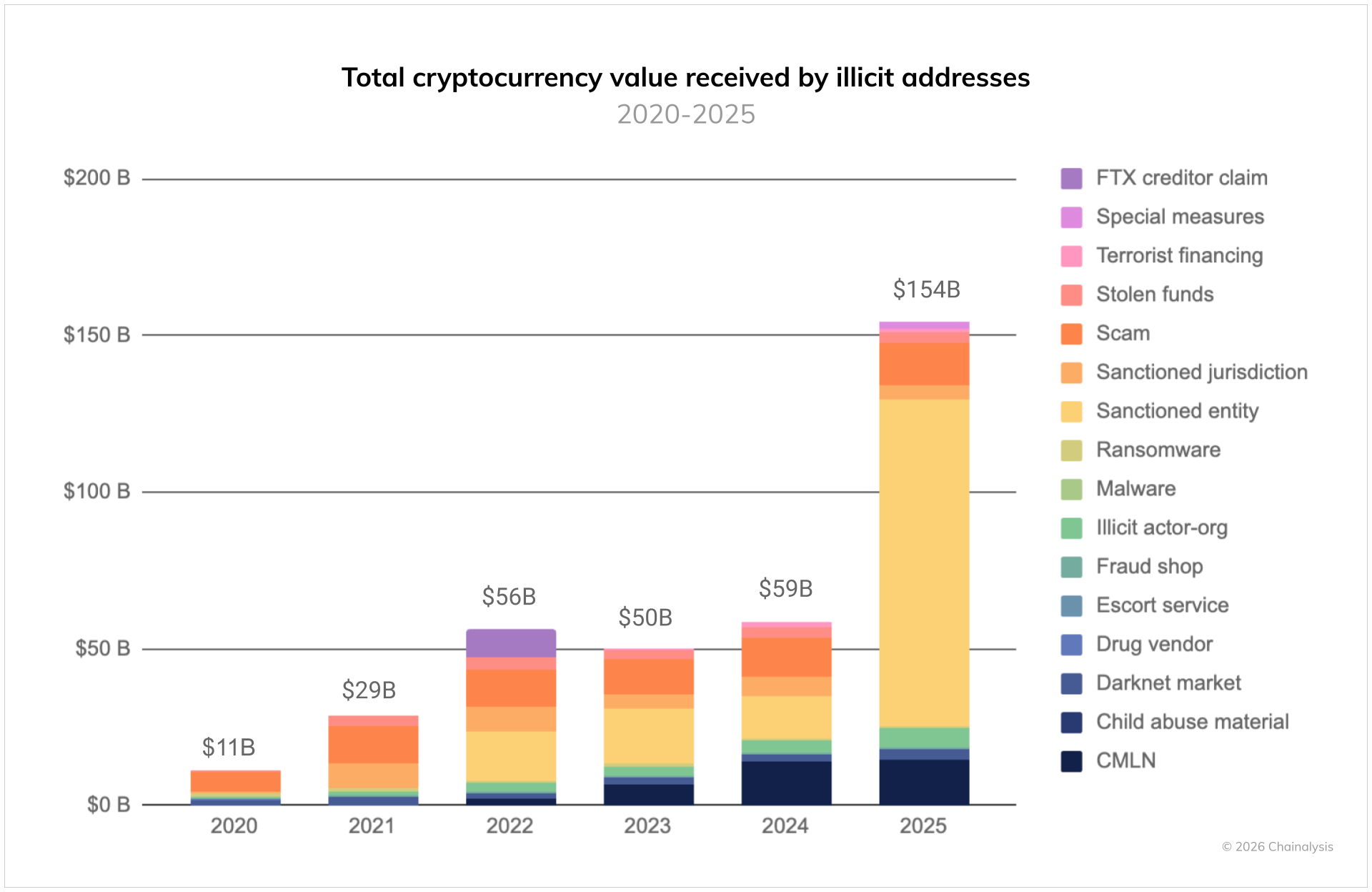
The data show a dramatic shift. Illicit addresses received at least $154 billion in 2025, representing a 162% year-over-year increase, while the value received by sanctioned entities surged 694%, totaling $104 billion.
These numbers point to a new reality: illicit crypto activity is no longer merely a byproduct of digital finance but an increasingly deliberate policy tool used by governments navigating sanctions, conflict, and financial isolation.
As the report notes, “Sanctions evasion has traditionally been viewed as a game of financial shell companies and hidden bank accounts.” Yet that paradigm is changing rapidly as blockchain infrastructure becomes part of state financial systems.
One of the most significant insights from the report is the transformation of illicit crypto activity from decentralized criminal behavior into coordinated state activity. Russia, Iran, and North Korea—three countries facing extensive international sanctions—have developed distinct approaches to integrating digital assets into their economic strategies.
What makes this shift notable is scale. In previous years, illicit crypto activity was largely tied to cybercrime operations. Today, governments appear to be using blockchain networks to facilitate cross-border trade, diversify reserves, and bypass restrictions imposed by the global financial system.
The Chainalysis analysis suggests that cryptocurrency has become embedded within national economic policy in sanctioned jurisdictions. “Nation-states have upgraded their capabilities not just to launder on-chain, but also to execute cross-border trade,” the report states. That statement reflects a profound change in how digital assets function within global finance.
Rather than serving solely as tools for criminals seeking anonymity, blockchain systems are increasingly becoming parallel financial rails used by governments to maintain economic activity under sanctions pressure. This trend is particularly evident in the use of stablecoins and tokenized settlement systems.
The implication is clear: illicit crypto activity cannot be analyzed purely through the lens of cybercrime anymore. It is increasingly tied to geopolitical competition and financial resilience strategies.
The surge in illicit crypto activity is closely linked to sanctions evasion efforts by states seeking alternatives to traditional banking systems. One of the most striking examples in the report is the ruble-backed token A7A5, which processed $93.3 billion in transactions within less than a year.
Unlike conventional cryptocurrencies designed for retail users, A7A5 appears to operate as a settlement layer for sanctioned actors seeking access to international markets. Trading patterns even resemble institutional financial activity, with volumes peaking during weekday business hours.
The system’s architecture demonstrates how blockchain infrastructure can be engineered specifically to facilitate sanctions circumvention. Through services like the A7A5 Instant Swapper, sanctioned tokens can be converted into widely used stablecoins, effectively bridging sanctioned financial ecosystems with the broader crypto economy.
Such mechanisms illustrate how illicit crypto activity is evolving beyond simple money laundering toward structured financial networks designed to sustain sanctioned economies. For regulators, this represents a complex challenge: enforcement efforts must now address not only individual wallets but entire infrastructures enabling digital asset flows.
Indeed, authorities have begun shifting their approach accordingly. Instead of focusing solely on illicit transactions, regulators are increasingly targeting the technical infrastructure behind them. Sanctions on hosting providers, exchanges, and other service layers reflect an emerging strategy to disrupt the operational backbone of illicit crypto activity.
Another key takeaway from the report is the degree to which illicit crypto activity mirrors global geopolitical dynamics. Blockchain transaction flows increasingly react to major political events in near real time.

Iran offers a particularly clear example. The report notes that addresses associated with the Islamic Revolutionary Guard Corps accounted for over 50% of value received by Iranian entities in the fourth quarter of 2025, totaling more than $3 billion for the year.
These funds reportedly support a network of regional proxy groups and trade operations involving commodities and oil. In this context, illicit crypto activity becomes a financing mechanism embedded within broader geopolitical strategies rather than a standalone financial crime issue.
North Korea provides another illustration. In 2025 alone, the country reportedly stole more than $2 billion in cryptocurrency, marking its most successful year of cyber-enabled theft. These funds ultimately support the regime’s weapons programs, reinforcing the connection between illicit crypto activity and national security concerns.
As the report emphasizes, “What were once experimental and opportunistic tactics have matured into institutionalized strategies embedded within national economic and security policy.”
This evolution complicates enforcement. Traditional anti-money-laundering frameworks are designed to target criminals, not sovereign governments leveraging digital finance to bypass sanctions.
Despite the dramatic growth in illicit crypto activity, the report also highlights an important paradox: the same technologies enabling sanctions evasion are also providing financial lifelines for ordinary citizens.
Venezuela illustrates this dual reality. With hyperinflation and banking instability eroding trust in the domestic financial system, many Venezuelans rely on cryptocurrency as a store of value and a means of accessing global markets.
At the same time, the Venezuelan government has explored using digital assets to facilitate oil trade and bypass sanctions. This overlapping usage creates a complicated policy landscape in which illicit crypto activity and legitimate financial survival coexist within the same ecosystem.
The broader lesson is that blockchain networks are fundamentally neutral infrastructures. They can enable both economic resilience and financial crime depending on how they are used.
For regulators and policymakers, this dual nature raises difficult questions. Efforts to restrict illicit crypto activity must be balanced against the risk of limiting access to financial tools that millions of people rely on during economic crises.
Looking ahead, the trajectory of illicit crypto activity suggests that enforcement strategies must evolve as quickly as the technology itself. As blockchain adoption expands globally, the lines between legitimate financial innovation and sanctions evasion will continue to blur.
The transparency of blockchain systems remains a key advantage for investigators, enabling real-time tracking of suspicious activity. Yet transparency alone cannot prevent governments from building alternative financial networks on public blockchains.
The report ultimately points to a structural shift in global finance. Cryptocurrency is no longer just a disruptive technology; it is increasingly a strategic asset used by states navigating geopolitical pressure.
If that trend continues, illicit crypto activity will remain not only a cybersecurity issue but also a central concern for international economic policy and national security.



Copyright © 2025 - The Bit Gazette.