


- Trending
- Comments
- Latest

Indian Member of Parliament Raghav Chadha has called on the government to introduce legislation enabling blockchain-based tokenization of real-world assets, arguing that fractional ownership of commercial real estate, infrastructure projects, and intellectual property could expand investment access for middle-income households.
Chadha’s proposal, raised in Parliament this week, requests dedicated regulation rather than relying on existing securities laws, and includes a call for a regulatory sandbox to test tokenized asset frameworks under government supervision before broader implementation.
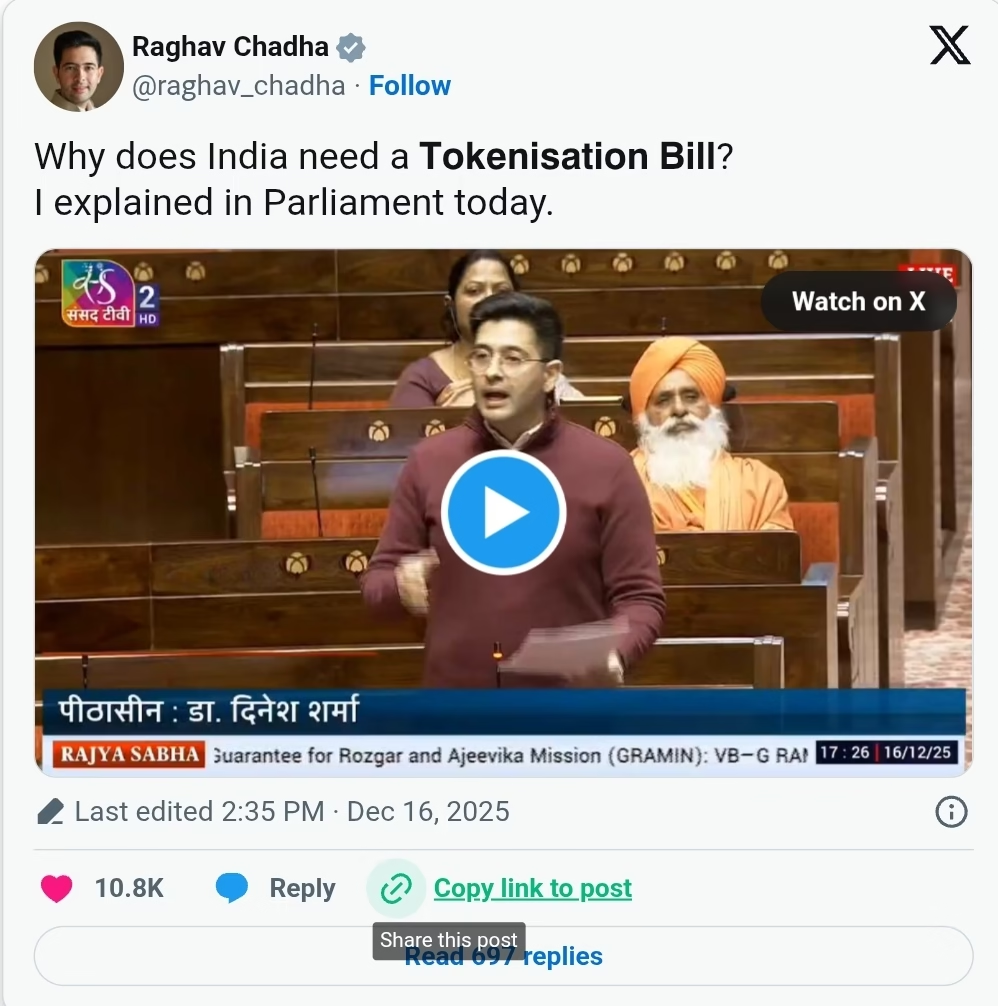
A central argument behind the India Tokenization Bill is the limited range of investment options currently available to India’s middle class. Households largely depend on fixed deposits, savings accounts, and mutual funds, instruments that often provide stability but limited exposure to high-growth assets.
Chadha’s proposal highlights how high capital requirements have historically excluded average investors from commercial real estate, infrastructure financing, and other long-term assets.
Tokenization, as outlined in the India Tokenization Bill, would allow these assets to be divided into digital units, enabling individuals to purchase small, affordable stakes rather than entire properties or projects.
“Fractional ownership” — Raghav Chadha, Member of Parliament, India.
Supporters argue that this structure could rebalance wealth access without dismantling existing financial systems. Tokenized assets may also improve liquidity, allowing investors to enter or exit positions more easily than traditional property or infrastructure investments, which often require lengthy settlement periods and broker mediation.
Digital records embedded on blockchain systems could further enhance transparency and reduce transaction costs. Advocates of the India Tokenization Bill say this aligns with India’s broader push toward financial inclusion and digital public infrastructure.
A defining feature of the India Tokenization Bill proposal is its call for tailored legislation rather than reliance on existing securities or property laws. Chadha emphasized that asset tokenization introduces unique legal, technological, and investor-protection challenges that current frameworks are not designed to address.
“Tokenization Bill” — Raghav Chadha, Member of Parliament, India.
The proposal calls for the creation of a regulatory sandbox that would allow controlled experimentation under the supervision of financial authorities. Such an approach would enable regulators to monitor risks, assess compliance requirements, and refine rules before permitting large-scale adoption.
According to Chadha’s parliamentary remarks, a sandbox model would protect investors while giving policymakers real-world data to guide future regulation.
Proponents of the India Tokenization Bill argue that this phased approach could prevent systemic risks while fostering innovation within clear legal boundaries.
Regulatory clarity is also seen as essential for defining asset custody, investor rights, taxation, and dispute resolution in a tokenized environment. Without explicit legislation, critics warn that India risks fragmented oversight and regulatory uncertainty that could deter responsible adoption.
Beyond domestic inclusion, the India Tokenization Bill carries strategic implications for India’s position in global capital markets.
Financial hubs such as Singapore, Hong Kong, and the United Arab Emirates have already advanced regulatory frameworks for tokenized assets, attracting institutional capital seeking compliant environments.
Chadha warned that without decisive policy action, India could fall behind jurisdictions actively courting blockchain-based finance. Clear rules under the India Tokenization Bill could make India more attractive to global investors looking for regulated exposure to tokenized real-world assets.
“Regulatory sandbox” — Raghav Chadha, Member of Parliament, India.
Supporters believe that embracing tokenization could unlock dormant capital in infrastructure and real estate while aligning with India’s broader economic modernization goals. For policymakers, the challenge lies in balancing innovation with consumer protection, financial stability, and legal certainty.
As Parliament debates the proposal, the India Tokenization Bill represents more than a legislative suggestion—it reflects a growing recognition that asset ownership models are evolving.
Whether the bill advances or stalls, it has already triggered a critical policy conversation about how India integrates blockchain technology into its financial system.



Copyright © 2025 - The Bit Gazette.