






- Trending
- Comments
- Latest

Kraken launches VIP program requiring $10 million balance as exchange targets wealthy crypto traders
An unverified listing on a dark web forum claims to offer access to Kraken customer support systems for as little as $1, allegedly allowing buyers to view user profiles, transaction histories, and KYC documents.
The claims, which surfaced in late December and circulated widely on X this week, have not been confirmed by Kraken or independent security researchers, and no evidence of an actual breach has emerged.
The allegations come amid a wave of social engineering attacks targeting crypto exchange support staff, including a confirmed breach at Coinbase that exposed customer data after support agents accepted bribes.
According to posts tracked by the web activity monitoring account Dark Web Informer, an unverified listing on a dark web forum claims to offer read-only access to Kraken internal support systems for as little as $1, with pricing described as negotiable. The listing was allegedly posted by a user identified as “ransomcharger.”
Screenshots of the forum thread suggest the seller claimed the access could allow viewing of user profiles and transaction histories, as well as the creation of customer support tickets that could be used for phishing or data extraction attempts. The same listing alleged that the access was not restricted by IP address and was routed through Kraken’s own systems.
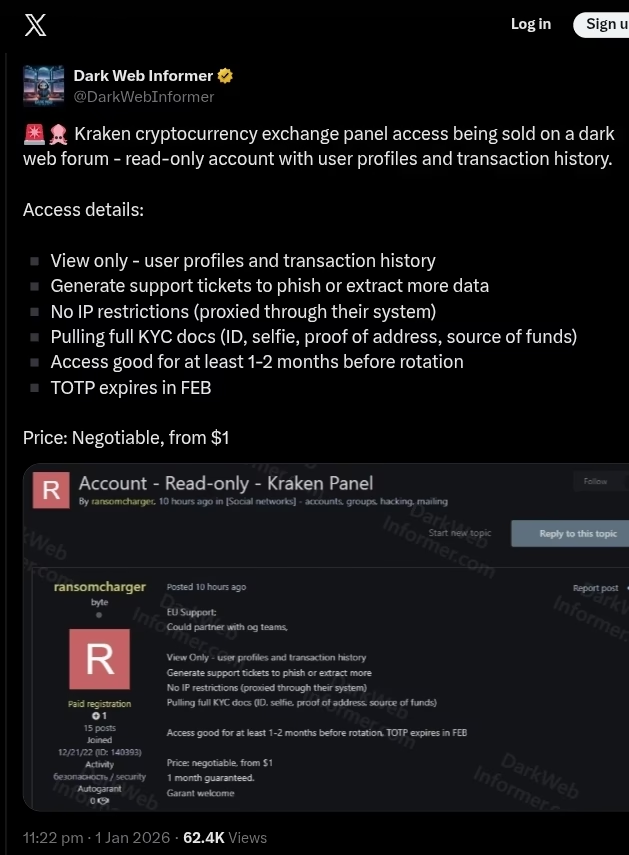
The claims further suggested that the access could retrieve sensitive know-your-customer documentation, including identification cards, selfies, proof of address, and declared sources of funds. The seller alleged that the access would remain active for one to two months, with time-based authentication codes expiring in February.
Despite the specificity of these assertions, no independent evidence has surfaced to confirm that Kraken internal support systems were actually breached. Cryptopolitan reported it was unable to verify the claims through other sources, and Kraken’s support team has not publicly confirmed any compromise of its internal infrastructure.
The allegations come as major cryptocurrency exchanges face growing scrutiny over social engineering attacks aimed at customer support staff. In mid-2025, Kraken and Binance were reportedly targeted by the same campaign that resulted in a confirmed data breach at Coinbase, according to people familiar with the matter.
In that case, attackers contacted overseas customer service agents and allegedly offered bribes in exchange for user information. Coinbase later disclosed that some representatives accepted the bribes, providing data such as customer names, addresses, partial KYC records, and account balances.
The attackers attempted to extort Coinbase for $20 million in exchange for deleting the stolen data, but the exchange declined to pay and instead alerted law enforcement. The incident exposed Coinbase to potential losses estimated at up to $400 million.
Kraken and Binance, however, were reported to have thwarted similar attempts through layered access controls and real-time monitoring of support interactions. Binance has said it deploys artificial intelligence systems to monitor customer support conversations in multiple languages, flagging suspicious behavior such as bribery attempts and automatically terminating risky communications.
Kraken has also emphasized safeguards designed to limit unnecessary access to customer information and detect anomalous behavior within Kraken internal support systems.
“Behind the scenes, there also is AI, machine learning, some other analytics that are going on behind the scenes that are transparent to the user to say, is everything looking the way it should?” — Nick Percoco, Chief Security Officer, Kraken. “There are times when our teams will be able to jump in front and stop those types of attacks.”
The renewed focus on Kraken internal support systems follows recent law enforcement actions tied to customer support abuses elsewhere in the industry.
Just last week, Coinbase CEO Brian Armstrong disclosed that a former Coinbase customer service agent had been arrested in India months after allegedly providing hackers with access to customer data.
A Coinbase spokesperson confirmed the arrest, noting that it resulted from coordinated efforts with law enforcement agencies across multiple jurisdictions to identify and prosecute those involved. The case underscored how insider threats can bypass technical defenses when support staff are compromised.
Separately, the Brooklyn District Attorney’s Office announced charges against a Brooklyn man accused of orchestrating a long-running impersonation scheme targeting Coinbase customers in the United States. According to the indictment, the defendant posed as a Coinbase representative and used social engineering tactics to convince victims their accounts were at immediate risk.
The U.S. Department of Justice said the suspect directed victims to transfer funds to wallets under his control, stealing nearly $16 million from approximately 100 victims. Authorities have recovered more than $600,000 so far.
While there is still no evidence that Kraken internal support systems were breached, analysts say the unverified claims illustrate how sensitive customer support infrastructure has become a focal point for attackers. As exchanges continue to expand globally, securing internal tools and monitoring insider access remains critical to maintaining trust.
For now, Kraken users are advised to remain cautious, verify communications claiming to be from support staff, and rely on official channels as investigations into the dark web claims continue.



Copyright © 2025 - The Bit Gazette.

