






- Trending
- Comments
- Latest

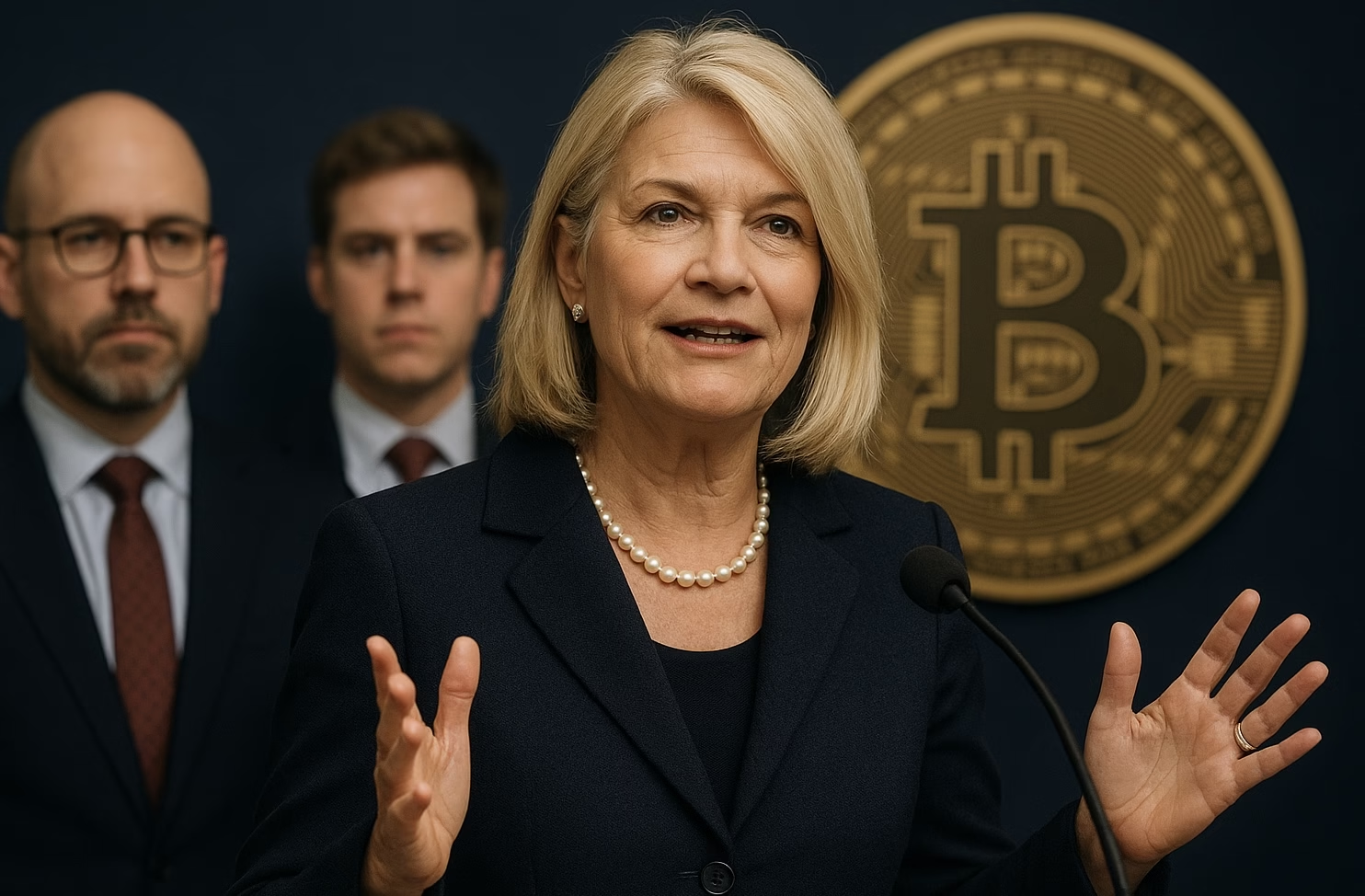
U.S. Senator Cynthia Lummis told banks this week they are missing significant revenue opportunities by resisting cryptocurrencies and stablecoins, arguing that blockchain-based payment services could modernize traditional banking while cutting costs for consumers.
Speaking in a televised interview, the Wyoming Republican said blockchain-based financial services could modernize traditional banking while delivering tangible benefits to consumers.
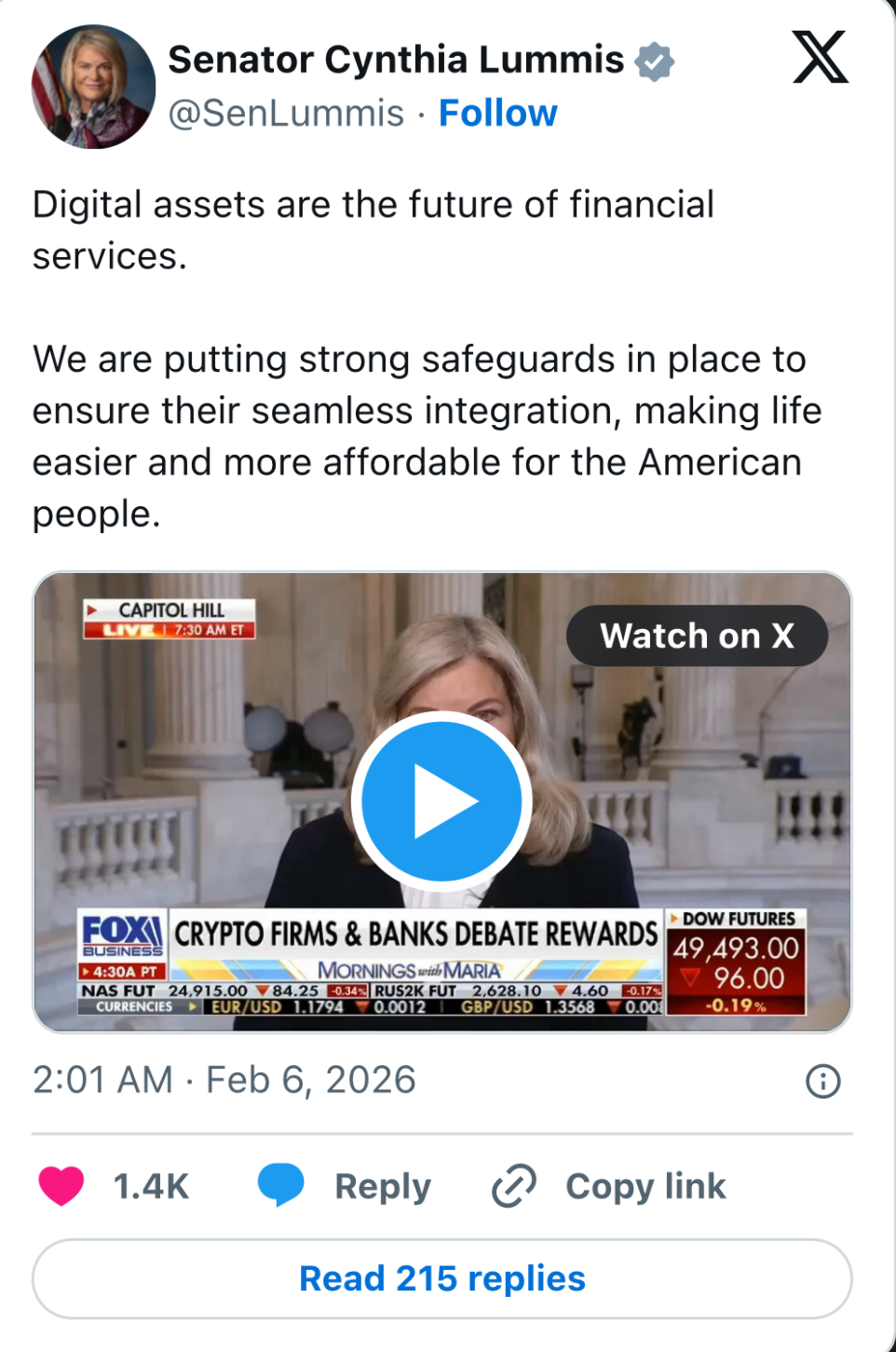
Lummis’ comments come as U.S. regulators and lawmakers continue to debate how digital assets adoption should be integrated into the existing financial system.
While some banks have taken cautious steps into crypto-related services, others remain hesitant amid regulatory uncertainty and perceived risk.
During an interview aired on Fox News and later shared on X, Lummis questioned why many banks remain resistant to digital assets adoption despite growing institutional interest and legislative momentum.
“One of the things I don’t understand about the bank’s resistance is this gives them an entirely new financial product that they can offer to their customers,” — Cynthia Lummis, U.S. Senator for Wyoming.
She argued that rather than displacing banks, digital assets adoption could expand their role by enabling new services such as crypto custody and blockchain-based payments.
According to Lummis, several U.S. states have already moved to permit banks to offer custody services for digital assets, laying the groundwork for broader participation.
“Whether it’s custody of digital assets, which three states already allow, or the use of stablecoins as a payment mechanism that’s faster and cheaper than a debit card,” she said, banks stand to gain by embracing innovation rather than resisting it.
Lummis framed digital assets adoption as a competitive necessity, particularly as non-bank financial platforms continue to attract users with faster settlement times and lower transaction costs.
A central pillar of Lummis’ argument for digital assets adoption is the efficiency of blockchain-based payments compared to traditional banking rails.
She emphasized that consumers, rather than financial institutions, stand to benefit most from the shift.
“For consumers, it’s going to be faster and cheaper to do business, whether it’s across the country or overseas,” — Cynthia Lummis, U.S. Senator for Wyoming.
She added that blockchain networks allow money to move more quickly than existing bank infrastructure, particularly for cross-border transfers that can take days to settle under current systems.
“Money can be transmitted on the blockchain more quickly than it can if you’re going through existing bank structures,” she said.
These efficiencies, Lummis argued, could lower costs for everyday transactions, remittances, and international payments areas where traditional banking fees have long been a pain point.
For banks, digital assets adoption could translate into lower operational costs while opening new fee-based revenue streams tied to custody, payments, and settlement services.
While advocating for faster innovation, Lummis acknowledged that digital assets adoption must be accompanied by strong consumer protections and regulatory safeguards.
She said lawmakers and regulators are actively working to ensure that blockchain-based financial services meet safety and security standards comparable to traditional banking.
“We want to make sure that not only is it faster and cheaper, but that it’s still safe,” — Cynthia Lummis, U.S. Senator for Wyoming.
According to the senator, discussions with the Federal Reserve and other regulators have centered on building appropriate guardrails as digital assets adoption accelerates.
These conversations aim to balance innovation with systemic stability, particularly as stablecoins and tokenized payments gain traction.
Lummis described digital assets adoption as a natural evolution of financial services rather than a disruptive threat.
She noted that multiple stakeholders including regulators, banks, and technology providers are increasingly aligned on integrating blockchain into mainstream finance.
“There are a lot of interested parties in making sure that as we integrate this into the 21st century financial services industry, that it integrates beautifully,” she said.
For crypto investors, Lummis’ comments underscore a broader shift in political sentiment toward digital assets adoption within the U.S. financial system.
Greater bank participation could increase liquidity, legitimacy, and long-term demand for blockchain-based products.
For banks, the message was direct: resisting digital assets adoption may mean ceding ground to fintech firms and offshore platforms that are already leveraging blockchain technology.
As regulatory clarity improves, institutions that move early could secure a competitive advantage in payments, custody, and digital asset services.
Lummis’ remarks highlight a growing consensus among pro-crypto lawmakers that digital assets adoption is no longer a question of if, but how.
As the debate moves from resistance to implementation, the banking sector may soon face pressure to adapt or risk being left behind in a rapidly evolving financial landscape.



Copyright © 2025 - The Bit Gazette.