







- Trending
- Comments
- Latest

Picture Ethereum on a bad day in 2021.
A major NFT drop goes live. Within minutes, hundreds of thousands of users rush to mint. The network clogs. Gas fees spike past $200. Transactions fail after users have already paid.
The moment exposed a growing problem: the blockchain that promised fast, open finance had become a traffic jam.
For years, the industry avoided a difficult question: Can one blockchain do everything?
A growing group of engineers now believes the answer is no. Their solution is a new design philosophy known as modular blockchains.
Early blockchains such as Bitcoin and the original Ethereum were designed as monolithic systems. Every node on the network performs four core tasks at once:
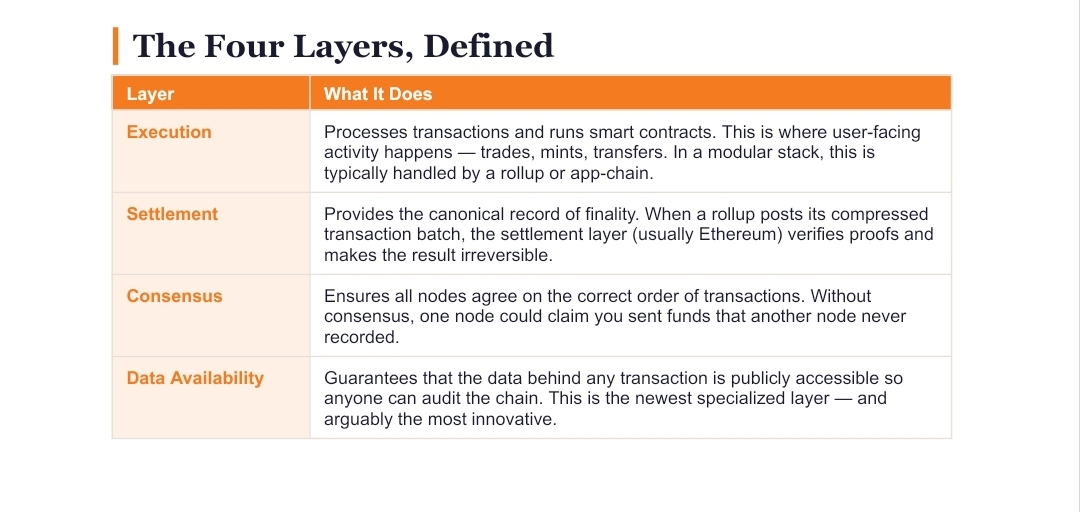
This design is secure, but inefficient. Because every node must do everything, the network can only move as fast as its slowest validator.
That trade-off led to what developers call the blockchain scalability trilemma: a system can optimize for scalability, security, or decentralization — but rarely all three at once.
Modular blockchains rethink this architecture entirely.
Instead of forcing one chain to handle every task, different layers specialize in different roles.
In a modular stack:
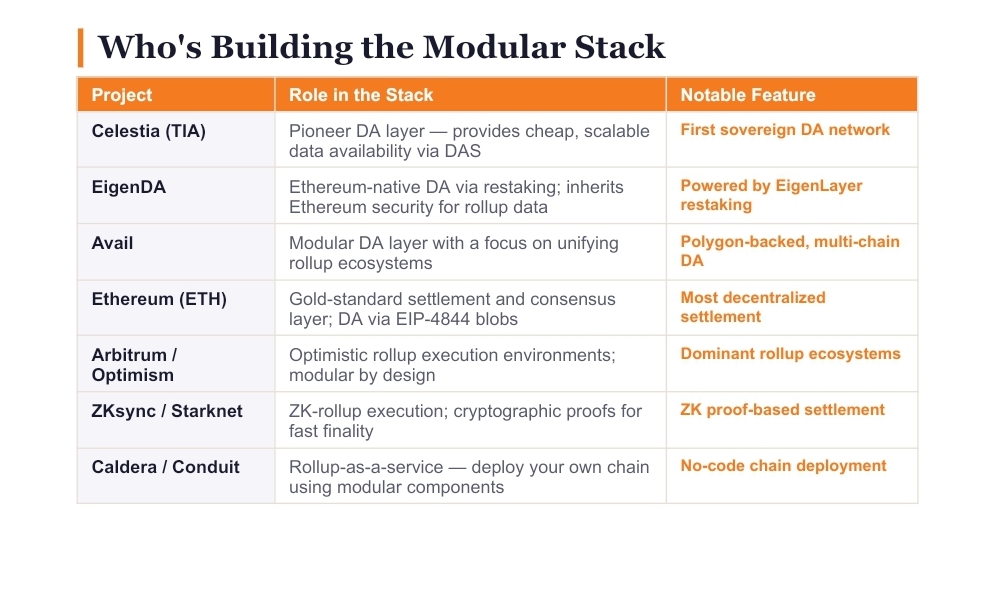
This separation allows blockchains to scale dramatically without sacrificing decentralization.
A typical example already exists today. Many rollups process thousands of transactions off-chain, then post compressed proofs to Ethereum, which acts as the settlement layer securing the system.
One of the most important innovations in the modular model is data availability (DA).
When rollups compress thousands of transactions into a proof, the base chain verifies the proof — but it may not store all the raw transaction data.
If that data disappears, users cannot independently reconstruct the chain’s history.
Data availability layers solve this problem by guaranteeing that transaction data remains publicly accessible. This allows anyone to verify the network independently.
New projects are being built specifically for this purpose. Networks like Celestia, EigenDA, and Avail focus primarily on publishing and verifying transaction data rather than executing smart contracts.
By separating this role from the rest of the system, modular designs can dramatically increase throughput while preserving trustlessness.
Another major benefit of modular architecture is composability.
Developers can mix and match different components to build custom blockchain stacks.
A project might choose:
This modular approach has significantly lowered the cost of launching a blockchain. New rollup-as-a-service platforms now allow developers to deploy application-specific chains using prebuilt infrastructure.
The shift could mirror how the internet evolved. Instead of one system handling everything, the web relies on layered protocols such as TCP/IP, DNS, and HTTP.
Modular blockchains aim to bring that same layered architecture to crypto.
Despite its promise, modular blockchain design introduces new challenges.
The most obvious risk is fragmentation. A world with hundreds of specialized chains means users may need to move assets between networks frequently. That often requires bridges — historically one of the most vulnerable parts of crypto infrastructure.
Security inheritance is another concern. Rollups depend on their underlying settlement and data availability layers. If those layers fail, the rollup’s security can be affected.
Finally, the ecosystem remains fragmented across competing frameworks and standards, making interoperability an ongoing challenge.
Even with these concerns, many developers believe modular architecture represents the next phase of blockchain evolution.
Rather than one chain attempting to do everything, the future may consist of specialized layers working together, each optimized for a single task.
The infrastructure is still evolving, and standards are still forming. But the direction is increasingly clear: blockchain systems are beginning to resemble the layered architecture that built the internet itself.
The era of the monolithic chain may be fading. In its place, a modular stack is emerging — one designed for a far larger and more complex digital economy.



Copyright © 2025 - The Bit Gazette.