







- Trending
- Comments
- Latest

Non-fungible token circulation reached 1.34 billion in 2025, up 25% year-over-year, even as NFT sales dropped 37% to $5.63 billion and average sale prices fell to $96 from $124.
The divergence—supply expanding while demand contracts—underscores a fundamental market imbalance as cheaper minting tools flood blockchains with tokens that fewer buyers want.
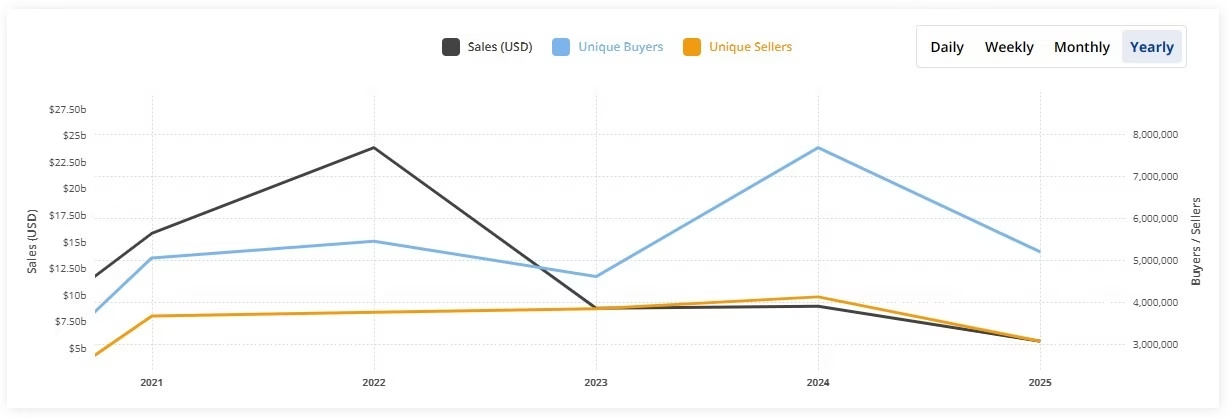
The NFT supply surge, driven by cheaper minting tools and lower entry barriers, expanded faster than the market’s capacity to absorb new assets, spreading liquidity thinly across a growing universe of tokens.
“NFT minting accelerated even as buyers spent less, pushing the market toward a high-volume, low-price dynamic,” — CryptoSlam data summary, 2025.
The NFT supply surge did not emerge overnight. CryptoSlam data indicates that total NFT supply has expanded steadily over the past four years, rising from just 38 million tokens in 2021 to more than 106 million in 2022. Growth accelerated sharply thereafter as creators scaled production across multiple blockchains.
By 2023, NFT supply had surpassed 550 million tokens. That figure nearly doubled in 2024 to one billion, before climbing again in 2025 to 1.34 billion. The current total represents a roughly 35-fold increase — or about 3,400% growth — in four years, highlighting how rapidly NFT creation has outpaced historical demand trends.
“The total number of NFTs in circulation climbed to more than 1.34 billion this year, marking a 25% increase from the one billion supply in 2024,” — CryptoSlam data.
This NFT supply surge reflects structural changes in the ecosystem, including simplified minting platforms, reduced fees on major networks and a shift toward experimental, utility-focused and cultural NFTs. However, the expanding supply has coincided with declining buyer participation and spending power.
While the NFT supply surge continued, the market’s financial metrics moved in the opposite direction. Total NFT sales peaked in 2022 and have trended lower since, with 2025 marking one of the weakest years in terms of dollar volume since the last market cycle.
Average NFT sale prices fell below $100 in 2025, compared with $124 in 2024 and roughly $400 during the 2021–2022 boom period. Lower prices suggest that buyers are becoming more selective, while sellers face increased competition for attention in an increasingly crowded marketplace.
“Average sale prices declined year-on-year, slipping to $96 from $124,” — CryptoSlam data.

The combination of the NFT supply surge, shrinking transaction values and fewer dollars flowing into the sector has reshaped incentives for creators and platforms alike. Instead of relying on high-priced, speculative sales, many projects are now experimenting with lower-cost NFTs tied to communities, memberships or digital utilities.
The effects of the NFT supply surge are also visible in overall market capitalization. According to CoinGecko data cited in the report, total NFT market capitalization peaked at about $17 billion in April 2022, during the height of speculative trading.
After a partial recovery to $10.8 billion in December 2024 and roughly $9.2 billion in January 2025, NFT market capitalization declined steadily throughout the year. By the end of 2025, the sector’s total market cap stood at around $2.4 billion.

This prolonged contraction highlights how lower prices and thinner liquidity have persisted even as NFT supply continued to expand. The divergence suggests that while NFTs remain widely used and minted, their role has shifted away from speculative assets toward lower-priced digital goods competing for limited consumer attention.
The NFT supply surge, paired with declining sales and capitalization, points to a market still searching for equilibrium.
As 2026 approaches, the data suggests that sustainability in the NFT sector may depend less on volume growth and more on whether creators and platforms can rebuild demand, utility and long-term value within an increasingly saturated ecosystem.



Copyright © 2025 - The Bit Gazette.