



- Trending
- Comments
- Latest

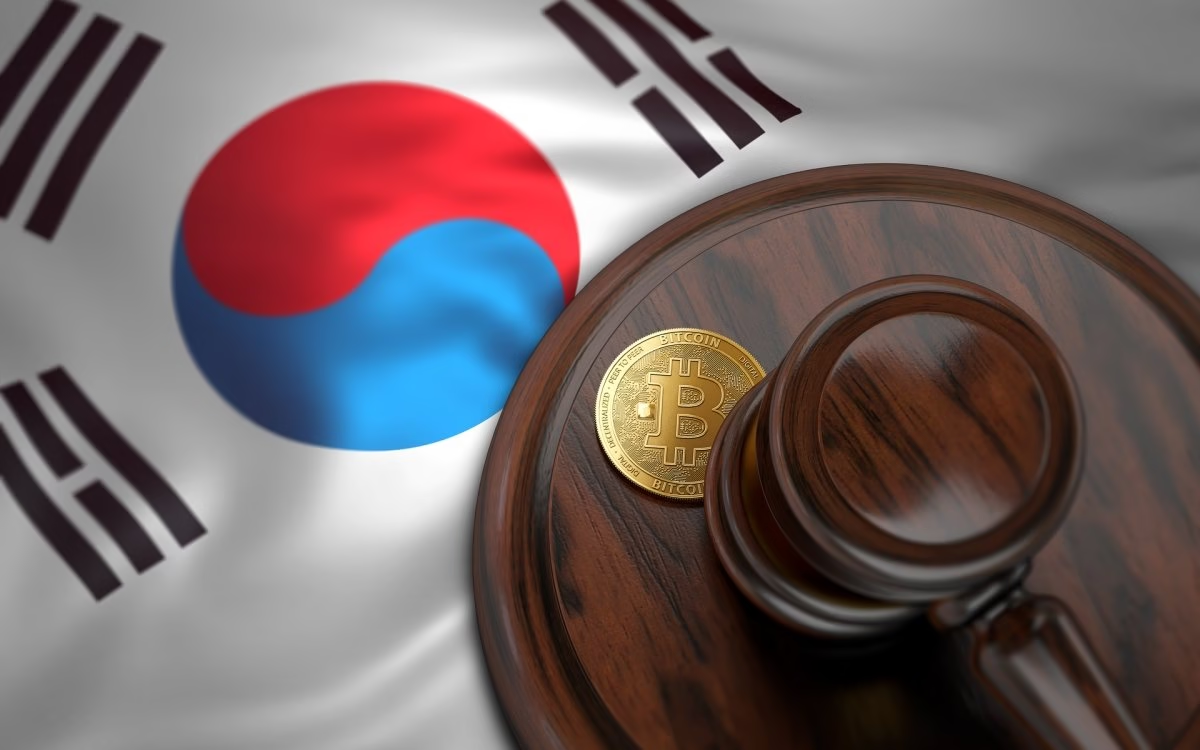
South Korea’s main stock exchange temporarily halted trading after a sharp market sell-off triggered circuit breakers, as rising fears of a broader regional conflict unsettled investors.
The move, announced during a session marked by heavy losses on the benchmark Kospi index, reflects growing anxiety across both traditional and digital asset markets.
The disruption occurred on the Korea Exchange (KRX), the operator of South Korea’s primary securities markets, amid heightened geopolitical tensions in the region.
The trading halt followed a steep intraday decline in the Kospi, prompting automatic safeguards designed to curb panic selling.
According to reporting by Cointelegraph, the sell-off was fuelled by concerns over escalating military tensions that could destabilise financial markets in East Asia.
South Korean authorities did not immediately attribute the decline to a single event but acknowledged “heightened volatility” tied to geopolitical uncertainty.
The Korea Exchange (KRX), formally known as Korea Exchange, imposed a temporary trading halt after the Kospi index fell sharply, triggering the market-wide circuit breakers.
These mechanisms are intended to provide a cooling-off period during extreme volatility, giving investors time to reassess positions and preventing disorderly trading conditions.
“The circuit breaker was triggered in accordance with market stabilization protocols. This is a precautionary measure to maintain orderly trading and protect investors.”
The benchmark Kospi index dropped significantly during early trading hours before the halt was imposed.
Analysts noted that foreign investors were among the largest net sellers, as global funds moved toward safer assets such as U.S. Treasuries and gold.
Financial regulators emphasized that the halt was temporary and part of established safeguards. Trading later resumed, though volatility persisted throughout the session.
The market turbulence came amid mounting concerns about potential military escalation in the region. While officials stopped short of declaring an immediate security crisis, traders reacted swiftly to headlines suggesting deteriorating diplomatic conditions.
“Markets are extremely sensitive to geopolitical risk, especially in regions with complex security dynamics. When uncertainty spikes, risk assets tend to sell off first.”
Park Sang-hyun, an economist at HI Investment & Securities, in comments reported by local business outlets.
South Korea, officially the Republic of Korea, has long faced periodic security tensions due to its proximity to North Korea and its strategic position in East Asia.
As one of Asia’s largest economies and a key technology exporter, market disruptions in South Korea can ripple across global supply chains and financial markets.
Investors also reacted to broader global risk-off sentiment, as equity markets in other parts of Asia and Europe posted losses in parallel sessions.
The sell-off extended beyond traditional equities to companies with exposure to cryptocurrency and blockchain businesses.
Shares of domestic firms involved in digital asset trading platforms and crypto mining operations declined in tandem with the broader market.
Although cryptocurrencies themselves trade independently of stock exchanges, investor behaviour often links the two markets during periods of stress.
Bitcoin and other major digital assets experienced heightened volatility during the same timeframe, though price movements were less severe than those seen in equities.
Market observers noted that South Korea remains one of the world’s most active cryptocurrency markets, with significant retail participation.
Any prolonged instability in its financial system could have downstream effects on global trading volumes and sentiment.
Financial authorities signalled they are monitoring developments closely.
The Financial Services Commission (FSC) and the Bank of Korea have both indicated readiness to implement stabilization measures if volatility intensifies.
Analysts say the episode underscores the fragility of investor confidence during periods of geopolitical uncertainty.
While circuit breakers can limit short-term panic, sustained tensions could weigh on capital flows and corporate valuations.
Markets appear to be stabilizing, but investors remain cautious. The incident highlights how rapidly geopolitical headlines can translate into financial disruption, particularly in globally integrated economies like South Korea’s.



Copyright © 2025 - The Bit Gazette.