







- Trending
- Comments
- Latest

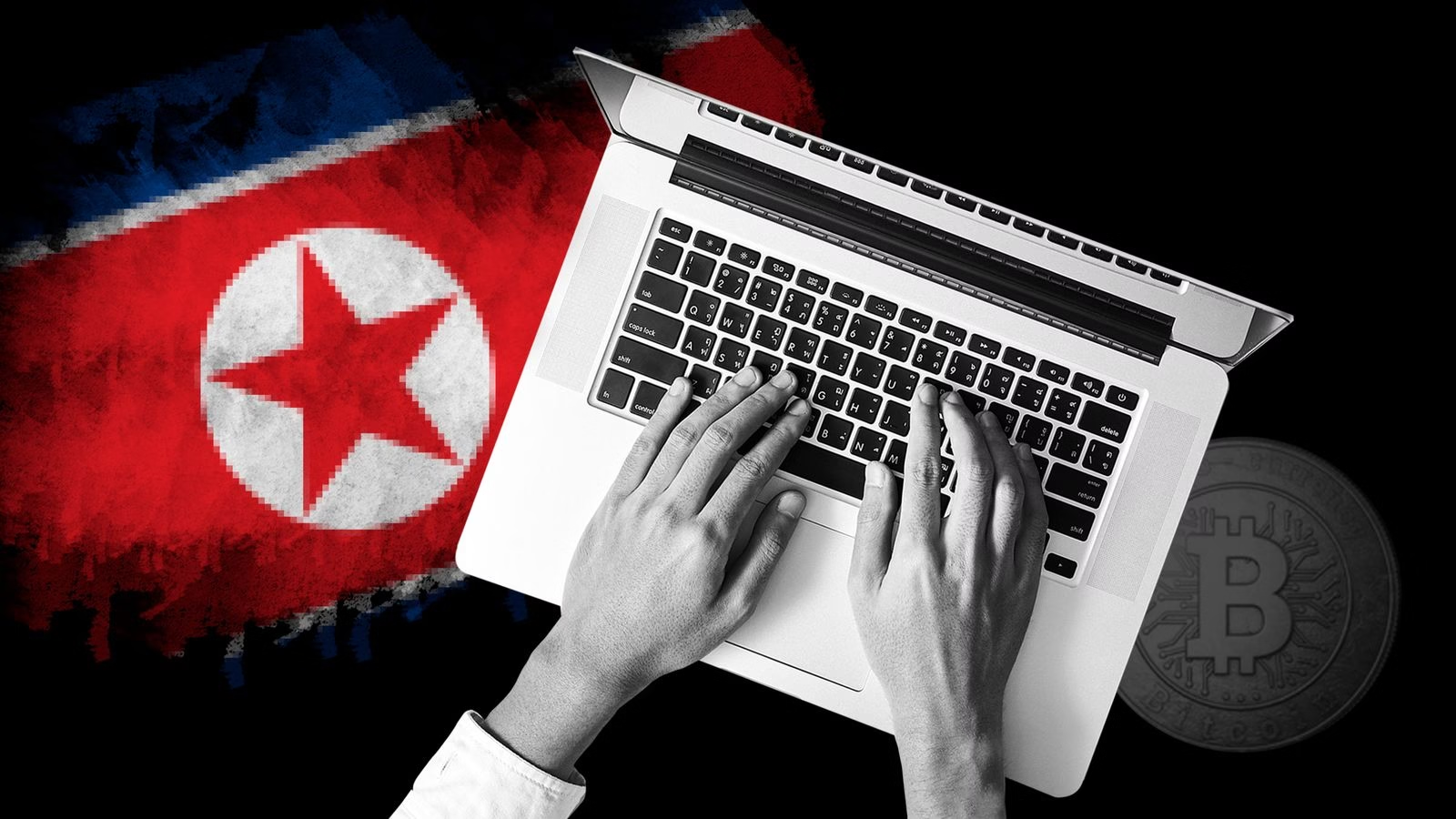
North Korea didn’t need to break Solana’s cryptography. It needed six months, a collection of fake developer profiles, and the reasonable human instinct to trust people who seem credible. That is a harder vulnerability to patch than any smart contract flaw, and the crypto industry has barely started reckoning with it.
Is this by any chance one of the most calculated cyberattacks in recent crypto history? Can this be managed? Below is a deep analysis on the story, and a shared opinion that could provide solution.
The breach, which unfolded in 2024, has since become a case study in how human vulnerabilities, not just technical flaws, pose the greatest threat to blockchain security.
According to investigations by blockchain intelligence firms such as Chainalysis and TRM Labs, the attackers infiltrated developer networks over an extended period, building trust with insiders before executing the exploit.
The operation is widely attributed to the notorious Lazarus Group, a state-backed cybercrime unit known for targeting financial systems and cryptocurrency platforms.
The attackers reportedly posed as developers, recruiters, and collaborators, gradually gaining access to sensitive systems.
By the time the exploit was triggered, the groundwork had already been laid months in advance, making detection extremely difficult.

While the crypto industry has historically focused on smart contract vulnerabilities and protocol exploits.
Social engineering, manipulating individuals into revealing confidential information proved to be far more effective than breaking cryptographic defenses.
Reports suggest that the attackers used fake job offers, GitHub collaborations, and phishing attempts to gain the trust of developers within the Solana ecosystem.
Over time, they were able to introduce malicious code and access credentials that enabled the exploit.
For crypto investors, this represents a critical shift. Security is no longer just about auditing code or choosing the right blockchain it now includes evaluating the operational security of teams behind projects.
The fallout from the exploit has raised serious questions about the resilience of the Solana ecosystem. Although Solana itself was not fundamentally broken at the protocol level.
Market reactions were swift, with increased scrutiny from institutional investors and calls for stronger security standards across decentralized ecosystems.
From an investment perspective, this highlights the importance of due diligence beyond tokenomics and performance metrics.
Investors must now consider factors such as team security practices, internal controls, and exposure to social engineering risks.
This attack is not an isolated incident but part of a broader pattern. North Korea has been linked to billions of dollars in stolen cryptocurrency over the past decade, often using increasingly sophisticated methods.
According to Chainalysis, North Korean-linked hackers stole over $1 billion in crypto assets in recent years alone, funding state operations and bypassing international sanctions.
For the wider crypto industry, the lesson is clear: technical innovation must be matched with equally robust human security frameworks.
This includes better employee training, stricter access controls, and continuous monitoring of insider threats.
For crypto investors, the biggest takeaway from this incident is not about Solana specifically, it’s about trust.
Blockchain technology was designed to eliminate the need for trust through decentralization and cryptography. Yet, as this exploit demonstrates, trust still exists at the human level, and it can be exploited.
The industry must evolve beyond the assumption that code is the only battleground.
In reality, the next generation of crypto threats will likely target people, processes, and perceptions.
Until that shift is fully understood and addressed, even the most advanced blockchain ecosystems will remain vulnerable not because of what’s written in code, but because of who has access to it.



Copyright © 2025 - The Bit Gazette.

