




- Trending
- Comments
- Latest

The US Office of the Comptroller of the Currency (OCC) has confirmed it will continue reviewing World Liberty Financial’s application for a national trust bank charter, resisting pressure from Democratic lawmakers to pause the process amid concerns about potential political and financial conflicts.
The decision keeps the World Liberty bank charter application on track despite heightened scrutiny surrounding the firm’s founders and ownership structure.
World Liberty Financial (WLF) submitted its application on January 7, seeking authorization to operate as a federally chartered national trust bank.
The move would allow the firm to directly custody, store, and convert its USD1 stablecoin internally rather than relying on third-party providers.
The OCC’s confirmation signals that the World Liberty bank charter review will proceed under standard regulatory procedures.
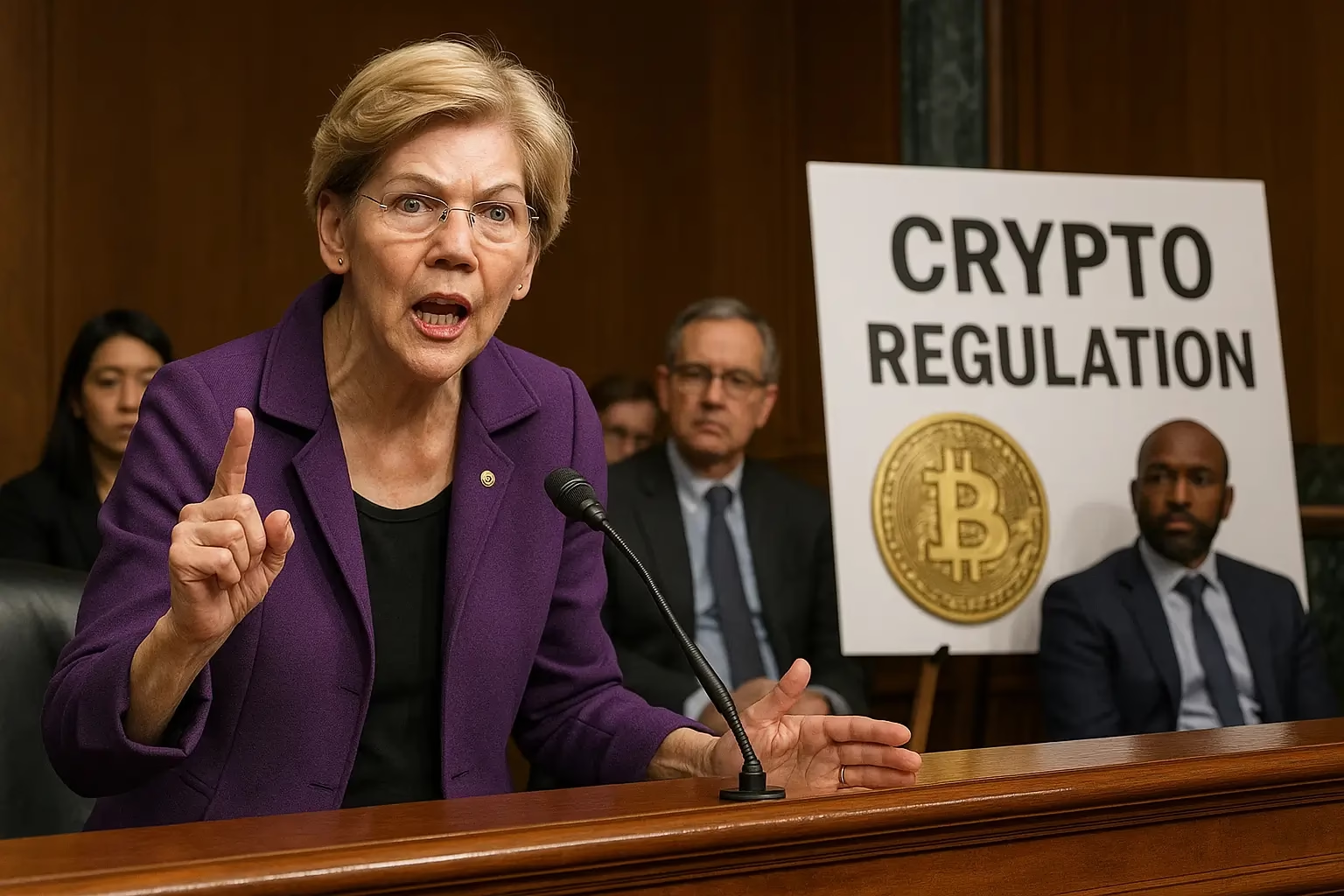
The issue has drawn attention on Capitol Hill after Senator Elizabeth Warren, the ranking member of the Senate Banking, Housing, and Urban Affairs Committee, urged the regulator to delay the process until President Donald Trump divests from the decentralized finance platform.
In a letter dated January 23, Comptroller of the Currency Jonathan V. Gould rejected Senator Warren’s request to halt the review, stating that the OCC would proceed independently and without political influence.
“The OCC plans to fulfill its responsibilities instead of following your request,” Gould wrote. He added, “The OCC’s charter application process should be neutral and nonpartisan, and under my guidance, it will remain that way.”
Gould emphasized that the World Liberty bank charter application would be evaluated under existing laws and supervisory standards, and that no personal or political relationships would affect the outcome.
He also noted that WLF’s proposal would face the same level of scrutiny applied to other charter applicants.
Senator Warren’s concerns stem from disclosures on World Liberty Financial’s website listing Donald Trump, Donald Trump Jr., Eric Trump, and Barron Trump as co-founders.
In her letter, Warren warned that the Trump family’s involvement raised questions about conflicts of interest and the accumulation of significant unrealized wealth tied to the platform.
Despite these objections, the OCC’s response makes clear that political considerations will not derail the World Liberty bank charter review process.
The regulatory debate intensified after World Liberty Financial outlined plans to expand its crypto operations through direct management of its USD1 stablecoin.
Launched in March 2025, USD1 has grown rapidly, reaching a reported market capitalization of $4.2 billion, placing it among the largest stablecoins globally.
By securing the World Liberty bank charter, the firm aims to internalize stablecoin issuance, custody, and settlement functions activities traditionally handled by federally supervised trust banks.
This shift has raised policy questions about whether politically connected crypto firms should gain expanded access to the US banking system.
Historically, crypto companies have struggled to obtain national trust bank charters. However, the regulatory environment has shifted significantly over the past year, reshaping expectations around the World Liberty bank charter application.
In December, the OCC issued conditional approvals to several major digital asset firms, including Circle, Ripple, Fidelity Digital Assets, BitGo, and Paxos, allowing them to move toward federally chartered trust bank status.
The approvals marked a notable change in the regulator’s approach to crypto integration.
In a public notice, the OCC said the approvals were intended to transition certain state-level trust companies into national trust banks, aligning crypto infrastructure more closely with federal oversight.
Commenting on the shift, Gould said, “New companies entering the federal banking sector benefit consumers, the banking industry, and the economy.” He added that, “The OCC will keep creating opportunities for both traditional and innovative financial services to ensure that the federal banking system adapts to changes in finance and supports a modern economy.”
These statements suggest that the World Liberty bank charter application is being reviewed within a broader regulatory strategy aimed at modernizing financial infrastructure rather than as a special case.
While Democratic lawmakers continue to raise ethical concerns, the OCC’s position underscores its intent to separate politics from prudential supervision.
The regulator has reiterated that approval is not guaranteed and that the World Liberty bank charter will be assessed on governance, risk controls, compliance systems, and financial stability considerations.
For policymakers, the case highlights the growing challenge of regulating crypto firms whose founders hold significant political influence.
For the industry, it signals that access to federal banking charters is increasingly possible but only through rigorous oversight.



Copyright © 2025 - The Bit Gazette.