





- Trending
- Comments
- Latest

OKX will distribute Midnight network’s Night tokens to users holding ADA, Bitcoin, Ethereum and five other cryptocurrencies during an upcoming airdrop, the exchange announced Monday.
OKX joins Binance and Kraken in supporting the 4.5 billion token distribution, with ADA holders set to receive 50% of the allocation and Bitcoin holders getting 20%.
OKX confirmed in an official announcement that it will participate in the Night token airdrop, distributing tokens to users who hold eligible assets during the designated snapshot period. According to the exchange, supported assets include ADA, BTC, ETH, SOL, XRP, BNB, AVAX, and BAT.
However, OKX emphasized that access to the Night token airdrop will depend on jurisdictional rules. “Access to the airdrop will vary depending on jurisdiction,” the exchange stressed, noting that regulatory limitations prevent distribution in certain regions.
The exchange also clarified that deposits must be made before the snapshot in order to qualify. Balances for each supported asset will be “calculated separately and need to be fully deposited before the snapshot to be counted toward allocation,” OKX said in the release.
Under the tiered model, ADA holders will receive 50% of the Night token airdrop pool—the largest share—while BTC holders will be allocated 20%. The remaining 30% will be distributed to holders of ETH, SOL, XRP, BNB, AVAX, and BAT. OKX added that it will open trading shortly after the Night token airdrop distribution begins, giving users immediate access to liquidity opportunities.
This coordinated launch follows Binance’s announcement that it will list the token on December 9, allowing qualified users to claim their allocation once trading goes live. Kraken also confirmed it will list the token, signaling broad industry support for the Midnight ecosystem.
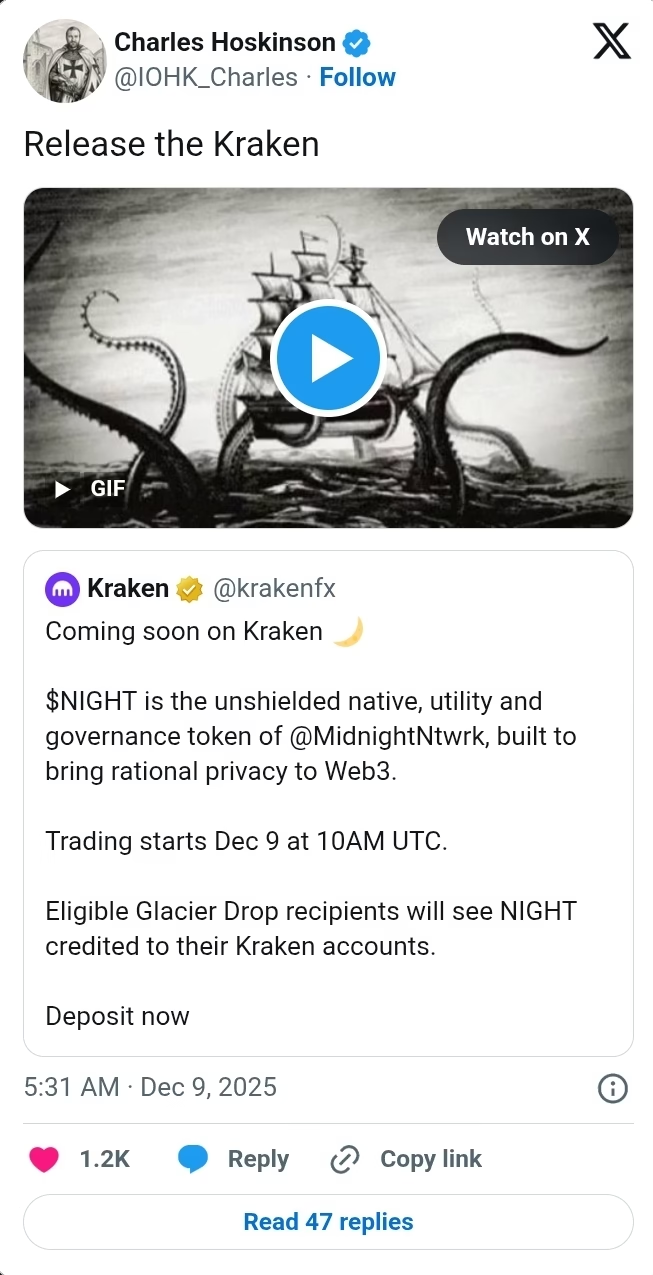
In a recent interview, Cardano founder Charles Hoskinson outlined the technology behind Midnight’s native asset and the implications of the Night token airdrop for the broader ecosystem. He explained that the network will use a high-performance consensus system called Jolteon.
“Jolteon can handle up to 5,000 transactions each second and has fast block times,” — Charles Hoskinson, Founder, Input Output.
The system is designed to support privacy-focused smart contracts while maintaining security and throughput. The network will begin with a nine-month integration period, during which stability, testing, and compatibility with the broader Cardano ecosystem will be prioritized.
Hoskinson added that new updates will roll out “every one to three months,” offering a structured development roadmap as distribution begins.
The Midnight Foundation confirmed that 4.5 billion tokens will be released through the Night token airdrop, with trading expected to begin across multiple platforms starting today. The Night token airdrop was initially announced in August and has generated significant excitement among community members anticipating ecosystem growth.
The coordinated exchange support for the Night token airdrop signals increasing confidence in the Midnight network’s potential to expand cross-chain participation. For crypto investors, the staggered allocation model may influence portfolio strategies tied to ADA, BTC, and other supported assets.
Policy makers will remain attentive to jurisdictional restrictions, as the Night token airdrop highlights the regulatory gap between countries managing token distributions.
Meanwhile, the general public—many encountering cross-chain token airdrops for the first time—will likely view this event as a test case for how large networks can collaborate on multi-asset launches.
As trading goes live and 4.5 billion tokens enter circulation, analysts expect liquidity to climb across exchanges that supported the Night token airdrop, further shaping adoption trends in the months ahead.



Copyright © 2025 - The Bit Gazette.