





- Trending
- Comments
- Latest

One in eight Gen Z Americans has already paid for a date using cryptocurrency, and nearly a third would welcome crypto as a Valentine’s Day gift, but the bigger finding in OKX’s new survey may be that 76% of younger Americans now consider financial literacy an attractive quality in a partner, a signal that digital asset awareness is becoming part of how a generation evaluates romantic compatibility.
The poll of 1,000 U.S. adults found that while some respondents have already used crypto to cover dating expenses, far more remain interested in the idea than able to execute it, underscoring a familiar gap between curiosity and convenience in everyday crypto use.
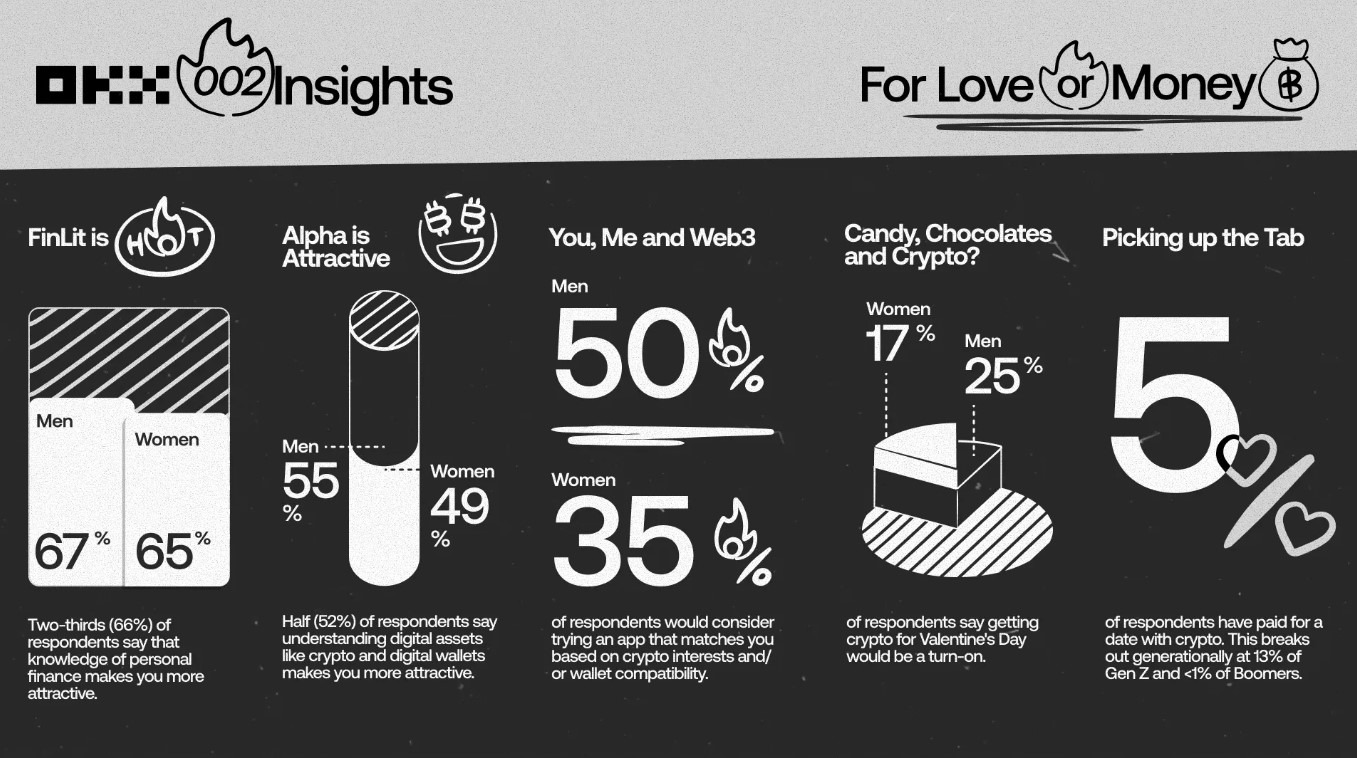
According to the OKX Pollfish survey, 13% of Gen Z respondents said they have paid for a date using cryptocurrency.
For those who have not, the most common explanation was logistical rather than ideological: many said they simply do not have a direct or easy way to pay with crypto in typical dating scenarios.
The findings point to a broader adoption challenge as digital assets attempt to move beyond investment portfolios into daily spending.
Beyond payments, the OKX Pollfish survey suggests crypto carries a certain symbolic appeal in romantic contexts. Roughly 31% of Gen Z respondents said receiving cryptocurrency as a Valentine’s Day gift would be appealing.
The same survey found that financial competence resonates strongly in dating, with 76% of Gen Z respondents saying financial literacy is an attractive trait in a partner.
“Knowing how to manage money is increasingly seen as a sign of maturity and long-term thinking,” — OKX spokesperson, in comments shared with Cointelegraph.
Still, the data shows that interest does not necessarily translate into participation. OKX said that 29.5% of respondents currently own or previously owned crypto assets.
That ownership rate, while significant, remains well below the share expressing curiosity about using crypto in social or romantic settings.
The OKX Pollfish survey indicates that without broader ownership and simpler onramps, crypto’s role in dating will remain mostly aspirational.
One of the strongest signals from the OKX Pollfish survey is that digital assets are often viewed through the lens of financial literacy rather than speculation.
Across all respondents, about two-thirds said financial literacy plays well in the dating marketplace, with Gen Z and millennials showing the highest levels of agreement.
Familiarity with digital finance tools also mattered. Between 52% and 55% of respondents said knowledge of cryptocurrencies and digital wallets can make someone more attractive as a potential partner.
However, only 17% overall said simply holding digital assets increases attractiveness, including 28% of Gen Z respondents.
Those results suggest that, in the context of dating, crypto awareness is increasingly treated as one component of broader financial competence.
The OKX Pollfish survey frames this as a generational shift: younger cohorts may not be impressed by token holdings alone, but they value an understanding of how digital finance works and how risks are managed.
While the OKX Pollfish survey paints a picture of cautious optimism, crypto’s presence in dating has also been shaped by high-profile fraud cases.
In 2024, the U.S. Federal Trade Commission issued a consumer alert warning about a rise in crypto-related romance scams, noting that fraudsters increasingly exploit dating platforms to solicit digital asset transfers.
“Scammers often build trust quickly and then request payment in cryptocurrency, which can be difficult to recover,” — Federal Trade Commission, consumer alert.
Canadian authorities issued similar warnings as romance scams proliferated across dating apps.
The issue intensified in 2025 with the use of artificial intelligence, including chatbots and deepfake technology, to impersonate romantic partners and manipulate victims emotionally and financially.
These developments have complicated crypto’s public perception, particularly in intimate social settings.
Separate research has reinforced that mixed image. A 2024 survey by the Date Psychology blog found that women ranked crypto among the least attractive male hobbies, highlighting a disconnect between financial curiosity and cultural acceptance.
The OKX Pollfish survey contrasts with that finding by showing nuance: while crypto enthusiasm alone may not impress, financial literacy and digital competence still carry weight.
Taken together, the OKX Pollfish survey suggests crypto’s role in dating is less about flashy payments and more about signaling financial awareness in a digital economy.
For crypto investors and industry observers, the results offer a glimpse into how younger generations may eventually integrate digital assets into daily life once usability improves.
The survey’s findings also reinforce a recurring theme in crypto adoption: ease of use matters as much as ideology. Until paying with crypto becomes as frictionless as tapping a card, most romantic transactions will remain firmly in fiat territory.
Even so, the OKX Pollfish survey shows that for Gen Z, crypto is no longer just an abstract investment concept. It is part of a broader conversation about money, trust, and competence qualities that, in dating as in markets, can influence long-term decisions more than novelty alone.



Copyright © 2025 - The Bit Gazette.

