





- Trending
- Comments
- Latest

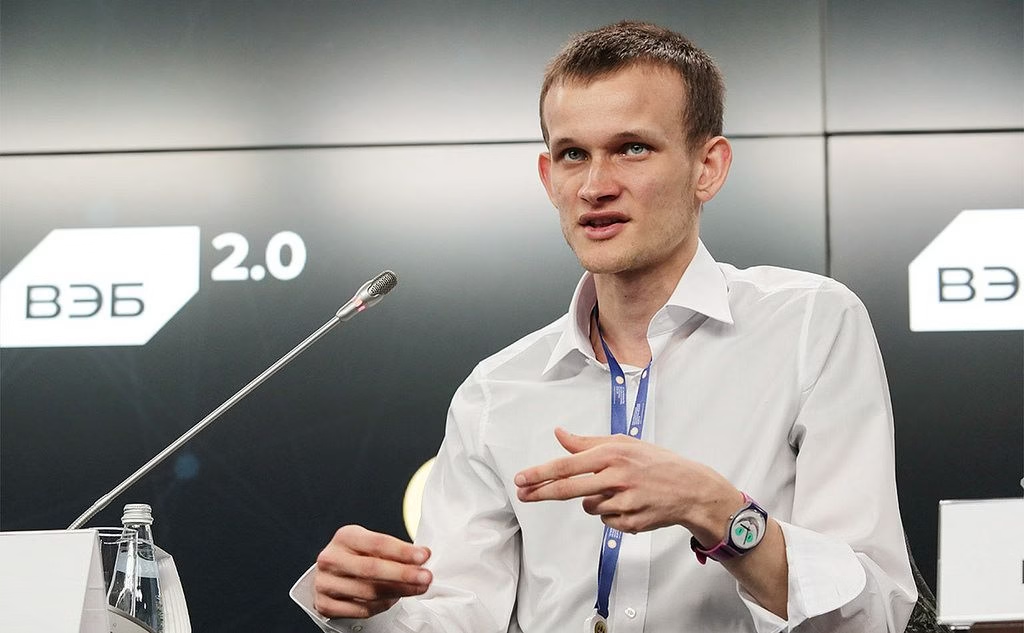
Ethereum co-founder Vitalik Buterin has proposed a gas futures system that would allow users to prepay and lock in transaction fees at fixed rates, hedging against the network’s volatile fee spikes.
The proposal, shared over the weekend, aims to provide cost certainty for developers and high-volume users who currently face unpredictable expenses during periods of network congestion.
According to Buterin, “people would get a clear signal of expectations for future gas fees, and would even be able to hedge against future gas prices.”
The idea mirrors traditional futures markets, where buyers and sellers fix a price in advance to reduce risk or speculate but applied to blockchain usage.
By allowing users to prepay for a specified amount of gas at a known rate for a chosen time window, Onchain Gas Futures could provide stability and allow better planning for liquidity and transaction budgeting as Ethereum continues to scale.
Even though basic Ethereum transactions have seen relatively low fees, more complex operations remain costly and volatile.
According to on-chain data, simple transfers are often cheap, but smart contract interactions, token swaps, NFT transactions and cross-chain bridging still incur higher and unpredictable gas costs. This volatility has discouraged some developers and users, especially when gas fees spike during network congestion or demand surges.
With Onchain Gas Futures, users could hedge against these fluctuations. For example, a project expecting heavy traffic could lock in gas at a defined price ahead of time ensuring cost certainty regardless of network congestion.
That reduces financial risk and friction, and could encourage broader use of Ethereum for high-volume or long-term operations.
Market analysts see the appeal: stable fees could lower barriers for decentralized applications, improve financial planning for DeFi protocols, and increase investor confidence in long-term commitment to Ethereum-based projects.
Recent data shows that Ether balances on centralized exchanges have dropped to one of their lowest levels since Ethereum’s inception. Many tokens have migrated toward staking, self-custody, long-term holdings, and active use in decentralized finance (DeFi) and layer-2 networks. This structural shift reduces the liquid supply of ETH on exchanges, while increasing demand for on-chain transactions.
With more users and contracts operating directly on-chain and fewer tokens held passively network activity and fee unpredictability may grow. In that context, Onchain Gas Futures could become not just a convenience, but a necessity for anyone using Ethereum infrastructure at scale.
The convergence of decreasing exchange ETC liquidity and rising on-chain utilization creates a scenario where predictable gas pricing becomes critical. The proposed futures model may address this challenge at a systemic level.
While promising, the Onchain Gas Futures concept is not without obstacles. Designing a robust futures market for gas requires careful consideration of collateralization, settlement mechanisms, and risk management especially given the decentralized, permissionless nature of Ethereum.
There are questions around how to integrate such a futures market with existing fee-burning mechanisms (e.g. under EIP-1559), and whether futures holders would be insulated from base fee fluctuations, priority fees (tips), and gas demand surges.
Moreover, if speculative behavior becomes dominant rather than genuine hedging the system might resemble a derivatives market more than a utility tool, which could undermine its intended purpose and lead to liquidity or market-manipulation concerns.
Blockchain infrastructure experts argue that any attempt to implement Onchain Gas Futures must include safety mechanisms: over-collateralization, transparent settlement, clear user protections, and fallback fees to avoid creating a new set of risks atop existing ones.
If successfully implemented, Onchain Gas Futures could mark a turning point for how Ethereum users manage fees. For developers, it could enable predictable budget planning for large-scale deployments or high-volume transaction flows.
For decentralized applications, it could reduce friction and make fee estimation simpler and more reliable. For investors and long-term holders, it could provide a hedge against fee volatility improving the overall usability and appeal of Ethereum as a platform.
In a blockchain ecosystem frequently criticized for unpredictable fees and high costs during congestion, this kind of innovation could restore confidence and stability. As Ethereum further deploys layer-2 scaling, rollups, and increased smart contract activity, a futures-based fee structure could help the network evolve more sustainably.



Copyright © 2025 - The Bit Gazette.