







- Trending
- Comments
- Latest

Original Penguin, the established apparel company, filed a federal trademark lawsuit on Thursday against Pudgy Penguins, claiming the NFT project’s merchandise uses branding elements ‘confusingly similar’ to its registered penguin trademarks dating back to 1956.
The case raises questions about how trademark law applies to Web3-native brands expanding into traditional retail markets.
According to the complaint, the NFT project’s apparel products allegedly infringe on the fashion company’s registered “PENGUIN” word marks and penguin design trademarks.
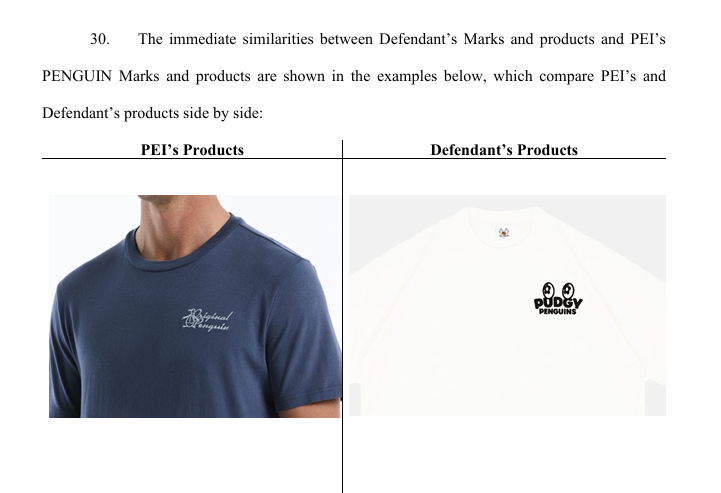
The Pudgy Penguins trademark lawsuit highlights growing legal tensions as blockchain-native brands expand into physical products, potentially overlapping with legacy trademarks that have existed for decades.
The Pudgy Penguins trademark lawsuit primarily focuses on apparel and merchandise linked to the NFT project’s brand expansion into retail products.
According to the filing by PEI Licensing, the company has used its “PENGUIN” word mark since at least 1967, while its penguin logo design dates back even further.
“This action results from Defendant’s unauthorized use and attempted registration of various PENGUIN word and design trademarks in connection with apparel and related goods and services that are confusingly similar to PEI’s federally registered and famous PENGUIN and penguin design trademarks,” — PEI Licensing, in its complaint filed in U.S. federal court.
The complaint states that the company first introduced a penguin design on apparel as early as 1956, establishing what it describes as decades of brand recognition in the clothing industry.
The Pudgy Penguins trademark lawsuit further alleges that the NFT project attempted to register similar marks through the United States Patent and Trademark Office, potentially strengthening its presence in apparel and retail markets.
PEI argues that these filings and product launches could mislead consumers into believing the companies are affiliated, potentially damaging its brand identity.
The Pudgy Penguins trademark lawsuit did not emerge suddenly. According to the complaint, PEI Licensing sent a cease-and-desist letter to Pudgy Penguins in October 2023.
The letter allegedly warned that Pudgy Penguins’ apparel and related merchandise infringed on the company’s established trademarks and requested that the NFT project abandon certain trademark applications.
PEI Licensing claims in the lawsuit that Pudgy Penguins had “misappropriated valuable property rights of PEI,” arguing the situation was likely to “cause confusion or mistake, or to deceive members of the consuming public.”
As part of the Pudgy Penguins trademark lawsuit, the company has asked the court to order the USPTO to reject the NFT project’s trademark filings.
It also requested that any apparel products deemed confusingly similar be destroyed and that profits from such sales be awarded to PEI.
Legal experts say the dispute illustrates the increasing overlap between traditional consumer brands and emerging Web3 companies.
As NFT projects grow into mainstream lifestyle brands, they often expand into merchandise, toys, and clothing areas long dominated by legacy fashion labels.
Despite the allegations, the NFT project has pushed back strongly against the Pudgy Penguins trademark lawsuit.
Jennifer McGlone, chief legal officer of Pudgy Penguins, said the company was caught off guard by the legal action.
“We were surprised by the action, particularly as both parties had been engaged in productive discussions to resolve this matter privately,” — Jennifer McGlone, Chief Legal Officer, Pudgy Penguins.
McGlone added that the company believes the claims lack merit and emphasized differences between the two brands’ visual identities and target markets.
“The trademarks in question are visually distinct and serve entirely different audiences and markets,” — Jennifer McGlone, Chief Legal Officer, Pudgy Penguins.
According to McGlone, Pudgy Penguins has already received approvals from the United States Patent and Trademark Office covering aspects of its brand.
“We have the utmost confidence that we will prevail as Pudgy Penguins has already secured multiple trademark application approvals from the USPTO covering the Pudgy Penguins brand and related marks,” she said.
Meanwhile, the project’s social media accounts appeared to address the controversy indirectly, sharing memes suggesting the two brands’ imagery is not similar.
The Pudgy Penguins trademark lawsuit reflects a broader trend as NFT-based companies expand beyond digital collectibles into physical retail markets.
Originally launched as a collection of Ethereum-based NFTs, Pudgy Penguins has evolved into a broader consumer brand that includes toys, apparel, and licensing deals.
The project has gained significant mainstream attention in recent years as it attempts to transition from a digital community into a lifestyle brand.
However, the Pudgy Penguins trademark lawsuit shows how that transition can collide with existing intellectual property rights.
For established companies such as Original Penguin, protecting long-standing trademarks remains a priority as new entrants enter the apparel market with internet-driven branding strategies.
The outcome of the Pudgy Penguins trademark lawsuit could provide important legal guidance on how courts interpret trademark disputes involving NFT-native brands and traditional consumer companies which is an issue likely to grow as Web3 projects continue expanding into mainstream commerce.



Copyright © 2025 - The Bit Gazette.