


- Trending
- Comments
- Latest

An Arizona investor is suing Pi Network for $10 million, alleging the project’s founders stole tokens from his wallet and secretly sold 2 billion Pi tokens while delaying network migration. Harro Moen Moen claims 5,137 Pi tokens vanished from his verified wallet without authorization, according to the October 24 filing in California federal court.
The Pi network fraud lawsuit targets company founders Chengdiao Fan and Nicolas Kokkalis alongside SocialChain Inc., accusing them of maintaining centralized control despite promoting Pi as a decentralized ecosystem.
The plaintiff, Harro Moen Moen, claims that 5,137 Pi tokens were transferred from his verified wallet to an unknown address without authorization, while an additional 1,403 tokens allegedly failed to migrate to the Pi Mainnet.
In the lead complaint, attorneys argue that these events combined with alleged secret sales led to a dramatic collapse in token value—an assertion that now forms the center of the Pi network fraud lawsuit.
According to the court filing, “the defendant and its executives conducted a massive fraud scheme through unauthorized token transfers, secret sales of 2 billion Pi tokens and deliberate migration delays that caused token values to plummet from $307.49 to $1.67,” — Bulldog Law, representing the plaintiff.
The Pi network fraud lawsuit has quickly become one of the most contentious issues within the Pi Network community this year, raising new questions about transparency, governance, and valuation metrics.
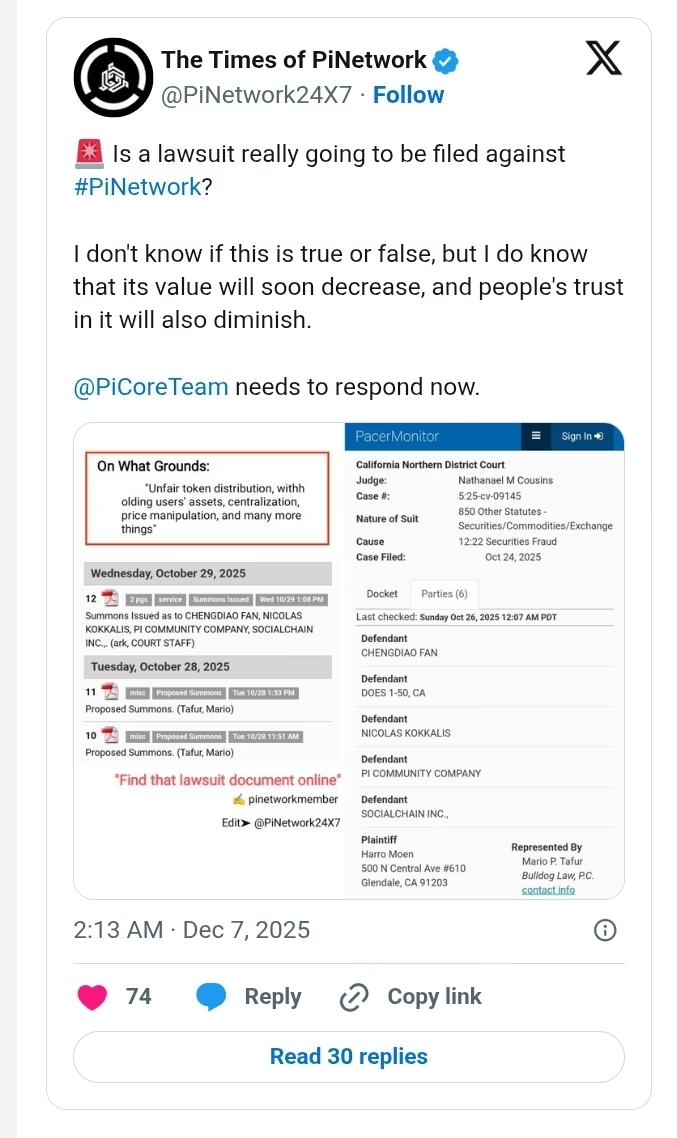
The Pi network fraud lawsuit goes beyond token-transfer allegations, accusing Pi Network leadership of operating the cryptocurrency as an unregistered security. The filing asserts that the founders maintained centralized oversight by reportedly operating only three validator nodes, contradicting the project’s public claims of decentralization.
The plaintiff, Moen, says the alleged multi-year scheme resulted in significant personal losses tied to missing tokens and purported valuation declines. The lawsuit asserts that Pi’s true open-market value collapsed, citing the disputed $307.49 price point.
While this claim serves as a foundation for damages sought in the Pi network fraud lawsuit, critics within the community argue that such valuations originate from speculative IOU markets that the Pi Core Team has repeatedly warned against.
A market observer commenting on the filing noted: “He’s also accusing Pi of being an unregistered security which is a whole other problem,” — market watcher, in community discussion.
This statement reflects broader regulatory concerns now entwined with the Pi network fraud lawsuit, adding complexity to how the court may interpret the project’s structure and disclosures.
While the Pi Core Team has not issued any public response to the Pi network fraud lawsuit, the broader community has been actively engaged in disputing several of the plaintiff’s claims. Many Pioneers argue that unauthorized transfers often arise from compromised login credentials or phishing attempts, not misconduct by the development team.
Supporters also question the $307.49 valuation figure cited in the Pi network fraud lawsuit, highlighting that the Pi Open Mainnet launched in February with an exchange-established floor price of $2 on OKX, later reaching an all-time high of $2.99 earlier in the month.
One community member emphasized the discrepancy: “Where did ‘$307.49’ come from—even the IOU value was never that high. Also, from a legal standpoint Open Market Value ≠ IOU Value. The lawsuit is based on false equivalence,” — Reddit user, in response to the filing.
This ongoing debate underscores how the Pi network fraud lawsuit has become a flashpoint between critics and supporters, revealing extensive disagreement over how Pi’s token value should be calculated and what constitutes legitimate loss.



Copyright © 2025 - The Bit Gazette.