






- Trending
- Comments
- Latest

On election night 2024, as traditional media awaited vote counts and pollsters scrambled to explain their errors, one platform had already called the outcome with unnerving accuracy: Polymarket.
The crypto-based prediction market—prohibited for U.S. users under CFTC restrictions following a 2022 settlement—provided the most accurate real-time probabilities throughout the entire campaign cycle. When mainstream polls showed key battlegrounds as toss-ups, Polymarket’s odds showed one candidate decisively ahead. By the time major networks called the race, Polymarket had already priced in the outcome.
Now, in late 2025, regulators have confronted an uncomfortable reality: by restricting this technology, they deprived Americans of one of their most accurate information sources.
The evidence became so overwhelming that on November 25, 2025, the CFTC approved an amended order enabling U.S. market access through licensed brokerages—a dramatic reversal validating everything prediction market advocates argued for years.
Polymarket’s track record extends far beyond a single election. Data from 2024 through 2025 confirms the platform’s forecasts consistently outperform traditional polling and statistical models across multiple domains.
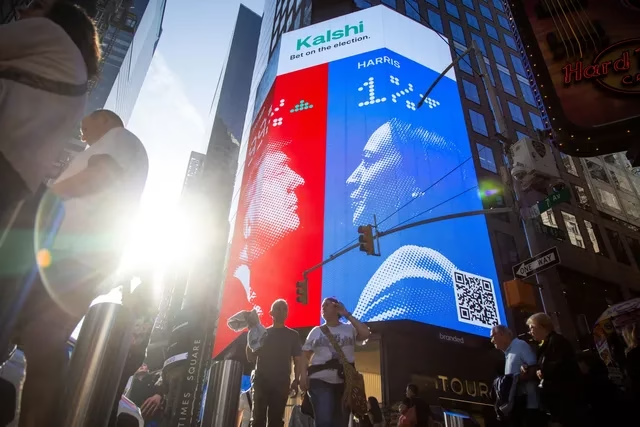
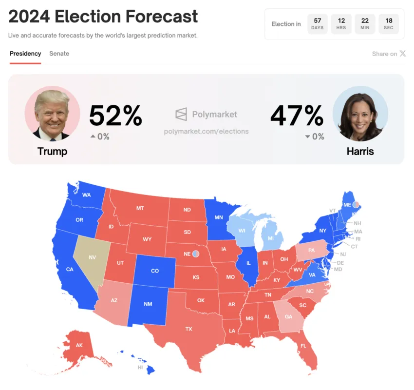
In Pennsylvania during the 2024 election, Polymarket’s final odds showed approximately 61% chance of a Trump victory while FiveThirtyEight modeled the state as a toss-up. Trump won by 1.7 points. In Michigan, where polls averaged a narrow Harris lead, Polymarket indicated 58% Trump probability; he won by 1.4 points. Across Arizona, Georgia, and Wisconsin, similar patterns held.
Throughout 2025, Polymarket has maintained 90-95% accuracy across diverse categories, with recent analysis showing 94% overall accuracy in predicting major events. This performance spans politics, macroeconomics, sports, and cryptocurrency markets.
In Federal Reserve rate decisions and crypto ETF approvals, markets priced in shifts days ahead of announcements. The platform captured momentum that polls missed—when Harris’s favorability peaked after the Democratic convention, Polymarket’s odds moved modestly then reversed within days. Traditional polls showed greater swings that proved to be noise.
Trading volume tells the story: the 2024 election generated $3.6 billion on Polymarket. In 2025, Q3 alone exceeded $3 billion as the prediction markets sector grew 47% to $955 billion.
When a French trader bet over $30 million on Trump in 2024, critics alleged manipulation. The market’s price remained accurate, demonstrating that large positions coexist with efficient aggregation. Attempts to move prices artificially created arbitrage opportunities restoring equilibrium within hours.
Nate Silver, whose model Polymarket outperformed, acknowledged markets excel at aggregation when real money is at stake. Research confirms prediction markets outperform polls by punishing inaccurate beliefs with financial consequences—a dynamic absent in polling where respondents face no cost for bias.
Polymarket’s success resulted from fundamental structural advantages.
Global liquidity and continuous operation. Operating offshore with stablecoin infrastructure enabled 24/7 trading worldwide, creating deep capital pools. This volume made manipulation prohibitively expensive—any attempt to distort prices faced immediate counterbets from arbitrageurs.
Perfect incentive alignment. Traders risk real capital and profit only from accuracy. This cuts through political bias. Polymarket priced in Trump’s 2024 victory even as many high-volume traders personally preferred Harris—financial incentive overwhelmed emotional preference.
Diverse information aggregation. The platform synthesizes knowledge from global observers, analysts, and researchers into a single price. By 2025, integrations with data providers including NYSE feeds enhanced precision further.
Ironically, features regulators deemed problematic—cryptocurrency rails, international access, pseudonymous trading—enabled the efficiency making predictions accurate.
Polymarket’s 2022 exclusion exemplified regulatory failure from outdated frameworks.
The settlement required Polymarket to block U.S. users from election contracts deemed illegal derivatives. Yet Americans remained legally permitted to trade complex derivatives carrying systemic risk, bet on sports through legalized sportsbooks, and invest in speculative penny stocks—while political event contracts providing valuable information were prohibited.
Regulatory concerns about “perverse incentives” and threats to “democratic integrity” conflated prediction with manipulation. In practice, attempts to manipulate prices proved self-defeating. Large bets moving odds created arbitrage opportunities; traders betting opposite directions restored equilibrium. Would-be manipulators lost money. Markets revealed truth.
More fundamentally, participants predict, they don’t vote. Markets priced outcomes accurately regardless of trader preferences because profit depends on accuracy, not ideology.

On November 25, 2025, the CFTC’s amended order enabling intermediated U.S. access represented complete reversal of the 2022 ban—tacit admission that restricting the most accurate platform had failed.
The new framework allows American traders to access Polymarket through registered brokerages providing surveillance and compliance infrastructure. Rather than maintaining prohibition, regulators embraced prediction markets with transparency mandates addressing manipulation concerns.
This scramble came after three years watching offshore innovation outpace domestic alternatives. While U.S. users faced bans, Polymarket’s global base grew exponentially, volumes exploded, and the platform secured over $2 billion in investment.
The new administration’s decision to drop enforcement probes and approve regulated access reflects broader regulatory philosophy shifts. Experts like Jerry Brito of Coin Center have long argued for outcome-focused frameworks over prohibitive bans. The November order represents exactly this evolution.
The Polymarket reversal tests whether U.S. financial regulation can adapt to innovation or continue pushing infrastructure offshore.
During three years of prohibition, Americans were deprived of the most accurate information source about their own election. They relied on systematically biased polling, hedging statistical models, and analysis lacking financial discipline.
The information deficit had real costs. Investors made decisions on flawed probabilities. Media amplified polling errors. Citizens formed beliefs based on inaccurate forecasts—because regulators banned what worked best.
Polymarket’s success demonstrates enormous demand for objective, market-based information on high-stakes events. More importantly, it proves decentralized finance infrastructure can deliver superior outcomes to centralized systems.
With projections for trillion-scale volumes and expansion into corporate forecasting and policy planning, prediction markets represent foundational infrastructure for information discovery in complex environments.
In polarized settings where bias infects traditional media and polling, market-based prediction offers mechanisms that cut through noise. When belief must be backed by capital, resulting prices become powerful signals of reality.
Polymarket proved regulators wrong. Data from 2024-2025 is unambiguous: the banned platform delivered superior accuracy across all categories compared to legal alternatives.
The November 2025 reversal represents regulators scrambling to catch up with innovation they tried suppressing. The 2022 ban created information deficits harming citizens and investors while pushing valuable industry offshore.
The amended framework vindicates years of advocacy arguing prohibition was counterproductive. By choosing adaptation, regulators preserved possibility that America leads rather than lags in essential forecasting infrastructure.
Questions remain about whether intermediated access preserves efficiency or whether compliance costs degrade market quality. What’s certain is market-based aggregation has proven superior. The scramble to catch up confirms what should have been obvious: banning accuracy to protect broken polling was never defensible.
Polymarket’s legacy is clear: when choosing between regulatory orthodoxy and demonstrable accuracy, reality eventually forces adaptation.
The only question was how long regulators would resist the inevitable.



Copyright © 2025 - The Bit Gazette.