







- Trending
- Comments
- Latest

Google DeepMind research is raising alarms about a dual threat to Bitcoin’s security: quantum computers that could break the protocol’s encryption in minutes, and AI systems that could be manipulated into executing transactions at vulnerable moments. While quantum threats have been discussed for years, linking them to emerging AI vulnerabilities creates a more complex security scenario than previously understood.
The so-called 9-minute nightmare stems from research suggesting that a sufficiently powerful quantum computer could break Bitcoin’s cryptographic protections during the brief window when a public key is exposed in a transaction.
In theory, an attacker could derive the private key and redirect funds before the transaction is confirmed. While current quantum systems are not yet capable of executing such an attack, the concept has raised concerns across the industry.
Security experts stress that this is not an immediate vulnerability, but rather a forward-looking risk that highlights the need for stronger defenses.
Alongside quantum concerns, AI Agent Traps are emerging as a parallel threat vector. These attacks focus not on breaking encryption, but on manipulating the environments and systems that interact with blockchain networks.
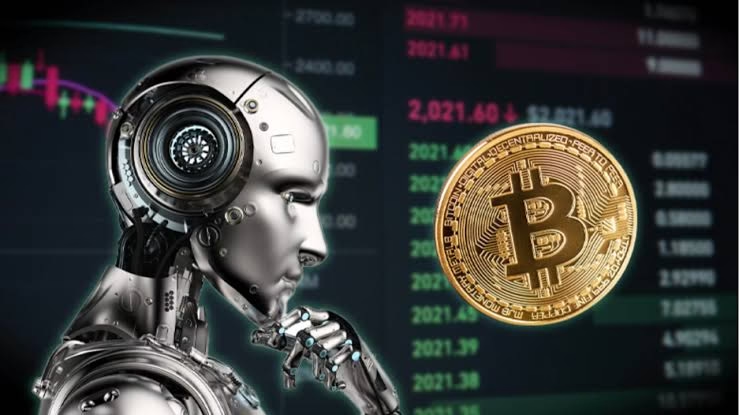
Research from Google DeepMind outlines how AI agents—autonomous systems designed to browse, analyze, and execute tasks—can be influenced by hidden instructions, deceptive content, or behavioral triggers embedded within web pages.
As AI becomes more integrated into financial systems, including crypto trading and wallet management, AI Agent Traps could be used to guide automated systems into making harmful decisions at critical moments.
What makes the situation more complex is the potential overlap between these threats. AI Agent Traps could, in theory, be used to manipulate when and how transactions are executed, increasing exposure during vulnerable windows such as the one described in the 9-minute nightmare.
“Security is no longer just about code—it’s about context,” said a digital asset researcher familiar with both quantum and AI security models.
This convergence suggests that future attacks may not rely on a single breakthrough, but rather on combining multiple weaknesses across systems.
For years, Bitcoin has been widely regarded as one of the most secure financial systems ever created, thanks to its robust cryptographic foundation. However, the emergence of scenarios like the 9-minute nightmare—and the rise of AI Agent Traps—are beginning to challenge that perception.

Rather than indicating immediate danger, these developments highlight how the threat landscape is evolving. The focus is shifting from direct attacks on blockchain code to indirect methods that exploit surrounding infrastructure.
In response to these concerns, developers and researchers are accelerating efforts to explore post-quantum cryptography—encryption methods designed to withstand attacks from quantum computers.
At the same time, mitigating AI Agent Traps will require a different set of defenses, including improved input validation, behavioral monitoring, and stricter controls on how AI systems interact with external data sources.
According to experts, addressing these risks will demand collaboration across multiple fields, from cryptography to artificial intelligence and cybersecurity.
Despite the alarming nature of the 9-minute nightmare, most experts agree that Bitcoin is not currently at risk. Quantum computing remains in its early stages, and practical attacks are still years away.

However, the introduction of AI Agent Traps into the conversation underscores a broader reality: future threats to crypto systems will likely be more complex and harder to predict.
Ultimately, the intersection of quantum risk and AI Agent Traps serves as a warning rather than a prediction. It highlights the importance of preparing for scenarios that may seem distant today but could become relevant faster than expected.
For the crypto industry, the message is clear security can no longer be viewed in isolation. As technologies converge, so too do their risks.



Copyright © 2025 - The Bit Gazette.