


- Trending
- Comments
- Latest

Roughly half of Fortune 500 companies are expected to formalize crypto and blockchain strategies by the end of 2026, according to Ripple president Monica Long, signaling a decisive phase of Institutional crypto adoption across the United States.
Writing on January 21, 2026, Long said the shift will be driven by years of infrastructure development, improving regulatory clarity, and growing confidence among corporate leaders that blockchain is ready for large-scale financial use.
The forecast comes as both corporations and traditional financial institutions begin integrating digital assets into balance sheets, treasury operations, and consumer-facing financial products.
From Fortune 500 boardrooms to insurance-linked retirement vehicles, Institutional crypto adoption is increasingly framed as a strategic necessity rather than a speculative experiment.
Long argues that the next two years will mark a turning point for Institutional crypto adoption, with blockchain moving from the margins of innovation teams into core financial operations.

She estimates that by the end of 2026, corporate balance sheets could collectively hold more than $1 trillion in digital assets, with around half of Fortune 500 firms implementing formal digital asset strategies.
According to Long, blockchain is becoming the “operating layer of modern finance,” — Monica Long, President, Ripple.
She said these strategies will extend beyond holding crypto for price exposure and instead involve active participation in tokenized assets, digital asset treasuries, stablecoins, on-chain Treasury bills, and programmable financial instruments.
Supporting this view, Long cited a mid-2025 Coinbase survey in which six out of ten Fortune 500 executives reported their companies were already working on blockchain initiatives.
While only a small number of large firms currently hold Bitcoin directly, early adopters such as Block Inc., Tesla, and GameStop have demonstrated how corporate treasuries can integrate digital assets as part of broader capital strategies. These moves, Long suggests, are early indicators of a broader wave of Institutional crypto adoption now taking shape.
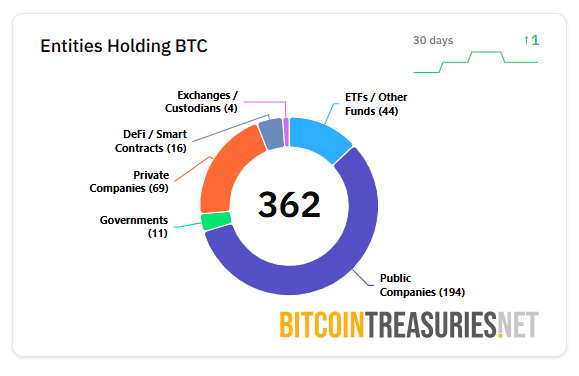
Beyond direct crypto holdings, Long highlighted the rapid expansion of digital asset treasury companies as evidence of deepening Institutional crypto adoption.
The number of such firms has grown from just four in 2020 to more than 200 today, with nearly half formed in 2025 alone. This growth reflects rising demand for professionalized crypto treasury management within corporate structures.
Long also predicted that stablecoins will evolve into a primary mechanism for global settlement, rather than remaining a niche payment alternative.
She pointed to regulatory progress and increasing involvement from established payment networks such as Visa and Mastercard as key accelerators. In this environment, stablecoins are positioned to play a central role in Institutional crypto adoption, particularly for cross-border payments and liquidity management.
In parallel, Long expects financial institutions to move toward directly custodying digital assets as part of their blockchain strategies.
She also argued that the convergence of artificial intelligence and blockchain technology will unlock efficiencies in risk assessment, yield optimization, and liquidity allocation, further embedding Institutional crypto adoption into enterprise finance.
The expansion of Institutional crypto adoption is not limited to corporate treasuries. Delaware Life Insurance Company has introduced a Bitcoin-linked annuity index developed in partnership with BlackRock, offering retirees and long-term savers indirect exposure to Bitcoin within a regulated framework.
The index blends US equities with a small, risk-managed allocation to Bitcoin, accessed through BlackRock’s iShares Bitcoin Trust ETF. This structure allows the product to reference Bitcoin’s price performance without requiring policyholders to hold the asset directly.
According to Delaware Life, the index applies volatility controls designed to cap fluctuations at around 12%, aligning with the risk parameters of fixed indexed annuities.
The product will be offered across three of Delaware Life’s fixed indexed annuities, which are insurance-based retirement vehicles that protect principal, offer tax-deferred growth, and link returns to market indices rather than direct asset ownership.
The structure underscores how Institutional crypto adoption is being adapted to fit long-standing regulatory and consumer protection frameworks.
Taken together, these developments suggest that Institutional crypto adoption is entering a more mature phase, characterized by integration rather than experimentation.
From Fortune 500 balance sheets to insurance-linked retirement products, blockchain and digital assets are increasingly embedded within established financial systems.

While challenges around regulation, volatility, and governance remain, Long’s forecast reflects growing confidence that the foundations for large-scale Institutional crypto adoption are now firmly in place.
As 2026 approaches, the question for many institutions may no longer be whether to engage with crypto, but how deeply it should be woven into their financial strategies.



Copyright © 2025 - The Bit Gazette.