






- Trending
- Comments
- Latest

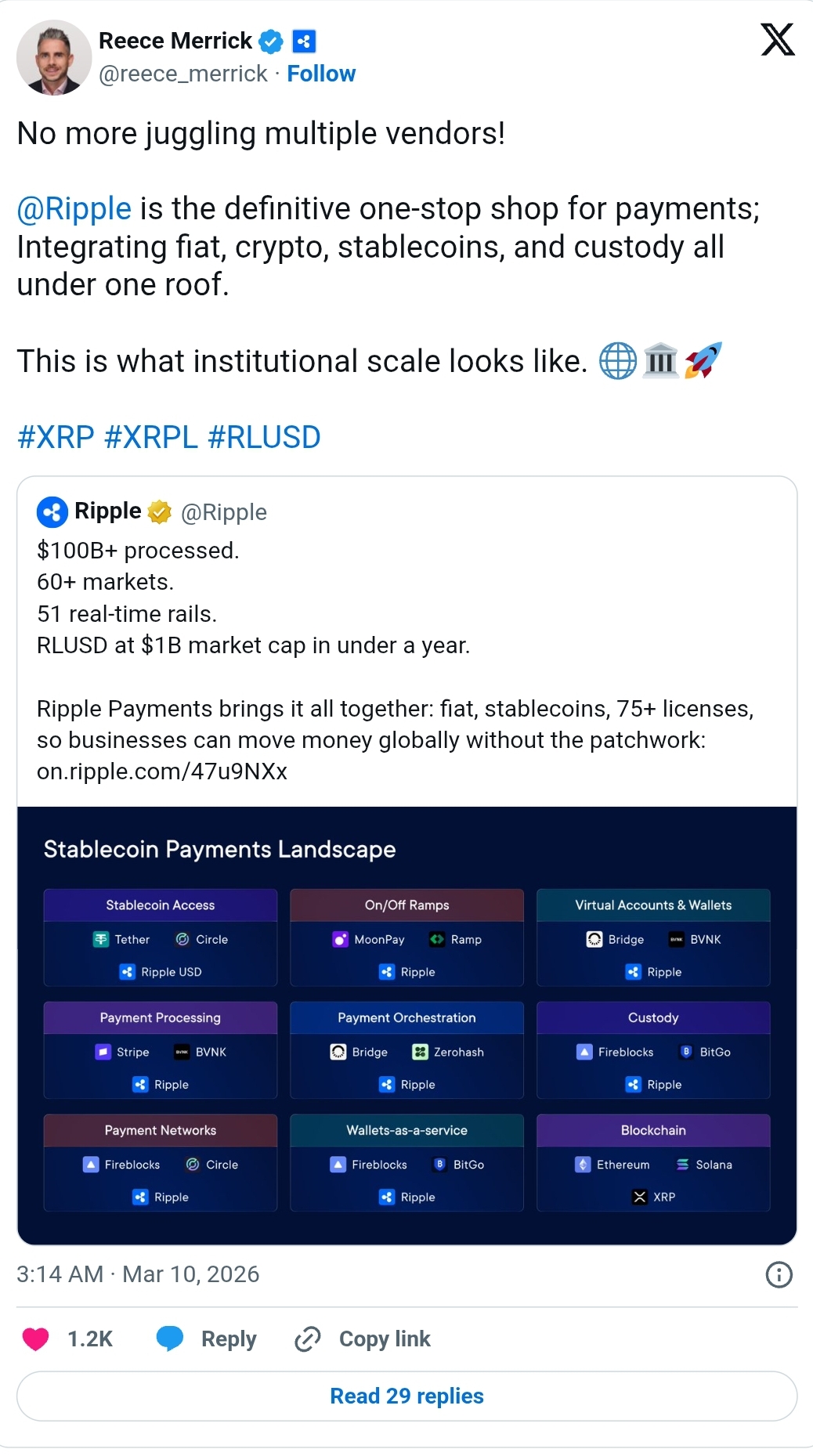
Ripple announced on March 10, 2026, that its payments platform has processed over $100 billion in cumulative transaction volume, while its regulated stablecoin RLUSD has reached approximately $1 billion in market capitalization within less than a year of launch.
The milestone reflects institutional adoption of blockchain settlement infrastructure, with Ripple now operating across 60+ markets through 75 global regulatory licenses and 51 real-time payment rail integrations.
Ripple’s payments platform now connects financial institutions and businesses through blockchain infrastructure that can process international transactions in both fiat currencies and digital assets. The expanding use of Ripple RLUSD illustrates how stablecoins are becoming an integral part of the company’s broader payments ecosystem.
According to Ripple executives, the $100 billion threshold demonstrates the scale the platform has achieved as global institutions explore blockchain-based payment rails.
Reece Merrick, a senior executive at Ripple, highlighted the company’s ambition to consolidate multiple financial services into a single infrastructure platform.
“This is what institutional scale looks like.” — Reece Merrick, Executive, Ripple
He added that the company has positioned itself as a comprehensive payments provider capable of supporting enterprise-level transactions.
“The definitive one-stop shop for payments.” — Reece Merrick, Executive, Ripple
The expanding footprint of Ripple RLUSD is seen by industry observers as a key factor behind the platform’s continued adoption.
A major driver behind the platform’s growth is the emergence of Ripple RLUSD, Ripple’s regulated stablecoin designed to facilitate cross-border payments and blockchain settlements.
Within less than a year of its launch, Ripple RLUSD has reportedly reached a market capitalization of approximately $1 billion. The speed of the growth reflects rising demand for digital dollars that can operate across blockchain networks while maintaining regulatory oversight.
Stablecoins such as Ripple RLUSD are typically pegged to traditional currencies, providing price stability while enabling fast, borderless transfers. For institutions, this combination can simplify treasury management, settlement operations, and foreign exchange transactions.
The increasing presence of Ripple RLUSD within Ripple’s payment infrastructure suggests the company is positioning the asset as a central settlement layer for financial institutions using blockchain technology.
Analysts say the rapid expansion of Ripple RLUSD demonstrates how stablecoins are evolving from experimental crypto assets into tools used by established financial organizations.
Ripple’s infrastructure upgrades and acquisitions are also contributing to the expansion of Ripple RLUSD and the broader payment platform.
The company has secured more than 75 regulatory licenses globally, allowing it to operate across multiple jurisdictions and financial markets. These licenses provide a compliance framework that supports institutional participation in blockchain payments involving Ripple RLUSD.
Ripple has also strengthened its technological stack through strategic acquisitions. The addition of Palisade enhances custody services, wallet infrastructure, and treasury automation capabilities.
Meanwhile, the acquisition of Rail expands the platform’s global financial connectivity by enabling virtual accounts and collection services across multiple regions.
These developments are designed to allow businesses to receive payments in fiat currencies or stablecoins such as Ripple RLUSD, then automatically convert funds into their preferred currency. The process can reduce foreign exchange exposure while simplifying global treasury operations.
Companies using Ripple’s system can also manage balances through virtual accounts and digital wallets, enabling more flexible financial operations across borders.
For organizations conducting international transactions, the growing integration of Ripple RLUSD into this infrastructure may provide an efficient alternative to traditional banking networks.
Ripple’s platform now supports payment settlements in more than 60 markets and connects to 51 real-time payment rails worldwide.
This extensive infrastructure helps enable instant or near-instant international transactions, an advantage that has historically been difficult to achieve through traditional banking systems.
The expanding ecosystem means Ripple RLUSD can increasingly function as a bridge asset within these payment networks, facilitating transfers between currencies and financial institutions.
Industry observers say the $100 billion milestone underscores the broader trend toward blockchain-powered financial infrastructure. As more institutions experiment with digital assets for settlement and liquidity management, stablecoins like Ripple RLUSD are expected to play a larger role in cross-border commerce.
The milestone also reflects how Ripple has evolved beyond its early focus on remittances. Today, the company operates as a broader financial technology provider offering payments, custody services, treasury automation, and blockchain settlement tools.
For the digital payments industry, the combination of institutional infrastructure and expanding Ripple RLUSD adoption signals a shift toward blockchain networks capable of supporting large-scale financial activity.



Copyright © 2025 - The Bit Gazette.