





- Trending
- Comments
- Latest

The U.S. Securities and Exchange Commission has formally abandoned its appeal in the Ripple case, eliminating the final layer of legal uncertainty surrounding XRP’s regulatory status and opening the door for institutional adoption of the digital asset.
The decision, confirmed in early February 2026, follows the full dismissal of the Ripple case in August 2025 and removes the final layer of legal uncertainty surrounding XRP’s status in secondary markets.
The conclusion of XRP Ripple Appeals means that no further challenge remains to the ruling that XRP is not a security when traded on secondary markets.
For banks, trading firms, and other institutions that had been waiting on the sidelines, the move signals that regulatory risk tied to the lawsuit has now been eliminated.
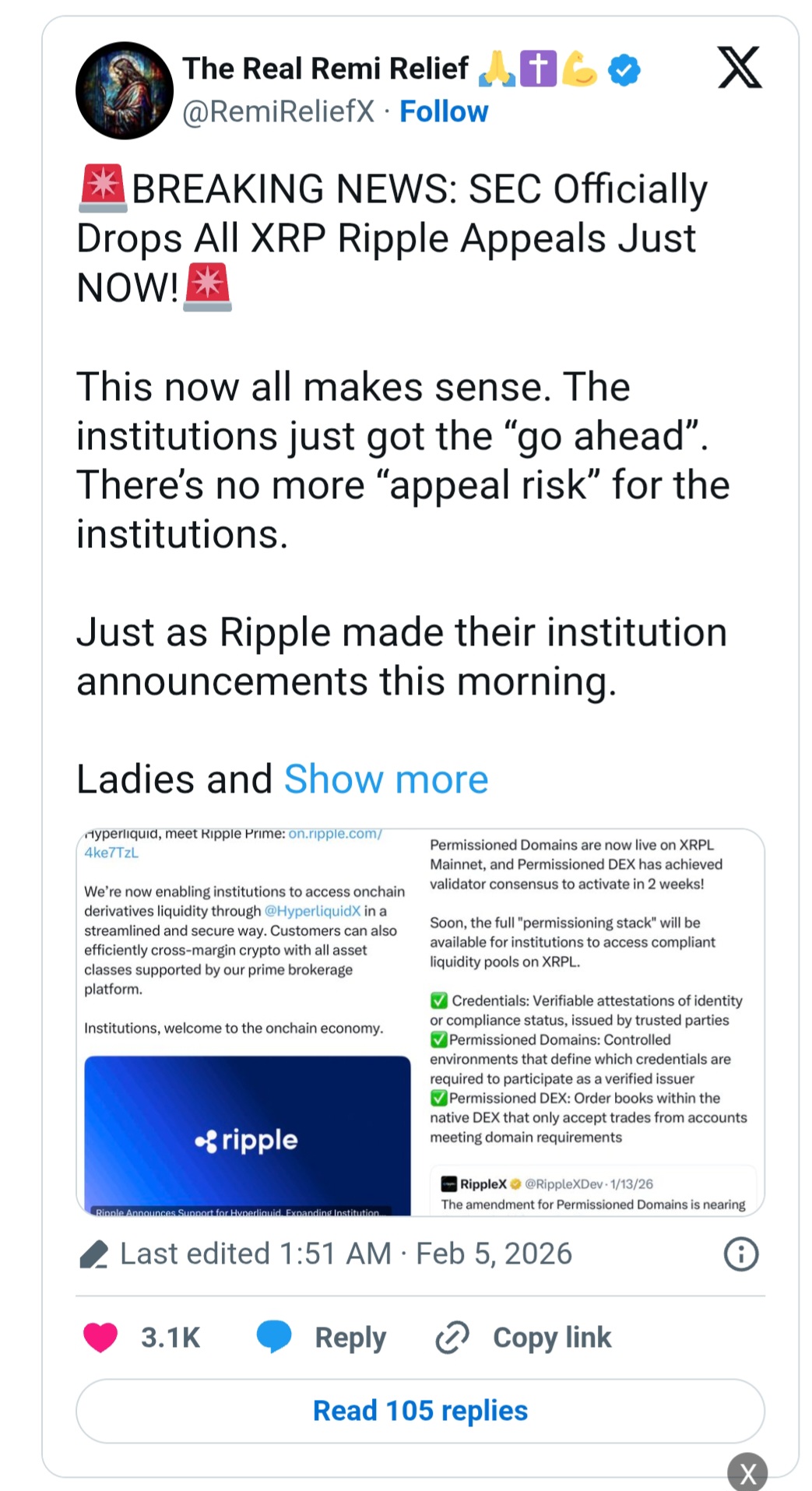
Crypto commentator Remi Relief highlighted the timing and significance of the development in a public post on X, linking the end of XRP Ripple Appeals to Ripple’s recent institutional announcements.
“There’s no more ‘appeal risk’ for the institutions,” — Remi Relief, Crypto commentator (@RemiReliefX).
At the heart of the development is the SEC’s decision to drop all remaining XRP Ripple Appeals, effectively cementing the outcome of the case that began years earlier. The lawsuit, which accused Ripple of conducting unregistered securities offerings, had cast a long shadow over XRP’s use in regulated financial environments.
With the appeals process now closed, the ruling that XRP is not a security on the secondary market stands without qualification. This outcome removes what many industry participants viewed as the last meaningful regulatory barrier to institutional engagement with XRP.
Remi Relief underscored the broader implications of the decision, arguing that the conclusion of XRP Ripple Appeals aligns with renewed institutional activity around Ripple’s ecosystem.
“The institutions just got the ‘go ahead’,” — Remi Relief, Crypto commentator (@RemiReliefX).
For institutional actors, regulatory clarity is often a prerequisite for participation. The end of XRP Ripple Appeals provides that clarity, allowing banks and trading firms to assess XRP based on market, liquidity, and infrastructure considerations rather than unresolved legal risk.
Alongside the legal resolution, Ripple’s technology arm, RippleX, has rolled out new infrastructure on the XRP Ledger designed to meet institutional compliance needs. RippleX recently announced that Permissioned Domains are now live on the XRPL, with the Permissioned DEX having reached validator consensus and scheduled for activation within two weeks.
These developments are closely tied to the broader impact of XRP Ripple Appeals, as institutions now have both legal certainty and compliant technical infrastructure. Permissioned Domains allow network participants to define which credentials are required for verified issuers, creating controlled environments within the public ledger.
RippleX described the feature as enabling “controlled environments that define which credentials are required to participate as a verified issuer,” — RippleX, in a statement.
The Permissioned DEX builds on this framework by ensuring that order books only accept trades from accounts that meet specific domain requirements. Together, these tools are designed to give regulated entities confidence that their on-chain activity aligns with internal compliance standards and external regulatory expectations.
The resolution of XRP Ripple Appeals also coincides with Ripple’s efforts to expand institutional liquidity options through its Ripple Prime platform. Ripple recently announced support for Hyperliquid, a move that broadens access to on-chain derivatives liquidity for institutional clients.
Through this integration, institutions can cross-margin crypto assets across multiple asset classes supported by the prime brokerage platform. The goal is to combine on-chain efficiency with the operational and compliance features expected by professional market participants.
Ripple framed the development as an open invitation to regulated players entering digital asset markets. “Institutions, welcome to the on-chain economy,” — Ripple, in a statement.
The combination of Ripple Prime’s expanded capabilities and the conclusion of XRP Ripple Appeals positions XRP within an ecosystem that is increasingly tailored to institutional use cases, including liquidity management and settlement.
With XRP Ripple Appeals now firmly in the past, XRP stands to benefit most directly from the convergence of regulatory certainty and infrastructure readiness. Market participants point to the alignment of legal clarity, permissioned trading environments, and institutional liquidity tools as a turning point for the asset.
The removal of appeal risk allows institutions to engage with XRP without fear of sudden regulatory reversal. At the same time, the activation of the Permissioned DEX and the expansion of Ripple Prime offer practical pathways for compliant participation.
Remi Relief captured the mood among XRP supporters following the announcement, declaring, “IT’S ON!!!” — Remi Relief, Crypto commentator (@RemiReliefX).
As the dust settles on XRP Ripple Appeals, the focus now shifts from litigation to adoption. For XRP, the end of the legal battle marks not just a courtroom victory, but a structural change in how the asset can be used within regulated financial markets.



Copyright © 2025 - The Bit Gazette.