






- Trending
- Comments
- Latest


A Russia-linked ruble-backed stablecoin processed more than $100 billion in transactions across Ethereum and Tron before sanctions and exchange delistings shut down its operations, according to blockchain analytics firm Elliptic.
The token, known as A7A5, surged in early 2025 as a bridge between rubles and Tether’s USDT, allowing Russian-linked entities to move value through crypto markets while avoiding Western asset freezes.
Activity peaked before mid-2025, then collapsed after US sanctions in August cut off liquidity and major platforms blocked the token.
Elliptic said the $100 billion figure represents the aggregate value of all A7A5 transfers recorded on public blockchains, including Ethereum and Tron, rather than net economic activity.
“This is the aggregate value of all A7A5 transfers,” said Tom Robinson, founder and chief scientist at Elliptic.
“We are not taking a subjective view on whether each transaction represents distinct economic activity, but transaction fees were paid on all transfers, indicating real utility to users.”
The scale of the flows alone underscores how quickly a rubble backed stablecoin can gain traction when demand exists for sanctions-resistant settlement rails.
According to Elliptic, the ruble backed stablecoin primarily functioned as a bridge between rubles and Tether’s USDt (USDT)—the world’s largest dollar-pegged stablecoin.
The structure allowed users to move value into USDT markets without maintaining prolonged exposure to wallets vulnerable to Western freezes.
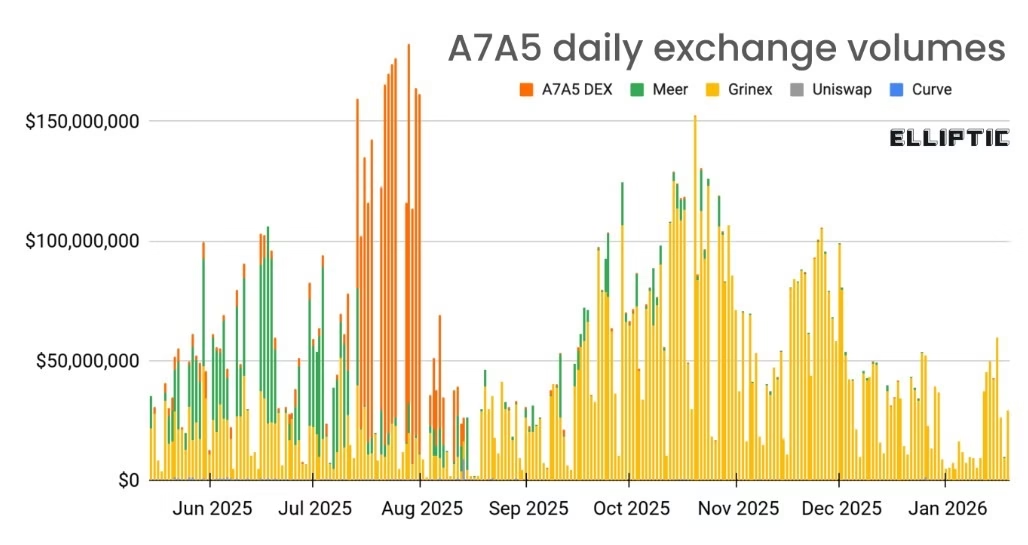
Activity was concentrated on a small number of venues, including Kyrgyzstan-based exchanges and project-linked infrastructure, reinforcing A7A5’s role as a purpose-built settlement tool rather than a retail stablecoin.
This design made the ruble backed stablecoin effective—but also highly visible once enforcement agencies focused on it.
Elliptic said growth stalled around mid-2025, with no major new issuances after July. Transaction volumes dropped from peaks near $1.5 billion to roughly $500 million.
Robinson pointed to US sanctions imposed in August 2025 as the inflection point.
“The US sanctions in August 2025 appear to have had the largest impact,” Robinson told Cointelegraph.
“USDT liquidity provision to A7A5’s DEX dropped substantially, removing one of the stablecoin’s key benefits—easy on-chain access to USDT.”
Further pressure followed. In November 2025, Uniswap added A7A5 to its token blocklist, cutting off access via its web interface. Users also reported USDT deposits frozen after exchanges traced funds back to rubble backed stablecoin wallets.
On Oct. 23, the European Union formally sanctioned A7A5, labeling it a mechanism used to bypass financial restrictions tied to Russia’s war economy.
Elliptic said A7A5’s rise and fall illustrates the narrow window in which sanctions-era stablecoins can operate.
“While the US dollar dominates the global economy, there are structural limits to how far a stablecoin such as this can grow,” Robinson said.
“However, if that changes, all bets are off.”
For policymakers, the ruble backed stablecoin episode is a warning. For crypto markets, it’s proof that enforcement still matters—and can work.



Copyright © 2025 - The Bit Gazette.

