




- Trending
- Comments
- Latest

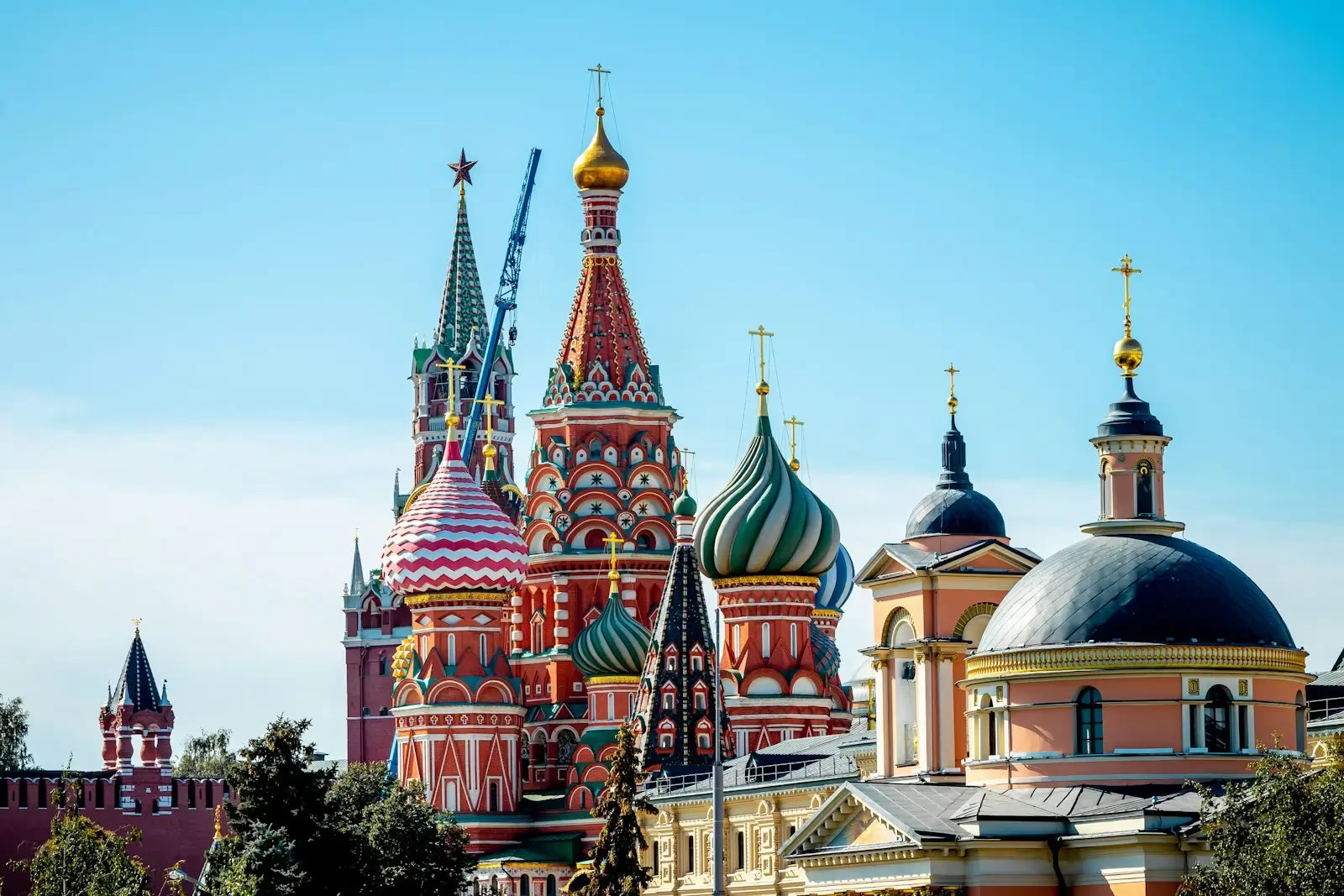
Russia’s Ministry of Finance signaled this week that it may legalize stablecoin payments while maintaining restrictions on decentralized cryptocurrencies like Bitcoin, according to statements by Financial Policy Department Director Alexey Yakovlev.
The shift suggests Moscow is preparing a three-tier regulatory framework that treats cryptocurrencies, stablecoins, and traditional digital assets as separate legal categories.
At a recent tokenization conference organized by “Banking Review,” Alexey Yakovlev, Director of the Financial Policy Department at the Ministry of Finance of the Russian Federation, outlined the ministry’s position on Russia crypto regulation.
According to Yakovlev, the ministry is inclined to treat cryptocurrencies, stablecoins and digital financial assets as separate phenomena under Russia crypto regulation.
He indicated that stablecoins pegged to national fiat currencies are “closer to a regular means of payment” than other crypto assets.
“This is, after all, a separate phenomenon that holds enormous potential. After we launch the main regulation, we can make concessions to this phenomenon as we proceed, in order to regulate it separately,” — Alexey Yakovlev, Director of Financial Policy Department, Ministry of Finance of the Russian Federation.
Yakovlev added that once the main crypto legislation enters into force, Russia crypto regulation could evolve to include a specific oversight regime for stablecoins, possibly through a dedicated law.
Speaking to reporters on the sidelines of the forum, he noted that such a move would “probably” involve adopting a separate stablecoin law, depending on Russia’s economic interests.
The ministry plans to continue consultations with the Central Bank of the Russian Federation and market participants as Russia crypto regulation develops.
Yakovlev’s remarks come as Russia crypto regulation moves toward a comprehensive legislative framework jointly drafted by the Finance Ministry and the Central Bank.
The proposed architecture would channel most cryptocurrency transactions through regulated financial institutions, including banks, brokers and stock exchanges.
Under the draft Russia crypto regulation model, these institutions would be permitted to work with decentralized digital assets under their existing licenses.
Meanwhile, dedicated crypto platforms would need to meet strict authorization standards to operate legally within Russia.
Foreign crypto service providers would be required to establish a local office to continue offering services.
The regulatory concept underpinning the draft legislation was published in late December by the Bank of Russia.
At the time, the central bank indicated that cryptocurrencies and stablecoins would be recognized as “monetary assets” under the evolving Russia crypto regulation structure.
However, recognition as monetary assets does not equate to approval for payment use.
Russian officials have repeatedly signaled that the use of cryptocurrencies such as Bitcoin for domestic payments is likely to remain prohibited under Russia crypto regulation.
Russia crypto regulation currently operates under the 2021 federal law “On Digital Financial Assets,” which primarily governs tokenized real-world assets and certain forms of digital securities.
The law defines “digital currency” as “a set of electronic data … that is offered and/or may be accepted as a means of payment.”
In practice, that definition has largely applied to central bank digital currency initiatives, including the digital ruble project overseen by the Central Bank of Russia.
Decentralized cryptocurrencies remain outside the scope of legal payment instruments under existing Russia crypto regulation.
By signaling openness to stablecoins while maintaining restrictions on cryptocurrencies, policymakers appear to be drawing a regulatory distinction between assets with identifiable issuers and those operating on fully decentralized networks.
For crypto investors and policymakers, the next phase of Russia crypto regulation will be closely watched.
A separate legal pathway for stablecoins could create new opportunities for cross-border settlements or domestic digital payments aligned with state oversight, while preserving strict limits on decentralized alternatives.
As legislative drafting continues, Russia crypto regulation is poised to clarify the legal status of different digital asset classes potentially reshaping how stablecoins and cryptocurrencies operate within one of the world’s largest economies.



Copyright © 2025 - The Bit Gazette.