


- Trending
- Comments
- Latest

When Ethereum scales through rollups, each rollup typically orders its own transactions independently, creating inconsistencies, MEV opportunities, and friction for cross-chain applications. Shared sequencing replaces that fragmented model with a single coordination layer that orders transactions across multiple rollups simultaneously.
At its core, shared sequencing refers to a system where multiple blockchains or rollups rely on a single, coordinated mechanism to order transactions.
In simpler terms, instead of each rollup deciding transaction order independently, shared sequencing allows them to use a common sequencer. This ensures that transactions across different chains are processed in a consistent and predictable order.
Without shared sequencing, each rollup operates in isolation. With shared sequencing, they operate in sync.
The need for shared sequencing comes from a growing problem: fragmentation.
As ecosystems like Ethereum scale through rollups, liquidity and users get spread across multiple chains. Each chain has its own sequencer, creating inconsistencies in transaction ordering.

Shared sequencing addresses this by creating a unified coordination layer.
Shared sequencing helps to:
Put simply, shared sequencing turns a fragmented system into a coordinated one.
One of the biggest issues shared sequencing tackles is MEV (Maximal Extractable Value).
When multiple sequencers operate independently, arbitrage opportunities arise due to inconsistent transaction ordering. This leads to inefficiencies and, in some cases, unfair advantages for certain actors.
Shared sequencing helps mitigate this by aligning transaction order across chains, reducing opportunities for exploitation.
It also improves cross-chain applications. Without shared sequencing, a transaction on one rollup might conflict with another on a different rollup. With shared sequencing, those conflicts are minimized.
In a shared sequencing model, a central or decentralized sequencer receives transactions from multiple rollups and orders them before they are finalized. This ordered list is then distributed back to each rollup, ensuring consistency.
Some designs use a single sequencer, while others aim for decentralized networks of sequencers. The goal in both cases is the same: coordinated ordering.
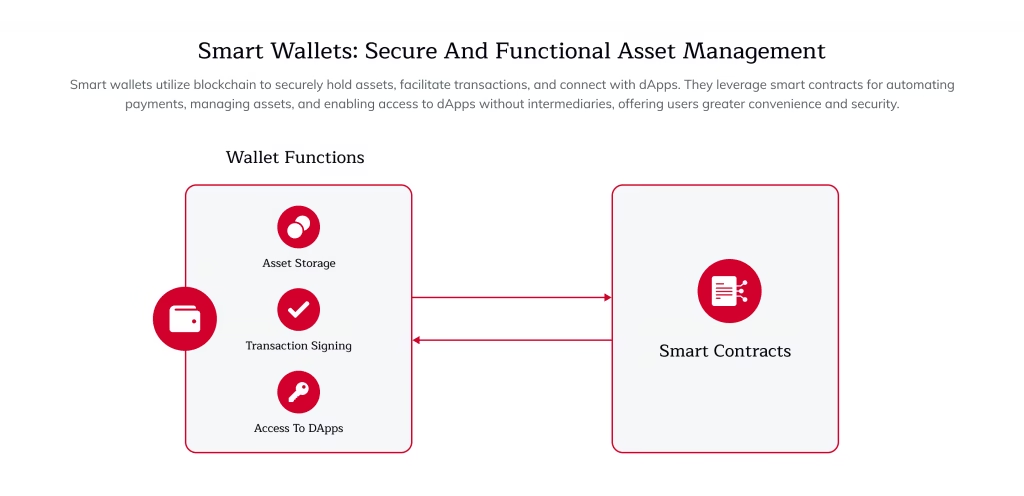
Projects in the space are exploring different implementations, including auction-based sequencing and validator-driven systems.
While shared sequencing offers clear benefits, it also introduces trade-offs.
The biggest concern is centralization. If one sequencer controls multiple rollups, it becomes a critical point of failure.
To address this, developers are working on decentralized shared sequencing models that distribute control across multiple participants.
Another challenge is latency. Coordinating across multiple chains can introduce delays, especially as the system scales.Still, many believe these issues are solvable and worth the trade-off.
Several projects are already experimenting with shared sequencing as part of next-generation blockchain infrastructure.
Teams building within the Ethereum ecosystem are leading the charge, as rollup adoption continues to grow.
The concept is also gaining traction among modular blockchain designs, where different components of the stack are separated and optimized independently.
Here’s the bigger picture: shared sequencing isn’t just about efficiency it’s about coordination.

As blockchain ecosystems expand, the ability to synchronize activity across multiple chains becomes critical. Shared sequencing provides that missing coordination layer.
Without it, scaling leads to fragmentation. With it, scaling becomes structured.
Shared sequencing is still evolving, but its importance is becoming harder to ignore.
If rollups are the engines of scalability, shared sequencing is the traffic system that keeps everything moving smoothly.



Copyright © 2025 - The Bit Gazette.