







- Trending
- Comments
- Latest

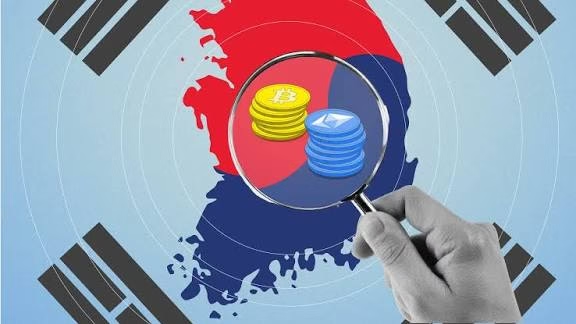
South Korea’s Financial Supervisory Service has expanded its AI-powered surveillance system to detect cryptocurrency market manipulation, deploying algorithms that can scan trading data in real time and flag suspicious activity faster than manual reviews.
According to FSS officials, this upgrade is designed to improve the timing and accuracy of spotting suspicious activity that could harm market integrity and retail investors.
Officials emphasized that the move reflects broader technological and regulatory trends as trading activity becomes more complex and high-frequency tactics are increasingly used by sophisticated actors.
“Automating our detection capabilities allows us to flag irregular trading patterns that would otherwise only be discovered after significant damage has occurred.”
An FSS spokesperson said in a statement to local media.
Previously, regulators relied on traditional methods of data analysis that were labor-intensive and slow to respond to sudden spikes or drops in asset prices.
The enhanced VISTA system uses a sliding-window grid search technique to scan every possible sub-period within trading datasets.
Back-testing on historic cases showed the AI could detect previously identified manipulation periods and flag additional intervals regulators had missed with previous tools.
The FSS secured a dedicated budget of 170 million won (about $116,000) for further AI development in 2026, with staged upgrades planned through the year.
These improvements will include the ability to identify coordinated trading networks and trace the origins of funds linked to illicit trading activities.
“The new AI tools significantly expand our ability to monitor the market’s microstructure in real time. This represents a meaningful step toward more proactive oversight that could reduce fraud and improve investor confidence.”
Lee Sang-woo, a regulatory technology expert at Seoul National University, said.
The AI surveillance expansion comes as South Korean authorities begin pairing sophisticated monitoring tools with legal enforcement under the Virtual Asset User Protection Act, a law enacted to safeguard investors and define criminal penalties for market abuse.
Earlier this week, the Seoul Southern District Court handed down the first known prison sentence for crypto price manipulation, convicting a crypto firm executive, referred to by the surname Lee, for orchestrating deceptive trading designed to mislead markets.
Prosecutors argued that the defendant’s repeated high-price buys and low-price sells, combined with deceptive order placement, constituted market manipulation.
The court sentenced the executive to three years in prison and imposed financial penalties, underlining the legal risks of market abuse.
Legal analysts see this combination of AI surveillance and criminal enforcement as a strong signal to both domestic traders and international investors that Seoul is serious about aligning crypto market behavior with traditional financial norms.
However, some industry participants caution that enforcement tools must be calibrated carefully to avoid suppressing legitimate market making or active trading.
“There’s a fine line between active trading and manipulation.” David Lee, a hedge fund manager familiar with Asian crypto markets, said.
South Korea’s approach is part of a broader trend toward tightening global crypto regulation, with regulators in major jurisdictions increasingly using technology to detect fraud and protect retail investors.
Continuous AI investment suggests Seoul aims to stay at the forefront of this movement, even as the policy landscape evolves around stablecoin regulation and exchange accountability.
The expanded surveillance puts more pressure on compliance infrastructure. Exchanges may need to adopt comparable internal monitoring tools and cooperate closely with regulators to avoid penalties or enforcement actions.
The heightened oversight could reduce the frequency of extreme volatility driven by illegal activity but may also lead to lower liquidity in certain markets as exchanges tighten risk controls.
As enforcement and surveillance capabilities mature, market participants will be watching closely to see whether Korea’s AI-augmented regulatory model becomes a template for other jurisdictions aiming to strike a balance between market innovation and investor protection.



Copyright © 2025 - The Bit Gazette.

