






- Trending
- Comments
- Latest

Major institutional investors including Baron Capital and ARK Invest have expanded their SpaceX positions as private share sales value the rocket and satellite company at approximately $180 billion, intensifying Wall Street speculation about an eventual initial public offering despite no formal announcement from CEO Elon Musk.
The renewed focus follows Baron Capital founder Ron Baron’s recent comments describing SpaceX as “one of the most important companies ever built” and regulatory filings showing ARK’s venture fund listing SpaceX as its largest holding.
While Musk has previously acknowledged the company will eventually go public, no IPO timeline has been set, leaving investors to parse private market activity and operational milestones for clues about listing readiness.
Among the most committed backers is Ron Baron, founder of Baron Capital, who has repeatedly described SpaceX as a core long-term holding. Speaking to Bloomberg, Baron said SpaceX represents a substantial portion of his firm’s investment exposure.
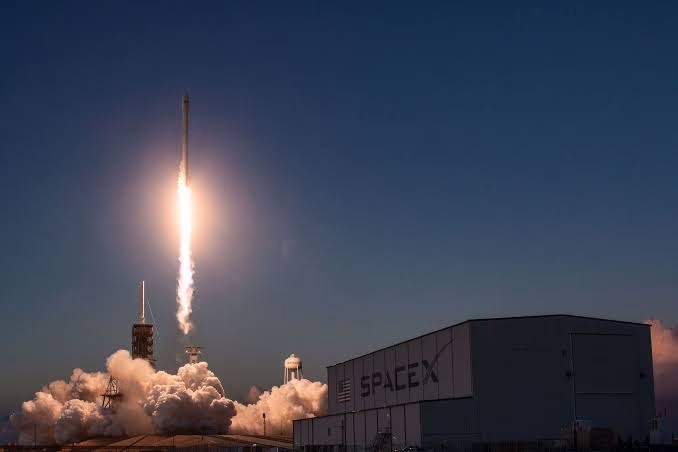
“We think SpaceX is one of the most important companies ever built,” Baron said, noting that the firm evaluates its position with a multi-decade horizon. His Baron Partners Fund continues to list SpaceX as one of its largest holdings, a signal of confidence tied directly to expectations around a future SpaceX IPO.
Cathie Wood has taken a similar stance. Regulatory filings show SpaceX as the largest position within ARK Venture Fund. Wood has argued that SpaceX’s vertically integrated launch system and satellite network give it structural advantages not seen in traditional aerospace firms.
“These are platforms with recurring economics,” Wood has said in prior remarks, pointing to Starlink’s subscription-based model as a central pillar supporting long-term valuation expectations tied to a SpaceX IPO.
Operational performance remains a central factor in investor optimism around a SpaceX IPO. According to Jefferies research, SpaceX recorded a sharp increase in launch volume during the final quarter of 2025, extending its lead in low-Earth orbit deployment.
Jefferies analyst Kevin Lin told clients that SpaceX continues to operate at a scale unmatched by competitors, citing a sustained rise in successful missions supporting the Starlink constellation.
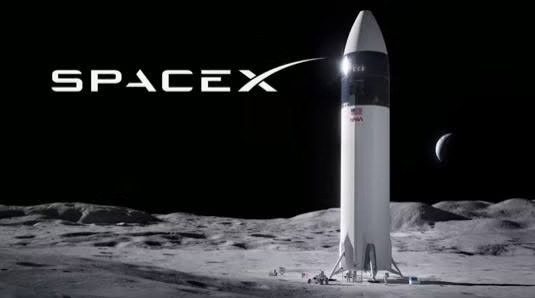
“Execution at this level is difficult to replicate,” Lin wrote, adding that SpaceX’s cadence allows it to deploy infrastructure faster and at lower cost than rival providers. That operational consistency strengthens the long-term financial outlook ahead of any SpaceX IPO.
Amazon’s Project Kuiper has begun limited testing, but analysts generally agree it remains years behind SpaceX in terms of satellite volume and launch experience. Lin noted that the competitive gap could widen further as SpaceX continues reinvesting cash flow prior to a SpaceX IPO.
Analysts are also examining SpaceX’s potential role beyond launches and broadband. One emerging area of interest is orbital computing infrastructure, as data-intensive workloads place growing strain on terrestrial power systems.
Lin suggested that space-based infrastructure could become a meaningful segment of the low-Earth orbit economy over the next decade, with SpaceX uniquely positioned to deploy and maintain such systems due to its launch capabilities.
Skepticism remains. Deutsche Bank analyst Edison Yu cautioned that significant technical challenges must be resolved before orbital computing becomes commercially viable.
“There are clearly engineering hurdles to overcome,” Yu wrote, “but these do not appear to be limitations imposed by fundamental physics.”
Yu added that firms such as Google and OpenAI have explored related concepts, lending credibility—but not certainty—to long-term projections often cited in SpaceX IPO discussions.
Market attention on SpaceX has intensified as performance elsewhere in Elon Musk’s business portfolio has softened. Tesla reported weaker-than-expected vehicle deliveries late last year, allowing BYD to surpass it in global EV sales.
Although Tesla shares finished the year modestly higher, the stock underperformed broader equity indices, prompting investors to reassess where future growth within Musk’s companies is most likely to originate. For many, that focus has turned squarely toward SpaceX and the prospects of a SpaceX IPO.
Musk’s recently approved Tesla compensation package has further fueled debate over value creation across his businesses, reinforcing the view that SpaceX may represent the most significant source of long-term upside.
Even without a confirmed timeline, expectations around a SpaceX IPO are already influencing private market pricing, venture fund strategy, and aerospace sector valuations.
Bankers say demand for a listing would likely be global, drawing interest from institutions seeking exposure to launch services, satellite communications, and emerging orbital infrastructure.
A public offering would also bring greater financial transparency, offering clearer insight into Starlink’s revenue base and SpaceX’s cost structure. That disclosure alone could alter how investors value space-focused companies.
For now, the SpaceX IPO remains a question of when rather than if. But with sustained execution, heavyweight investor backing, and expanding commercial ambitions, Wall Street is treating the eventual listing as one of the most closely watched market events ahead.
SpaceX IPO speculation grips Wall Street as investors brace for historic debutSpaceX IPO speculation grips Wall Street as investors brace for historic debut



Copyright © 2025 - The Bit Gazette.

