







- Trending
- Comments
- Latest

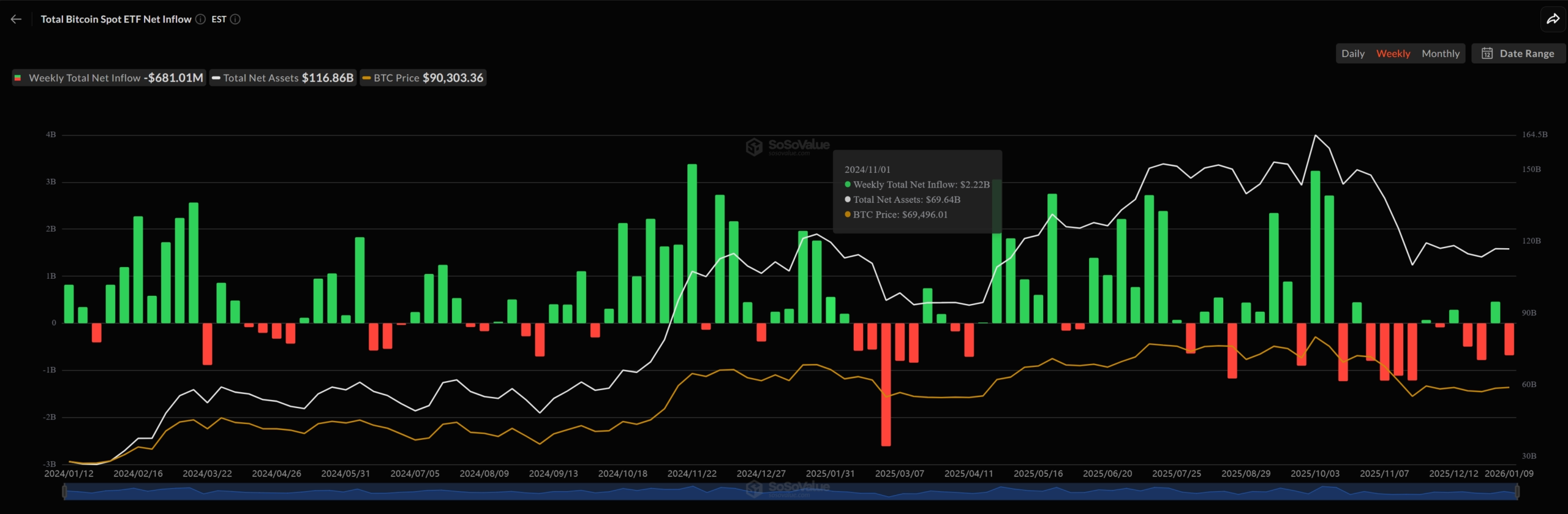
Spot bitcoin ETFs recorded $681 million in net outflows during the first full trading week of 2026, erasing early January optimism as fading hopes for near-term interest rate cuts and mounting geopolitical tensions drove investors away from risk assets.
The reversal came despite strong inflows of $471 million and $697 million on the year’s first and third trading days, underscoring how quickly macro sentiment shifted as the Federal Reserve’s policy path grew murkier.
The sell-off is notable because Spot Bitcoin ETFS began 2026 on a strong footing. On Jan. 2, the funds attracted $471.1 million in fresh capital, followed by a sizable $697.2 million inflow on Jan. 5. At the time, traders appeared to be positioning for a continuation of late-2025 momentum, betting that macro conditions would soon turn more supportive.
Instead, that optimism proved short-lived. By the second half of the week, concerns about stubborn inflation, delayed monetary easing, and escalating geopolitical tensions pushed investors toward a more defensive stance, triggering broad-based selling across risk assets—including crypto.
Spot Ether ETFs mirrored the trend. On a weekly basis, Ether-linked products recorded net outflows of roughly $68.6 million, ending the week with total net assets of about $18.7 billion. The parallel drawdown reinforced the view that the move was macro-driven rather than specific to Bitcoin.
Market participants point to shifting expectations around interest rates as the key catalyst behind the reversal in Spot Bitcoin ETFS flows. Vincent Liu, chief investment officer at trading firm Kronos Research, said that investors are reassessing risk as hopes for near-term policy easing dim.

“With Q1 rate cuts looking less likely and geopolitical risks rising, macro conditions have turned risk-off,” Liu told Cointelegraph. “As traders wait for clearer positive signals, reduced risk appetite is spilling into crypto.”
Liu added that upcoming US economic data will be critical for determining whether Spot Bitcoin ETFS can regain momentum.
“Investors are watching CPI prints and Federal Reserve guidance very closely,” he said. “Until clearer signals emerge, positioning is likely to remain cautious.”
The reassessment comes as global markets grapple with renewed geopolitical tensions and persistent inflation pressures, both of which complicate the outlook for monetary policy. For crypto ETFs, which have increasingly become a vehicle for institutional macro trades, that uncertainty has translated directly into fund flows.
The latest drawdown highlights how Spot Bitcoin ETFS are now deeply embedded in broader portfolio strategies. Unlike earlier cycles, where crypto often traded independently, Bitcoin ETFs have become sensitive to the same macro forces that drive equities and other risk assets.
Analysts note that the ease of entering and exiting positions through ETFs has amplified short-term flow volatility. Large asset managers can now scale exposure up or down quickly, making Spot Bitcoin ETFS a preferred tool for expressing macro views rather than long-term conviction alone.
That dynamic helps explain why inflows earlier in the week reversed so abruptly. When the macro narrative shifted, redemptions followed just as quickly.
Despite the near-term weakness, institutional adoption of crypto ETFs continues to advance. Even as Spot Bitcoin ETFS saw outflows, major financial institutions pressed ahead with new product plans.
Morgan Stanley recently filed with the US Securities and Exchange Commission to launch two spot crypto ETFs—one tracking Bitcoin and another tied to Solana. The filings signal that large banks still see long-term demand for regulated crypto exposure, even amid short-term volatility.
The move followed a decision by Bank of America, the second-largest US bank, to allow advisers in its wealth management divisions to recommend exposure to four existing Bitcoin ETFs. That development marked another milestone for mainstream acceptance of Spot Bitcoin ETFS, expanding their reach into traditional advisory channels.
For now, analysts expect flows into Spot Bitcoin ETFS to remain choppy as investors await clearer macro signals. A softer inflation print or more dovish Federal Reserve messaging could quickly revive inflows, while further delays to rate cuts may prolong the risk-off trend.
Still, market observers stress that the bigger picture remains constructive. The infrastructure around Spot Bitcoin ETFS—from liquidity and custody to adviser access—continues to strengthen. Temporary outflows, they argue, do little to change the long-term trajectory.
As 2026 unfolds, the performance of Spot Bitcoin ETFS is likely to hinge less on crypto-specific narratives and more on the broader economic backdrop.
For investors, the first week of the year delivered a clear message: in today’s market, Bitcoin ETFs move with macro—and macro is firmly in the driver’s seat, at least for now.



Copyright © 2025 - The Bit Gazette.


