







- Trending
- Comments
- Latest


Stablecoins could drain approximately $500 billion from developed-market banks by 2028 as digital dollar adoption accelerates faster than regulation, according to a new analysis from Standard Chartered that identifies regional US banks as particularly vulnerable.
The warning from Geoff Kendrick, the bank’s global head of digital assets research, estimates that deposit outflows equal roughly one-third of stablecoin market capitalization—a relationship that points to significant funding pressure on traditional lenders as the $301 billion stablecoin market continues expanding.
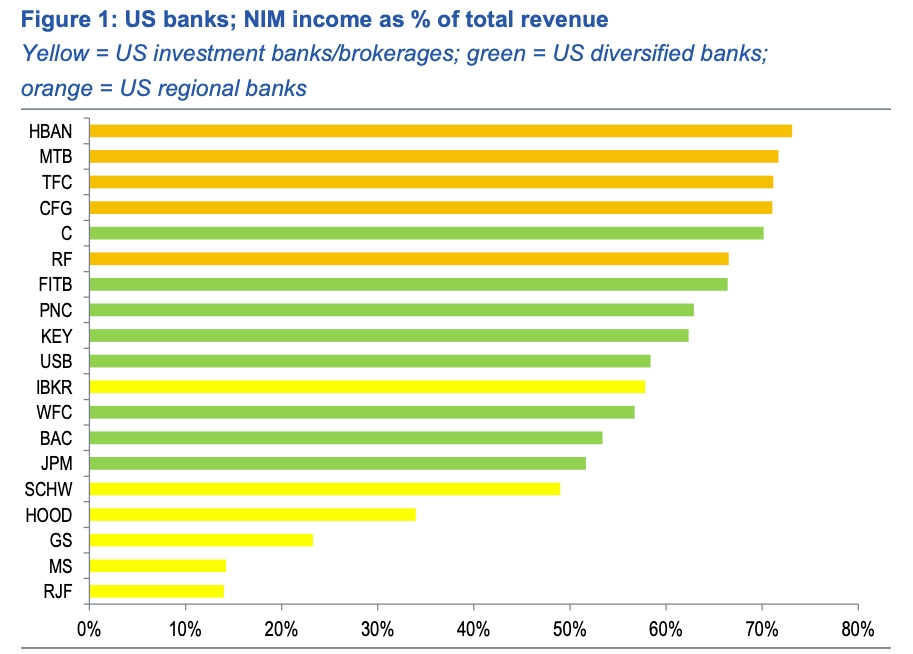
Kendrick’s analysis focused on net interest margin (NIM) income which is the difference between interest earned and interest paid and relative to interest earning assets which he described as the clearest indicator of deposit risk under evolving stablecoin regulation.
“Measured against total revenue, NIM income best captures this risk because deposits are the primary driver of NIM and face potential outflows linked to stablecoin usage” Kendrick said.
He added that regional US banks are more exposed than diversified banks while investment banks are least exposed citing Huntington Bancshares, M&T Bank, Truist Financial and CFG Bank as among the most vulnerable.
The scale of deposit outflows linked to stablecoins depends on several variables including where issuers hold reserves whether demand is domestic or foreign and whether usage is wholesale or retail all areas where stablecoin regulation could shape outcomes.
If stablecoin issuers were to hold most reserves as bank deposits in the jurisdictions where their stablecoins circulate, the pressure on banks would be reduced, Kendrick noted a scenario often raised in stablecoin regulation discussions.
“In theory, a deposit outflow from a bank into a stablecoin would not reduce aggregate bank deposits if the issuer holds its reserves entirely within the banking system” he said.
In practice however, that is not happening at scale. Tether and Circle the issuers of USDT and USDC respectively hold just 0.02% and 14.5% of their reserves in bank deposits.
So very little re-depositing is happening Kendrick said underscoring why stablecoin regulation alone may not fully offset deposit risks.
Domestic demand for stablecoins drains local bank deposits while foreign demand does not, Kendrick explained.
He estimated that around two thirds of current stablecoin demand comes from emerging markets leaving roughly one third from developed markets a split that matters for future stablecoin regulation frameworks.
Based on a projected $2 trillion stablecoin market cap, Standard Chartered estimates that about $500 billion in deposits could leave developed market banks by the end of 2028 while roughly $1 trillion could exit emerging-market banks.
Kendrick said the bank still expects the CLARITY Act to pass by the end of the first quarter of 2026.
He added that risks to bank funding are not limited to stablecoins but also stem from the “inevitable” expansion of tokenized real world assets another area where stablecoin regulation and broader digital asset rules are likely to play a defining role.



Copyright © 2025 - The Bit Gazette.

