







- Trending
- Comments
- Latest


Crypto payments to suspected human trafficking networks surged 85% year-over-year in 2025, reaching hundreds of millions of dollars, according to a Chainalysis report published Thursday, with stablecoins emerging as the dominant payment method among exploitation rings operating across Southeast Asia.
The report found that total transaction volume to identified services reached “hundreds of millions of dollars,” with much of the activity concentrated in Southeast Asia and tied to scam compounds, online casinos, and Chinese-language money-laundering networks.
The findings place Human Trafficking Crypto Flows at the center of an escalating global enforcement challenge, as criminal organizations adopt stablecoins and other digital payment methods to move funds more efficiently across borders.
At the same time, Chainalysis argues that the inherent transparency of blockchain technology offers law enforcement new tools to track and disrupt these operations.
Chainalysis said the spike in Human Trafficking Crypto Flows reflects a broader shift in how illicit actors coordinate and monetize exploitation.
The firm identified crypto-facilitated trafficking linked to Telegram-based international escort services, labor placement agents accused of kidnapping individuals and forcing them to work at scam compounds, prostitution networks, and vendors of child sexual abuse material.
The report stated that many of these services are “closely aligned” with online scam compounds and illicit gambling platforms, particularly in Southeast Asia.
According to Chainalysis, these networks have grown in scale and sophistication, integrating digital asset payments to reduce reliance on traditional banking channels.
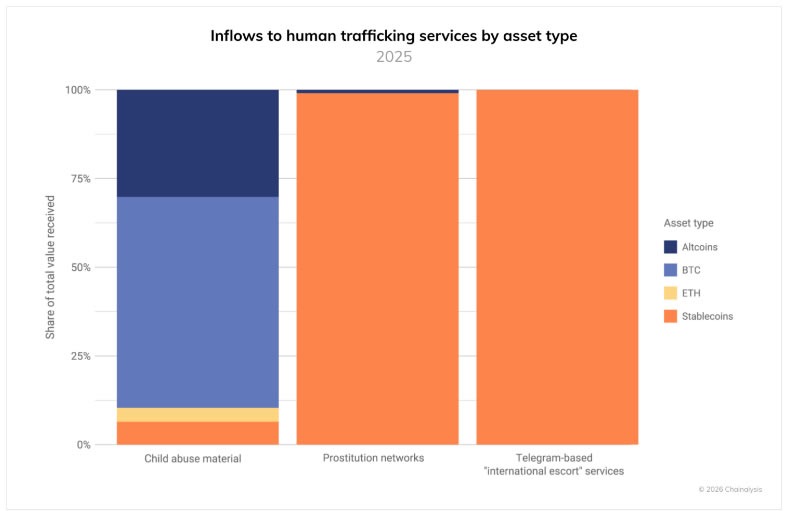
Stablecoins emerged as a dominant payment method within Human Trafficking Crypto Flows, particularly among international escort services and prostitution networks, which reportedly operate “almost exclusively” using dollar-pegged tokens.
Analysts note that stablecoins provide price stability and rapid settlement, features that can be exploited by criminal enterprises seeking predictable cross-border transfers.
Despite the surge in Human Trafficking Crypto Flows, Chainalysis emphasized that blockchain data can be leveraged to identify patterns and dismantle networks.
“Unlike cash transactions that leave no trace, the transparency of blockchain technology provides unprecedented visibility into these operations, creating unique opportunities for detection and disruption that would be impossible with traditional payment methods,” — Chainalysis, in its report.
The company said investigators can track wallet clusters, monitor repeated payment patterns, and identify large, regular transfers to labor placement services.
Compliance teams at exchanges can also analyze stablecoin conversion trends and cross-reference wallets connected to multiple categories of illicit activity.
By focusing on chokepoints such as centralized exchanges and online marketplaces authorities may be able to intercept funds moving through Human Trafficking Crypto Flows before they are laundered or cashed out.
Chainalysis recommended that compliance officers flag consistent high-volume transfers to suspected service providers and monitor wallets that demonstrate overlapping links to scam and exploitation networks.
The rise in Human Trafficking Crypto Flows comes amid intensified global efforts to combat digital-enabled exploitation.
Chainalysis noted that law enforcement agencies achieved several significant victories in 2024, including German authorities dismantling a child sexual exploitation platform.
The firm said blockchain analysis played a role in identifying financial trails connected to the platform.
International cooperation remains central to addressing Human Trafficking Crypto Flows, particularly given the cross-border nature of digital asset transfers.
While blockchain transactions are public, attribution linking wallets to real-world identities requires coordination between analytics firms, exchanges, and investigative agencies.
Policy makers are increasingly examining how anti-money laundering (AML) frameworks apply to crypto intermediaries.
The growth of stablecoin usage within Human Trafficking Crypto Flows may further intensify scrutiny of issuers and trading venues, especially where conversion into fiat currencies occurs.
For crypto investors and industry stakeholders, the surge in Human Trafficking Crypto Flows presents both reputational risks and regulatory implications.
While blockchain transparency can aid investigations, the association of digital assets with exploitation networks may accelerate calls for stricter compliance standards.
Chainalysis maintains that blockchain-based payments are not inherently more conducive to crime than traditional methods but can, in some cases, make illicit finance more traceable.
The firm argues that effective monitoring and enforcement partnerships can turn transaction transparency into a strategic advantage for law enforcement.
As regulators weigh additional oversight measures, the trajectory of Human Trafficking Crypto Flows will likely influence debates over stablecoin governance, exchange reporting requirements, and cross-border AML coordination.
The data underscores a dual reality: digital assets are being misused by criminal actors at increasing scale, yet the same technology may provide the evidence trail needed to dismantle those networks.
In the evolving battle between enforcement agencies and organized trafficking rings, Human Trafficking Crypto Flows illustrate both the risks and the traceability inherent in blockchain-based finance which is an intersection that is likely to remain a focal point for regulators and crypto markets alike.



Copyright © 2025 - The Bit Gazette.

