

- Trending
- Comments
- Latest

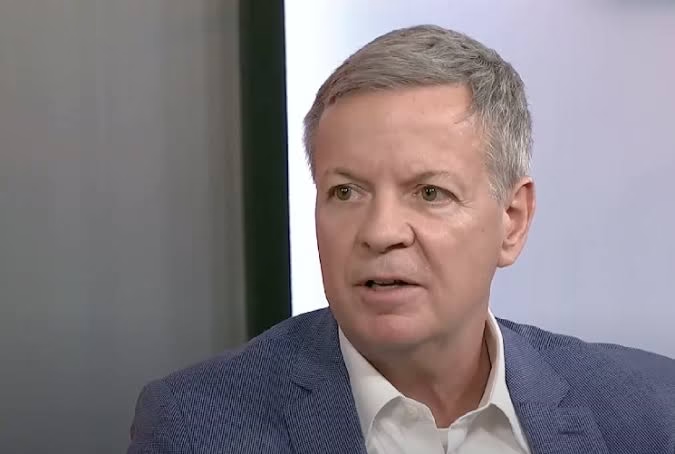
Tom Zschach, who spent six years as SWIFT’s chief innovation officer defending the global payments network against blockchain alternatives, is stepping down to join a research team focused on frontier AI, institutional finance, and scientific discovery.
His departure, announced April 3, signals a notable pivot—from protecting legacy financial infrastructure to exploring what might replace it.
The SWIFT CIO resignation carries added weight because of Zschach’s history as a vocal critic of XRP and competing blockchain-based financial networks. During his tenure, he consistently defended SWIFT’s governance model against decentralized alternatives.
He notably challenged the perceived resilience of Ripple amid its legal battle with regulators, arguing that endurance alone does not equate to institutional strength.
“Neutral, shared governance is. Institutions don’t want to live on a competitor’s rails,” — Tom Zschach, Chief Innovation Officer, SWIFT.
Zschach positioned SWIFT’s system—where thousands of financial institutions collectively define operational rules—as a more stable and trusted framework compared to blockchain ecosystems like the XRP Ledger. His comparisons, including likening XRP to a “fax machine,” reinforced his skepticism toward crypto-native infrastructure.
The SWIFT CIO resignation therefore represents more than a leadership change; it underscores an ongoing ideological divide between centralized financial networks and decentralized alternatives.
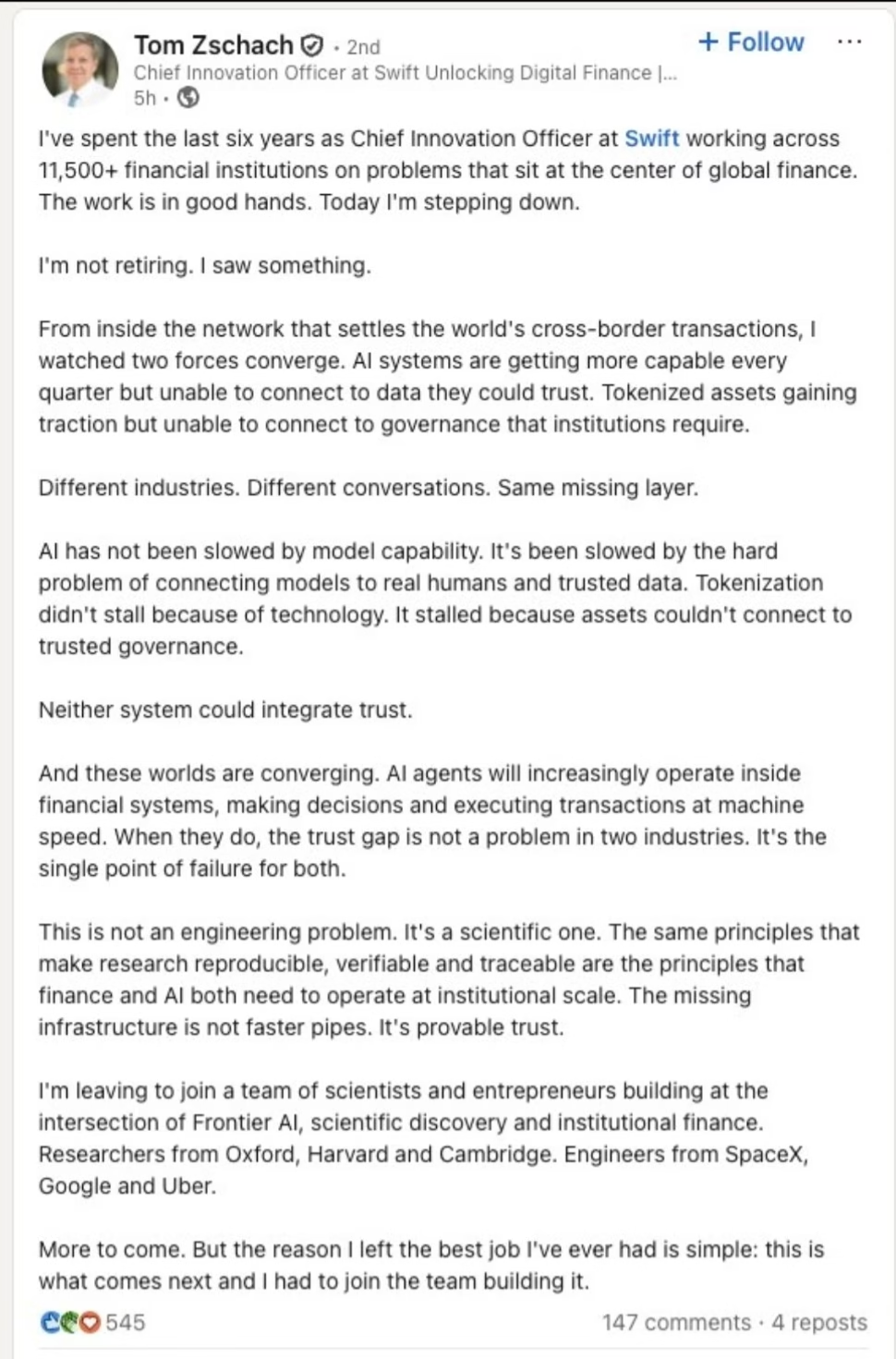
At the center of the SWIFT CIO resignation is what Zschach described as a “trust gap” affecting both artificial intelligence and financial systems. In his resignation letter, he emphasized that technological limitations are not the primary barrier to innovation.
“AI has not been slowed by model capability,” — Tom Zschach, Chief Innovation Officer, SWIFT.
“It’s been slowed by the hard problem of connecting models to real humans and trusted data.”
He extended this argument to tokenization, noting that progress has stalled not because of technical shortcomings but due to governance challenges.
“Tokenization didn’t stall because of technology. It stalled because assets couldn’t connect to trusted governance,” — Tom said
According to Zschach, this lack of a unified trust layer could have far-reaching consequences. He warned that as AI agents begin to operate within financial systems executing transactions and making decisions autonomously the absence of trust infrastructure could become a systemic risk.
The SWIFT CIO resignation thus reflects a broader concern about how emerging technologies integrate with existing financial systems, particularly in areas where trust and verification are critical.
Following the SWIFT CIO resignation, Zschach revealed plans to join a team of scientists and entrepreneurs working at the convergence of frontier AI, institutional finance, and scientific discovery. The group includes researchers from leading academic institutions and engineers from major technology companies.
“I’m not retiring. I saw something,” — Tom Zschach, former Chief Innovation Officer, SWIFT.
His decision signals a pivot away from traditional financial infrastructure toward experimental and research-driven innovation. Notably, this move contrasts with his earlier position that traditional finance would ultimately absorb emerging technologies rather than be disrupted by them.
“The reason I left the best job I’ve ever had is simple: this is what comes next, and I had to join the team building it,” — Tom Zschach, former Chief Innovation Officer, SWIFT.
The SWIFT CIO resignation could influence how both legacy institutions and fintech innovators approach collaboration, particularly as lines between AI, blockchain, and financial services continue to blur.
The SWIFT CIO resignation may have broader implications for the global financial ecosystem. As one of the most prominent figures in SWIFT’s innovation strategy exits, questions arise about the organization’s future direction in a rapidly evolving technological landscape.
Zschach’s departure also highlights a growing trend: senior leaders within traditional finance are increasingly exploring opportunities in emerging technology sectors. This movement suggests that innovation may no longer be confined within established institutions but could increasingly occur in interdisciplinary environments.
At the same time, the SWIFT CIO resignation reinforces ongoing debates about governance, trust, and infrastructure in financial systems. While SWIFT has long emphasized centralized coordination, blockchain proponents continue to advocate for decentralized alternatives.
Ultimately, the SWIFT CIO resignation serves as a reflection of a financial industry in transition—one grappling with how best to integrate transformative technologies while maintaining stability and trust.



Copyright © 2025 - The Bit Gazette.