

- Trending
- Comments
- Latest

Imagine buying Apple stock without opening a brokerage account, in seconds, from anywhere in the world. Synthetic assets make this possible. They’re blockchain tokens that track real-world asset prices, currencies, stocks, commodities, letting users access global markets directly through DeFi protocols without intermediaries or KYC delays.
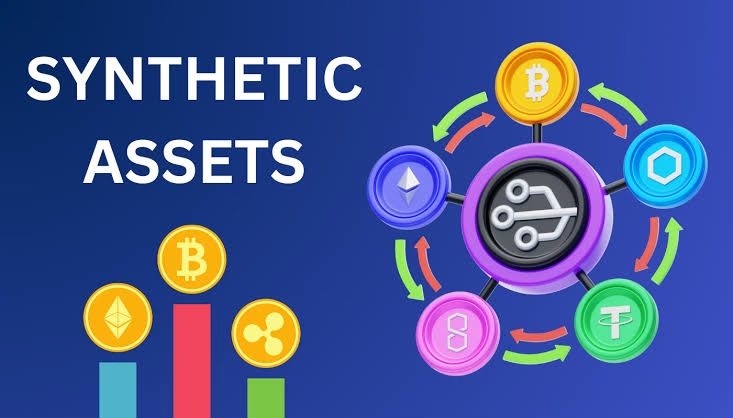
Synthetic Assets are digital tokens whose value is derived from another asset. Instead of buying gold or a stock, users hold a token that tracks its price.
These assets rely on smart contracts and collateral systems. Users lock crypto assets into a protocol, which then issues Synthetic Assets pegged to external values. Price oracles feed real-time data to maintain accuracy.
This model is closely tied to the broader DeFi infrastructure. For example, TheBitGazette recently reported how the Compound Foundation expanded collateral options with new stablecoins highlighting how on-chain assets are increasingly used to simulate real-world financial exposure.
The mechanics behind Synthetic Assets revolve around three components: collateral, smart contracts, and price feeds. Users deposit collateral, and the system mints tokens representing the synthetic value.
These systems depend heavily on liquidity and stable pricing mechanisms. TheBitGazette’s coverage of Solana’s expanding stablecoin ecosystem shows how diverse digital assets now act as financial building blocks, supporting trading, lending, and synthetic exposure.
As liquidity deepens, Synthetic Assets become easier to create and trade, enabling more complex financial strategies onchain.
“Stablecoins are highlighting inefficiencies in existing financial systems,” said Eswar Prasad, pointing to how digital assets are reshaping finance.
One major use of Synthetic Assets is market access. Users in regions with limited financial infrastructure can gain exposure to global assets without traditional brokers.
Another use case is capital efficiency. Instead of selling crypto holdings, users can lock them as collateral and mint Synthetic Assets to access liquidity or hedge positions.
This aligns with broader DeFi trends. As TheBitGazette reported, protocols like Compound are expanding collateral frameworks to increase flexibility and participation conditions that directly support the growth of Synthetic Assets.
The main advantage of Synthetic Assets is accessibility. They remove intermediaries and open global markets to anyone with internet access.
However, risks remain. These include smart contract failures, oracle inaccuracies, and liquidity shocks. If the system fails to maintain collateral ratios, Synthetic Assets can lose their peg.
Regulatory scrutiny is also increasing, as these instruments resemble traditional derivatives.
Synthetic Assets are reshaping how value is accessed and traded, but they require strong infrastructure and informed participation. As DeFi matures, their role will likely expand but so will the need for caution.



Copyright © 2025 - The Bit Gazette.