






- Trending
- Comments
- Latest

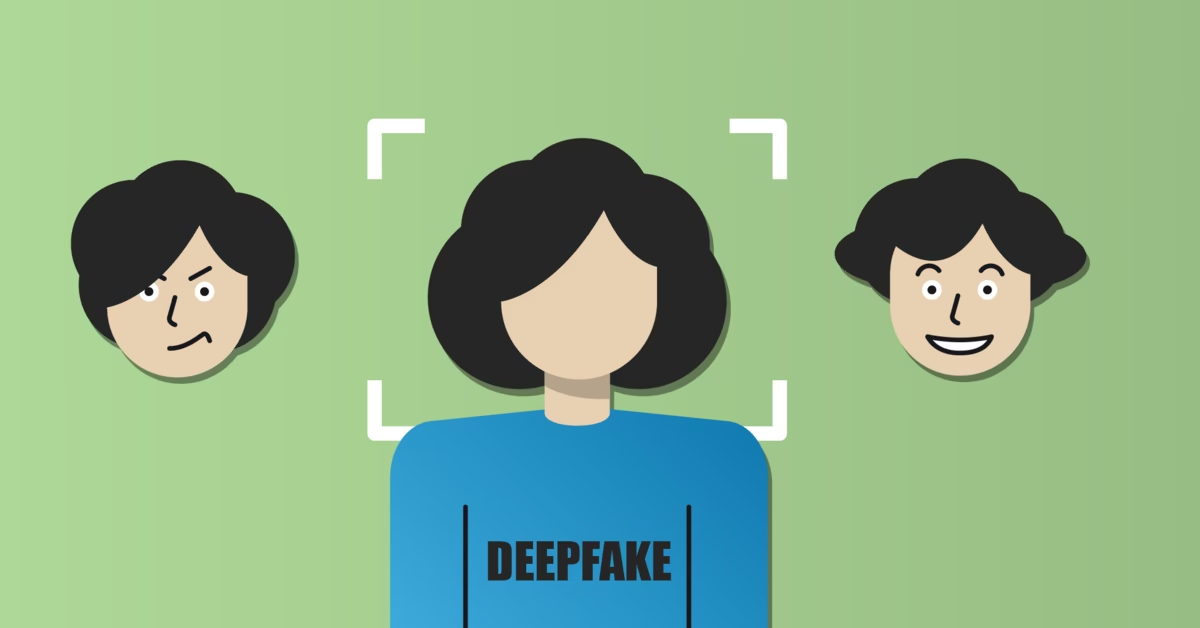
Crypto security has always been a game of cat and mouse. From phishing links to smart contract exploits, attackers evolve as quickly as the technology itself.
But a new threat is emerging that changes the rules entirely as one that doesn’t target code first, but people.
Artificial intelligence, particularly deepfake technology, is rapidly becoming one of the most dangerous tools in a scammer’s arsenal.
By replicating voices, faces, and identities with alarming accuracy, attackers can now bypass one of the strongest defenses in crypto: human judgment.
This shift marks a turning point. The weakest link in crypto security is no longer just technical as it is psychological.
Traditional crypto scams rely on deception at a surface level which is fake websites, misleading links, or impersonation through text. These attacks work, but they require users to make obvious mistakes.
Deepfakes remove that friction.
With AI-generated video and voice cloning, attackers can:
The result is a new class of scams where victims are not tricked by poor imitations as they are convinced by realistic ones.
Crypto ecosystems are uniquely exposed to deepfake attacks for several reasons:
1. Irreversible Transactions
Once funds are sent, they are gone. There is no chargeback system, no central authority to reverse mistakes.
2. High-Value Targets
Wallets often hold significant value, making them attractive targets for sophisticated attackers.
3. Pseudonymous Environment
Identity verification is limited. Trust is often built through online personas, which can now be replicated using AI.
4. Culture of Speed
Crypto markets move fast. Users are conditioned to act quickly which is a behavior that deepfake scams exploit.
Together, these factors create an environment where a single moment of misplaced trust can lead to irreversible loss.
Deepfakes represent an evolution of social engineering from manipulation to simulation.
Instead of pretending to be someone, attackers can now become them convincingly enough to bypass skepticism.
Common attack scenarios include:
These attacks work because they exploit familiarity. When users believe they are interacting with someone they trust, they lower their guard.
Unlike traditional scams, deepfake attacks do not rely on obvious red flags.
Even experienced users can struggle to distinguish real from fake in high-pressure situations.
And as AI models improve, detection becomes even harder. What is convincing today will look primitive compared to what is possible tomorrow.
One of the most dangerous aspects of AI-driven scams is scalability.
Previously, high-quality scams required time, effort, and skill. Now, AI tools can:
This turns targeted attacks into mass operations. Scammers no longer need to choose between quality and quantity as they can have both.
Most crypto security advice focuses on:
While still important, these measures do not address deepfake threats.
Because the attack happens before the transaction at the decision-making stage.
If a user is convinced to send funds willingly, even the most secure wallet cannot prevent the loss.
The rise of deepfake-driven attacks signals a shift from technical security to behavioral security.
Future protection will likely depend on:
In other words, the solution to AI-driven scams may also require AI.
But even then, the arms race will continue.
As crypto infrastructure becomes more secure, attackers are moving up the stack from code to cognition.
The battlefield is no longer just wallets and smart contracts. It is:
Deepfakes exploit these layers with precision, turning everyday interactions into potential attack vectors.
If you can no longer trust what you see or hear online, how do you verify anything in a decentralized world?
Because in the age of AI, the most secure wallet in crypto may not be the one with the strongest encryption but the one behind the most skeptical user.



Copyright © 2025 - The Bit Gazette.

