






- Trending
- Comments
- Latest

Reality Labs, Meta Platforms’ division built to carry the weight of Mark Zuckerberg’s virtual-world ambitions, posted losses of $13.7 billion in 2022, $16.1 billion in 2023, $17.7 billion in 2024, and $19.1 billion in 2025. In just a few years, the company burned through more than $80 billion chasing a vision that never fully arrived.
Its flagship platform, Horizon Worlds, never became the digital society it promised. While Roblox scaled into a global ecosystem with tens of millions of daily users, Horizon Worlds struggled to sustain meaningful activity. The gap wasn’t just numerical — it was cultural. One became a place people lived. The other remained a place people visited once.
By 2024, Meta had quietly stopped emphasizing the word “metaverse” altogether. Strategy calls shifted. Language changed. Even product decisions grew uncertain — including a brief removal of Horizon Worlds from VR before a rapid reversal.
The metaverse didn’t collapse in a dramatic failure. It faded. Slowly, expensively, and in full view.But something else was already taking its place.
The metaverse was built on a simple premise: leave reality behind.
The Reality Casino is built on the opposite idea: stay and let reality be redesigned around you.
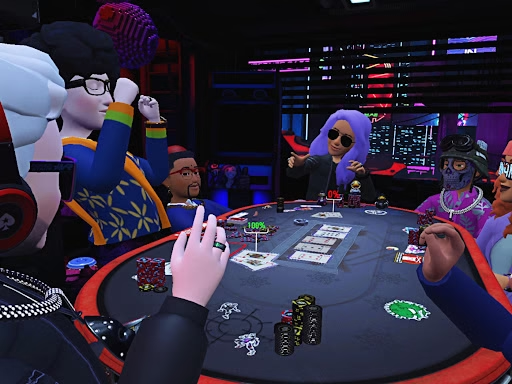
The metaverse asked users to log into another world. The Reality Casino removes the boundary entirely, layering digital systems directly onto physical life.
This is its defining principle:
The Reality Casino is a system where digital layers are engineered to continuously extract attention, emotion, and money from real-world environments.
It doesn’t transport you. It modifies your surroundings.
It doesn’t replace reality. It monetizes it.
The shift is already visible — not as a single product, but as a pattern.
On a morning commute, someone wearing the Apple Vision Pro watches a coral reef bloom in midair, superimposed over a crowded train. He isn’t escaping the world. He’s inhabiting two versions of it at once — the physical and the engineered.
Elsewhere, AI companion platforms like Replika and Character.AI simulate emotionally responsive relationships. They remember, adapt, and respond with calibrated warmth — not necessarily to deepen connection, but to sustain engagement.
Social platforms have already made the transition. Chronological timelines have been replaced by algorithmic loops — systems optimized to remove every natural stopping point. You don’t decide when to leave. The system decides how long you stay.
Across all these systems, the logic is the same: mimic human needs, then optimize them for retention.
Connection becomes engagement.
Curiosity becomes scrolling.
Presence becomes screen time.
A casino doesn’t create wealth. It creates the sensation of almost winning.
The Reality Casino doesn’t create fulfillment. It creates the feeling of almost having it.
The consequences are subtle- and that’s what makes them dangerous.
Research from institutions like the The University of Minnesota suggests that prolonged interaction with emotionally responsive AI systems can shift behavior over time. Users don’t necessarily feel worse. Instead, they begin to find human relationships more difficult — less predictable, less efficient, less immediately rewarding.
In other words, the baseline changes.
In workplaces, augmented reality systems designed to improve efficiency have introduced a different kind of tradeoff. Workers guided by overlays become faster — but also more narrowly focused. Researchers describe this as “cognitive tunneling”: attention becomes so optimized for tasks that awareness of the surrounding environment diminishes.
Efficiency increases and awareness decreases.
And in some cases, those two outcomes are directly in conflict.
What makes the Reality Casino difficult to regulate is that it doesn’t fit into existing categories.
It is not just a device.
Not just a platform.
Not just a marketplace.
It is all of them at once. Embedded directly into lived experience. And because it operates across these boundaries, it avoids the frameworks designed to control them.
You cannot regulate what you cannot clearly define.
Back on the subway, the man in the headset reaches his stop.
The train slows. The doors open. For a brief moment, everyone shares the same physical space — the same light, the same air, the same reality.
Then he steps out.
And whatever world he is inhabiting moves with him.The metaverse failed because people didn’t want to leave reality.
The Reality Casino succeeds because it never asks them to.
It is already here. Quietly redesigning the world, one layer at a time, making it harder to tell where reality ends and the system begins… and harder still to ever look away.



Copyright © 2025 - The Bit Gazette.