
- Trending
- Comments
- Latest

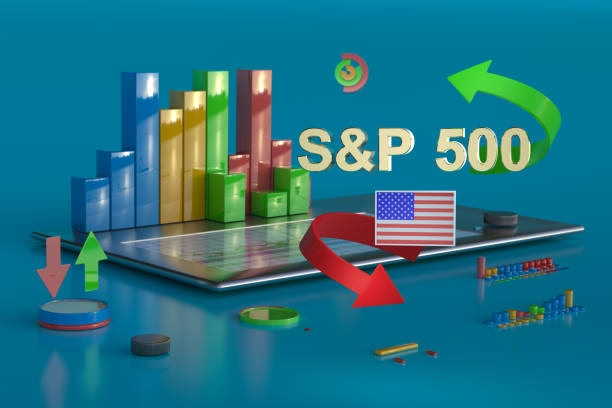
The story of crypto versus traditional finance was always framed as disruption. But what is actually happening looks more like absorption, and the gradual move to bring S&P 500 exposure on-chain may be the clearest evidence yet that blockchain’s biggest winner will be the system it was supposed to replace.
This is not happening loudly. There are no dramatic announcements or singular turning points. But beneath the surface, a structural transformation is underway which is one that could redefine how markets operate without appearing to change them at all.
The S&P 500 is not a single asset as it is an index representing the performance of 500 of the largest publicly traded companies. Traditionally, exposure to the index comes through ETFs, mutual funds, or derivatives.
Moving “on-chain” does not mean replacing the S&P. It means recreating access to it using blockchain infrastructure.
This can take several forms:
In each case, the goal is the same: make traditional market exposure available within blockchain systems.
Traditional finance is not adopting blockchain out of ideology as it is doing so out of necessity.
1. Demand for 24/7 Markets
Crypto markets operate continuously. Investors increasingly expect the same from all assets.
2. Faster Settlement
Traditional equity trades can take days to settle. Blockchain reduces this to minutes or seconds.
3. Global Accessibility
On-chain assets can be accessed by anyone with an internet connection, bypassing geographic and regulatory barriers (to some extent).
4. Programmability
Financial products can be automated, combined, and integrated into broader digital systems.
These advantages are too significant to ignore.
The common assumption is that blockchain will disrupt traditional finance. But what is actually happening looks more like absorption.
Instead of:
We are seeing:
This allows institutions to:
In this model, blockchain becomes a backend upgrade, not a front-end revolution.
This is where the idea of a “silent checkmate” emerges.
If traditional finance successfully brings assets like the S&P on-chain:
In effect, it neutralizes the threat of disruption by incorporating it.
Crypto does not overthrow the system, it upgrades it.
This shift is not one-sided. Crypto benefits in several ways:
But there are trade-offs:
As TradFi moves on-chain, the ecosystem becomes more integrated but also more controlled.
While headlines focus on tokens and prices, the real battle is happening at the infrastructure level.
Key questions include:
If traditional institutions dominate on-chain infrastructure, they may shape the future of finance in ways that look familiar even if the technology is new.
Unlike major market events, this transformation is gradual.
There is no single moment where the S&P “goes on-chain.” Instead, it happens in layers:
Each step seems small. But together, they add up to a fundamental shift.
A Hybrid Financial System Is Emerging
The end result is not a replacement of traditional finance or a purely decentralized alternative.
It is a hybrid system:
This model combines the strengths of both systems but also their limitations.
If traditional finance can adopt blockchain without giving up control, was disruption ever really the goal?
Because if the S&P can move on-chain without changing who owns or governs it, then the real transformation may not be about power but about efficiency.
And in that case, the winners may not be the ones who tried to replace the system…
…but the ones who quietly upgraded it.



Copyright © 2025 - The Bit Gazette.