

- Trending
- Comments
- Latest

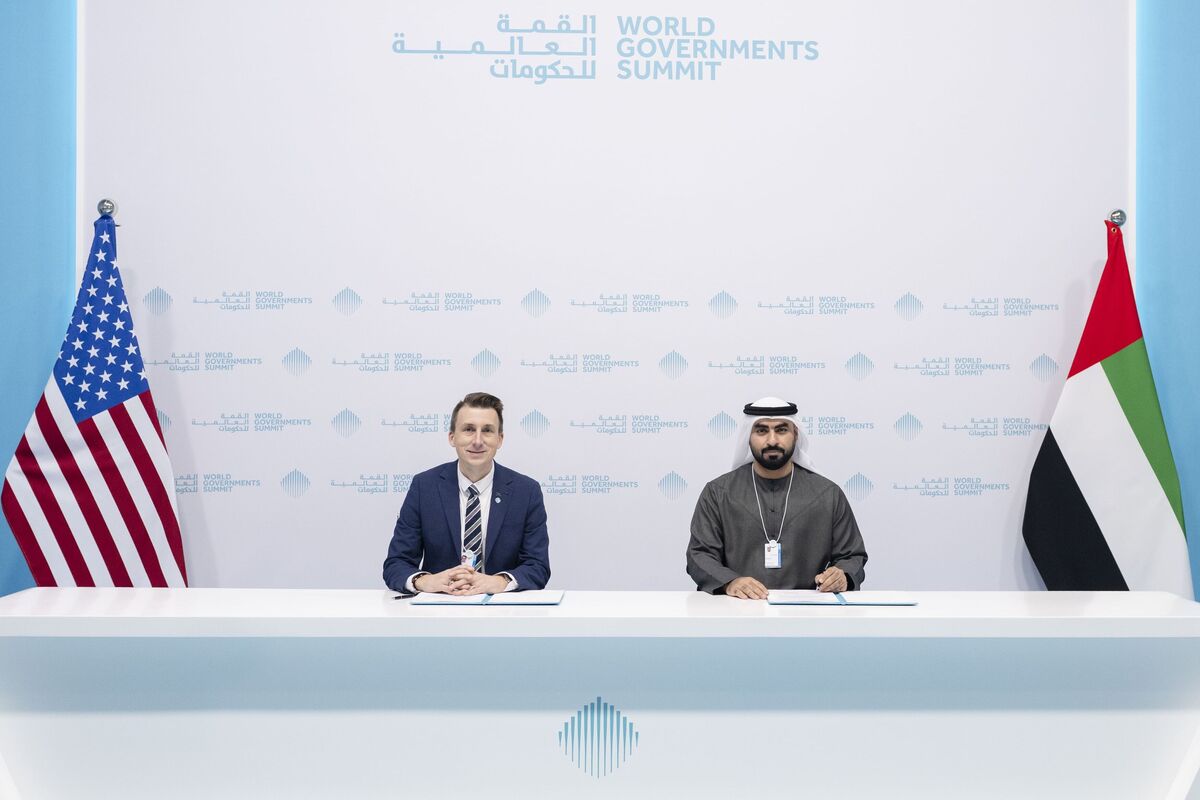
The United Arab Emirates announced a partnership with SpaceX’s Starlink on Tuesday at the World Governments Summit in Dubai to provide satellite internet to 100 remote schools worldwide, with a focus on underserved communities across Africa.
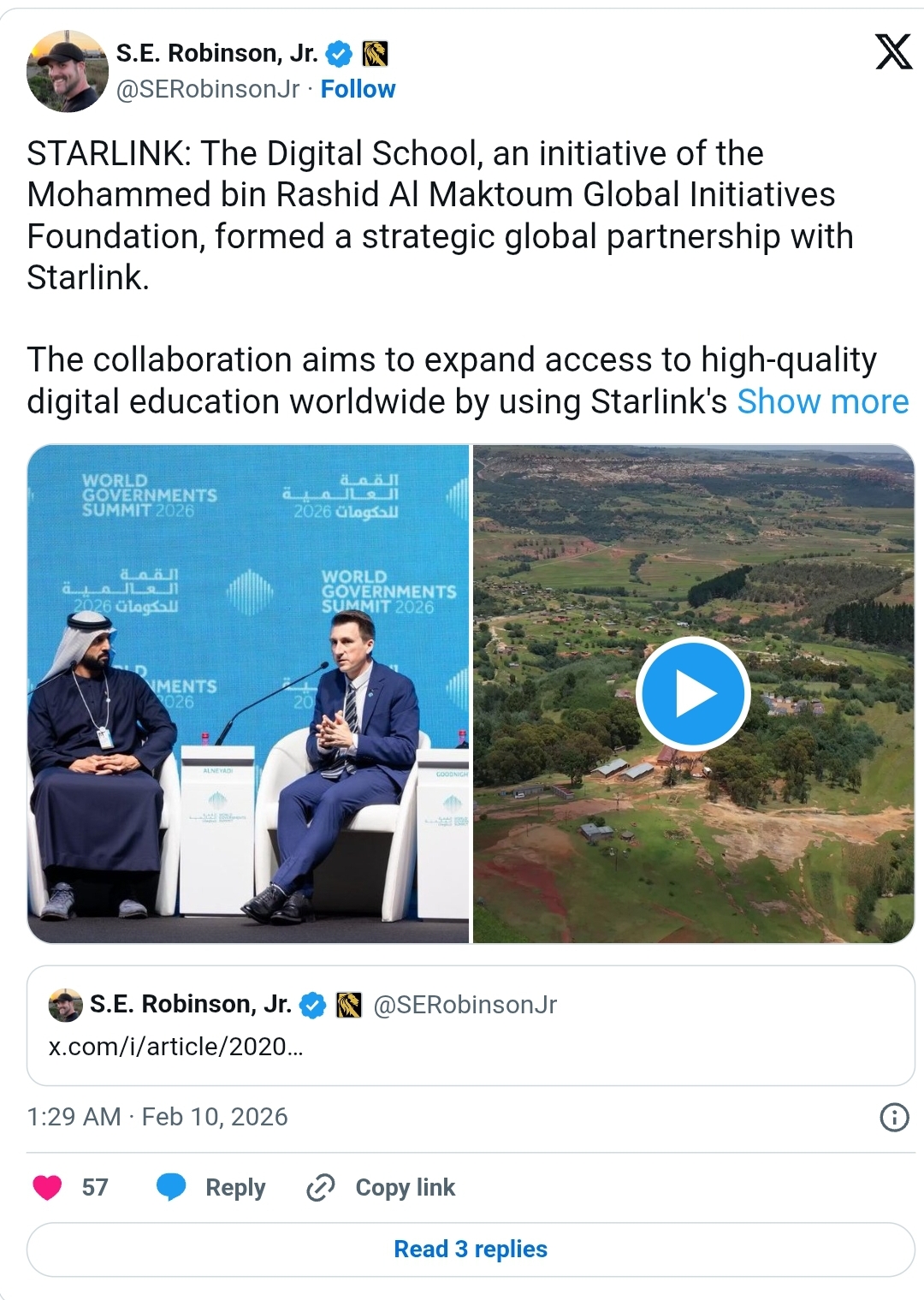
The initiative will integrate Starlink’s low-Earth-orbit satellite network into The Digital School, an education program operating under the Mohammed bin Rashid Al Maktoum Global Initiatives Foundation, to deliver online curriculum and teacher training to geographically isolated regions lacking traditional broadband infrastructure.
The UAE-Starlink Digital Education Partnership was formally introduced during a World Governments Summit session featuring Ryan Goodnight, Senior Director of Starlink Market Access and Development at SpaceX, and Emirati astronaut Dr. Sultan bin Saif Al Neyadi.
In remarks delivered at the event, Goodnight said Starlink would support initiatives aimed at expanding digital access for students in underserved communities.
“Starlink will support efforts to expand digital access for young students in underserved communities,” — Ryan Goodnight, Senior Director of Starlink Market Access and Development, SpaceX.
The collaboration integrates satellite-based connectivity into The Digital School’s hybrid education model, which combines remote instruction with localized classroom environments.
By relying on satellite internet rather than ground-based broadband infrastructure, the UAE-Starlink Digital Education Partnership is structured to operate in regions where terrestrial networks remain limited or entirely unavailable.
Omar Sultan Al Olama confirmed that satellite connectivity would become part of the program’s global education framework, underscoring the government’s broader digital transformation agenda. The initiative aligns with long-term sustainability goals tied to educational infrastructure development and equitable access to digital tools.
Financial terms and a detailed rollout schedule were not disclosed during the summit. However, officials confirmed that the first phase of the UAE-Starlink Digital Education Partnership will prioritize schools in remote areas where connectivity constraints have historically limited curriculum delivery and teacher support programs.
The UAE-Starlink Digital Education Partnership builds on Starlink’s expanding global footprint. SpaceX’s satellite internet network currently comprises more than 9,000 satellites in orbit, serving an estimated 9 million users worldwide.
Recent Falcon 9 launches from California and Florida have deployed additional satellite batches to strengthen network capacity. In parallel, India’s Gujarat state signed a letter of intent with SpaceX to expand satellite internet services to underserved and border areas, following similar agreements in Maharashtra and Goa
Officials involved in the initiative emphasized that connectivity remains a foundational requirement for effective digital learning. Without reliable internet access, remote instruction platforms, digital coursework, and teacher training modules cannot operate at scale. The UAE-Starlink Digital Education Partnership therefore positions connectivity not as a standalone objective but as an enabler of long-term educational access.
The announcement of the UAE-Starlink Digital Education Partnership comes amid broader strategic developments within Musk’s companies. SpaceX is preparing for NASA’s Crew-12 mission to the International Space Station, scheduled for launch no earlier than February 12 next year from Cape Canaveral Space Force Station.
Meanwhile, SpaceX recently confirmed it was acquiring artificial intelligence firm xAI, also owned by Musk. The combined entity is estimated to hold a valuation of approximately $1.25 trillion, with SpaceX valued at roughly $1 trillion and xAI at about $250 billion. Musk is estimated to own approximately 43% of the merged organization.
In a separate strategic update, Musk stated that SpaceX is prioritizing development of a self-growing lunar city over near-term Mars missions, citing faster launch cycles and shorter travel times to the Moon.
“We’re prioritizing the development of a self-growing lunar city over near-term Mars missions,” — Elon Musk.
The education-focused agreement with the UAE unfolds against this backdrop of expanding space infrastructure and artificial intelligence consolidation. While the UAE-Starlink Digital Education Partnership centers on connectivity for schools, it also highlights the increasing intersection between national digital strategies and privately operated satellite networks.
For the UAE, the initiative represents a continuation of efforts to position itself as a global advocate for digital learning accessibility. For SpaceX, it marks another application of satellite internet beyond consumer broadband and commercial services.
As rollout details emerge, the UAE-Starlink Digital Education Partnership is expected to serve as a test case for satellite-enabled education delivery in regions where connectivity gaps have long hindered classroom modernization.



Copyright © 2025 - The Bit Gazette.