




- Trending
- Comments
- Latest


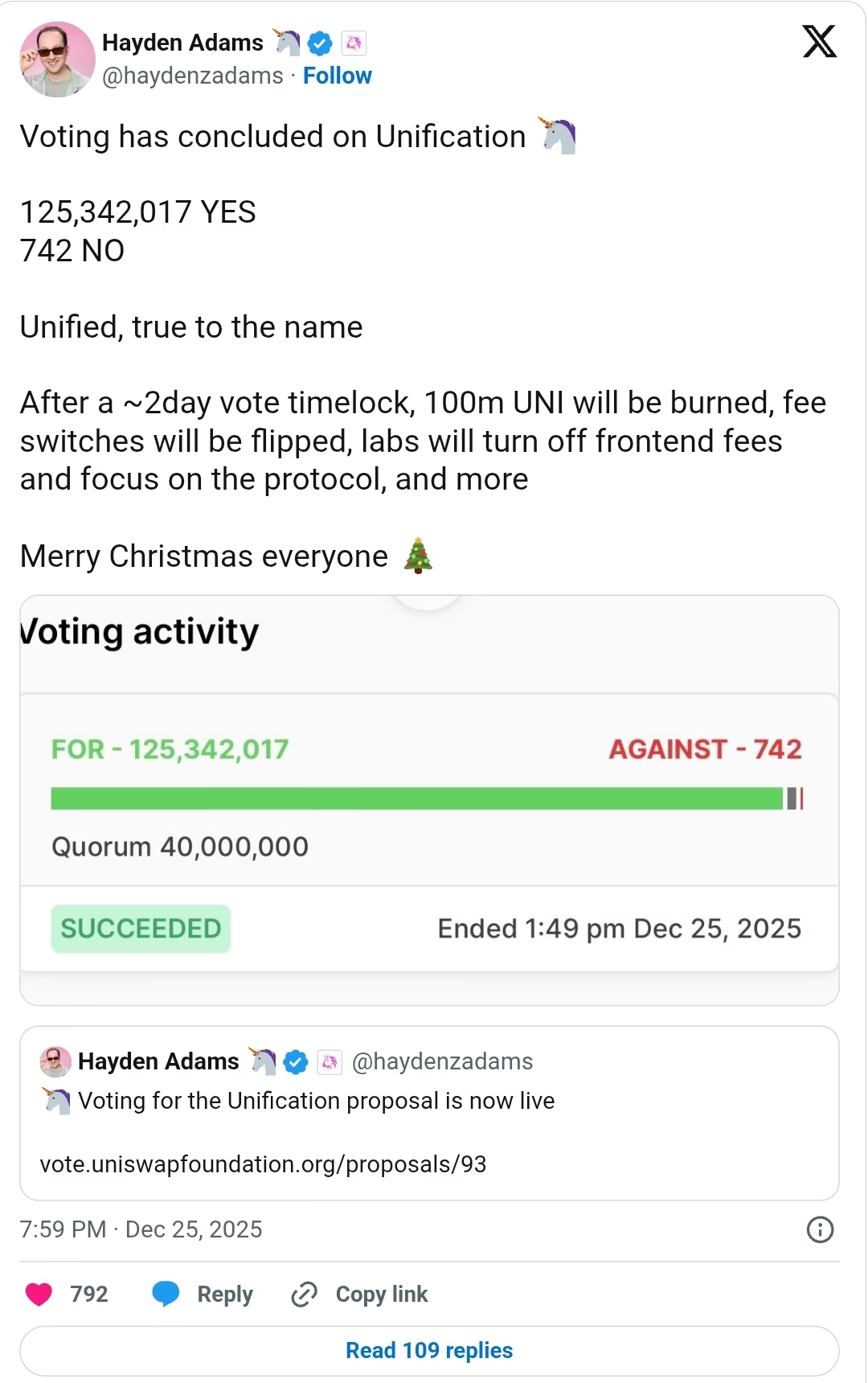
Uniswap governance voted 99.9% in favor of activating the protocol’s long-dormant fee switch on Thursday, a historic decision that will redirect a portion of trading fees to continuously burn UNI tokens and fundamentally reshape the decentralized exchange’s economics.
More than 125 million UNI tokens supported the measure—with just 742 voting against—setting the stage for an initial burn of 100 million tokens and establishing a permanent deflationary mechanism tied to trading volume.
The protocol has generated over $1.05 billion in fees this year, volume that will now feed directly into supply reduction.
The decision carries implications not only for crypto investors tracking token economics, but also for policymakers watching how major DeFi protocols evolve amid shifting regulatory conditions.
At its core, the Uniswap UNIfication proposal activates the long-discussed protocol fee switch, a mechanism that had remained dormant since UNI’s launch. Under the new framework, a share of trading fees—previously paid entirely to liquidity providers—will now flow to the protocol and be used to burn UNI tokens on a continuous basis.
Net sequencer fees generated on Unichain will also be routed into the same burn mechanism. Together, these changes establish a direct link between platform activity and supply reduction: as trading volume increases, more UNI is permanently removed from circulation.
The economic shift is designed to align token value with protocol growth, a step many in DeFi have debated for years. By tying usage to scarcity, Uniswap is positioning UNI less as a purely governance token and more as an asset that reflects the exchange’s underlying performance.
Beyond fee mechanics, the Uniswap UNIfication proposal introduces structural changes aimed at simplifying governance and operations. The plan transitions Uniswap Foundation teams and responsibilities into Uniswap Labs, removes fees from Labs’ interface, wallet and API services, and establishes a recurring growth budget funded in UNI.
That budget is intended to support long-term development and ecosystem expansion rather than short-term incentive programs. Following approval, the proposal enters a two-day timelock, after which Uniswap will execute a one-time burn of 100 million UNI. The amount reflects an estimate of tokens that might have been burned had the fee switch been active since UNI’s inception.
The governance package also introduces a Protocol Fee Discount Auctions system to improve returns for liquidity providers, while aligning Uniswap Labs, the Foundation and on-chain governance under a single legal structure using Wyoming’s DUNA framework.
Several influential DeFi figures backed the measure, including Variant founder Jesse Waldren, Synthetix and Infinex founder Kain Warwick, and former Uniswap Labs engineer Ian Lapham, all of whom hold significant voting power.
Uniswap framed the Uniswap UNIfication proposal as timely, pointing to what it described as a shifting regulatory climate after years of pressure on decentralized finance during the tenure of former U.S. Securities and Exchange Commission Chair Gary Gensler.
In its governance materials, the protocol argued that DeFi has reached a level of maturity and acceptance that makes protocol-level value capture more viable.
“I believe Uniswap protocol can be the primary place tokens are traded,” — Hayden Adams, Founder, Uniswap, said, adding that the proposal “sets the stage for the next decade of its growth.”
Adams also confirmed the scale of support, noting that voting concluded with 99.9% approval. The result signals confidence among token holders that the redesigned economic model can coexist with regulatory scrutiny while sustaining growth.
In the hours following the vote, UNI traded at $5.92, up 18.9% over the past week, reflecting renewed investor interest as the Uniswap UNIfication proposal moves from governance to execution.
The protocol has already generated more than $1.05 billion in fees so far this year, a figure that highlights the volume of activity now feeding into its new burn-based model.



Copyright © 2025 - The Bit Gazette.

