







- Trending
- Comments
- Latest

U.S. Bitcoin and Ether ETFs posted combined inflows of $339 million on Tuesday, rebounding sharply after Monday’s $754 million in outflows as Federal Reserve Chair Jerome Powell signaled potential rate cuts by year-end.
Fidelity led the recovery with $287 million across its Bitcoin and Ethereum funds, while BlackRock’s Bitcoin ETF saw modest outflows of $31 million. The swift reversal suggests institutional investors view crypto ETFs as resilient vehicles despite last week’s tariff-driven volatility that triggered $20 billion in exchange liquidations.
Powell’s comments at the National Association for Business Economics conference—where he indicated the Fed may pause balance sheet reduction and consider rate cuts if labor markets soften—sparked renewed optimism in risk assets including cryptocurrencies.
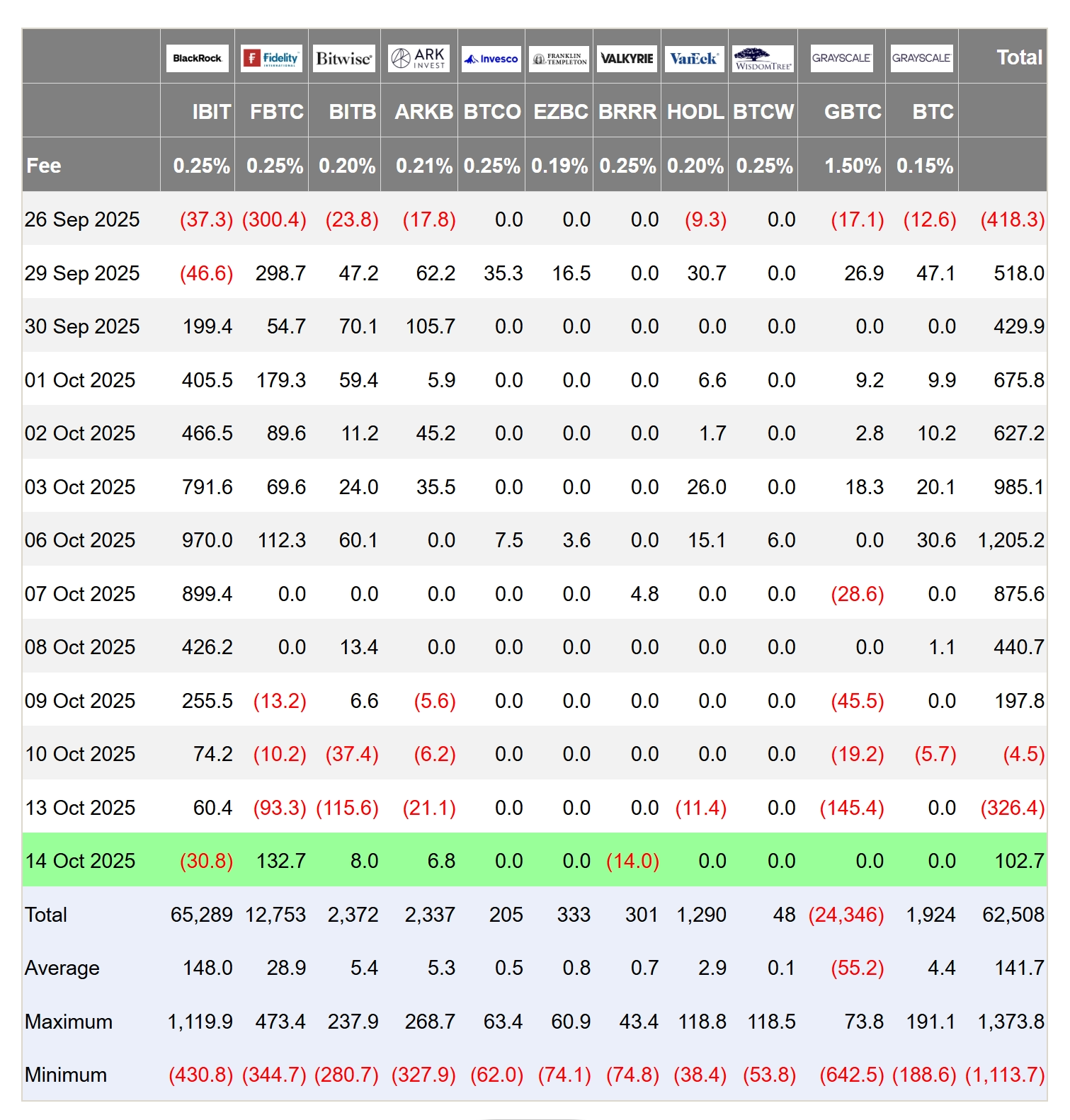
Spot Bitcoin ETFs saw net inflows of $102.58 million, marking a return to the market after $326 million in outflows the previous day.
Fidelity’s Wise Origin Bitcoin Fund led the way with $132.67 million, while BlackRock’s iShares Bitcoin Trust saw a modest $30.79 million in outflows. Total assets now stand at $153.55 billion, accounting for about 7% of Bitcoin’s market cap and reflecting rising investor confidence.
Ether ETFs also continued the trend, posting net inflows of $236.22 million after Monday’s $428 million in outflows. Fidelity’s Ethereum Fund led the way with $154.62 million, while Grayscale’s Ethereum Fund and Bitwise’s Ethereum ETF contributed $34.78 million and $13.27 million, respectively.
These figures show that investor confidence is also growing in Ether-focused ETFs.
Federal Reserve Chair Jerome Powell has signaled that the central bank may pause its balance sheet reduction and consider cutting interest rates if the labor market softens.
During his speech at the National Association for Business Economics conference, Powell said that current reserves are “somewhat above adequate levels,” which maintains liquidity in the market and provides a supportive environment for ETFs.
Vincent Liu, chief investment officer at Taiwan-based Chronos Research, said a potential October rate cut could trigger significant capital rotation into crypto ETFs.
“We’re likely to see a 20-30% increase in institutional allocations if the Fed cuts 25-50 basis points by year-end,” Liu told BeInCrypto. “Digital assets historically outperform traditional equities by 15-40% in the six months following rate cut cycles, based on 2019 and 2020 data.”
Despite last week’s market turmoil, crypto ETFs have held firm. According to CoinShares, $3.17 billion was invested even during the flash crash caused by the US-China tariff dispute.
This shows that investor confidence in Bitcoin and Ether ETFs remains intact. According to experts, these funds are becoming a reliable and safe way to access digital assets.
Despite the market turmoil and $20 billion in liquidations on exchanges on Friday, ETFs saw only $159 million in outflows. This shows the strength and stability of well-managed funds.
Bitcoin and Ether ETFs maintain investor confidence and can easily absorb market shocks, making them an attractive choice for cautious investors.
In 2025, investments in crypto ETFs exceeded $48.7 billion, exceeding last year’s total. This clearly shows the strong confidence of investors in Bitcoin and Ether ETFs.
Both retail and institutional investments are increasing, and analysts see this as a sign of market maturity and stability.
Investors must decide whether to pursue short-term gains or focus on long-term exposure. Bitcoin and Ether ETFs provide investors with regulated, convenient, and liquid access to crypto, and are suitable not only for retail
but also for institutional investors. Market timing and capital allocation are important factors, which play a key role in decision-making.
Despite strong recent inflows, several factors could reverse momentum:
Regulatory uncertainty: The SEC has yet to approve Ethereum staking for ETFs, limiting yield potential compared to direct token holding. Any regulatory crackdown on centralized exchanges could impact ETF liquidity.
Tariff escalation: Last week’s flash crash was triggered by 100% tariffs on Chinese imports. Further trade war escalation could drive risk-off sentiment, pressuring crypto alongside equities.
Bitcoin halving effects: With the next Bitcoin halving expected in 2028, some analysts warn that reduced miner selling pressure is already priced into current ETF valuations.
Competitor products: The potential approval of Bitcoin options on ETFs (pending CFTC review) could shift trader preference away from spot ETFs toward derivatives products.
James Seyffart, ETF analyst at Bloomberg Intelligence, notes that crypto ETFs face “tail risks” from exchange hacks, stablecoin de-peggings, or sudden regulatory changes that traditional ETFs don’t encounter.
The crypto ETF market’s resilience during last week’s $20 billion liquidation event—where ETFs saw just $159 million in Friday outflows compared to Monday’s $754 million—signals growing institutional conviction in regulated crypto vehicles.
If Powell follows through with rate cuts by December, analysts expect monthly inflows could reach $5-8 billion, potentially pushing total ETF assets under management above $200 billion by year-end.
However, much depends on macroeconomic stability. “We’re one geopolitical shock away from another drawdown,” warned Nate Geraci, president of The ETF Store. “These products are maturing rapidly, but they’re still tied to highly volatile underlying assets.”
For now, Tuesday’s $339 million rebound suggests the crypto ETF story is far from over—and may be just beginning.



Copyright © 2025 - The Bit Gazette.


