





- Trending
- Comments
- Latest

Major Wall Street trading firms including DRW and Susquehanna International Group are building dedicated prediction market teams and offering base salaries up to $200,000 for traders who can exploit pricing inefficiencies on platforms like Polymarket and Kalshi, which now handle more than $8 billion in monthly volume.
At the center of this shift are platforms like Polymarket and Kalshi, where contracts tied to sports outcomes, elections, economic data, and geopolitical events are now generating billions in monthly trading volume. What was once seen as a niche corner of finance is quickly becoming a new battleground for professional arbitrage.
Traders hired for a Wall Street prediction desk are not there to place directional bets on who will win an election or a championship. Instead, they are focused on split-second pricing discrepancies between contracts, platforms, and correlated markets—buying low on one venue and selling high on another, often within milliseconds.
Prediction markets gained mainstream attention during the 2024 U.S. presidential election, when traders flocked to event contracts as a real-time alternative to polls. Since then, both Polymarket and Kalshi have pivoted heavily toward sports-related markets, which offer frequent events, tighter spreads, and repeatable trading strategies.
The growth has been explosive. In early 2024, combined monthly trading volumes across major prediction platforms were below $100 million. By December 2025, that figure had surged past $8 billion, according to industry data. That liquidity spike is what finally made the Wall Street prediction desk economically viable at scale.
One of the most aggressive entrants is DRW, the Chicago-based trading firm founded by Don Wilson. DRW is offering base salaries of up to $200,000 for traders tasked with monitoring Polymarket and Kalshi in real time. Job listings explicitly reference the creation of a “dedicated prediction markets desk,” underscoring how central the strategy has become.
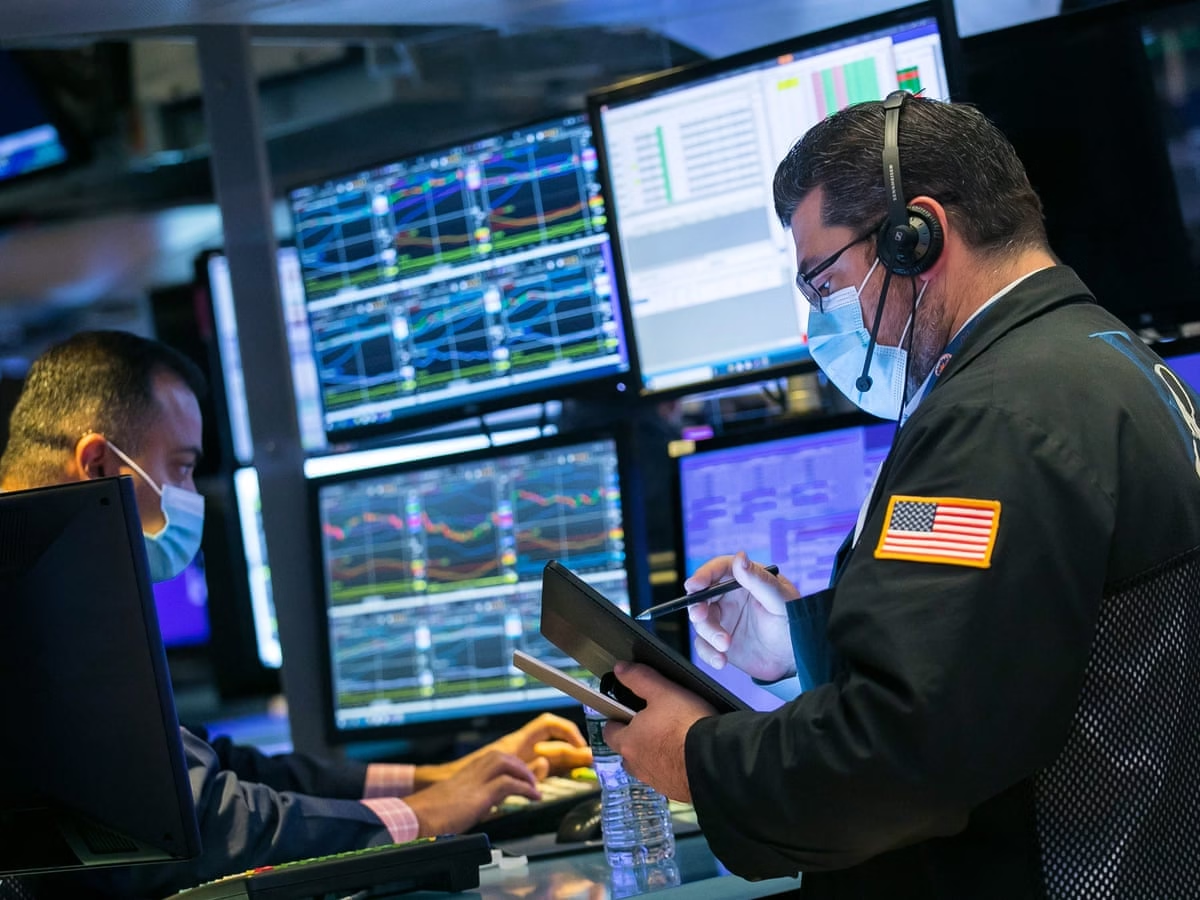
Susquehanna International Group, already well known for its sports trading operations, is also expanding its Wall Street prediction desk footprint. The firm is seeking traders capable of identifying “incorrect fair values,” spotting abnormal market behavior, and capitalizing on inefficiencies before they close.
“They want people who can read noise and turn it into edge,” said Madison Zitzner, vice president of quantitative research and proprietary trading at Selby Jennings. “Firms are clearly in growth mode when it comes to prediction markets. They really want to understand the liquidity and scalability these strategies can bring.”
Crypto-focused funds are also getting involved. Tyr Capital, a hedge fund with deep digital-asset roots, is recruiting experienced traders already running advanced strategies. The firm is not interested in training newcomers.
“We’re extremely bullish on prediction markets’ prospects, especially around monetary policy and macroeconomic data over the coming years,” said Ed Hindi, chief investment officer at Tyr Capital.
The institutional stampede is not limited to established firms. New players like Kirin and Anti Capital in New York, crypto investor Sfermion in Chicago, and Switzerland-based G-20 Advisors are actively hiring.
G-20 is searching for a quantitative engineer to design models that estimate probabilities, detect mispricing, and manage risk—core functions of a modern Wall Street prediction desk.
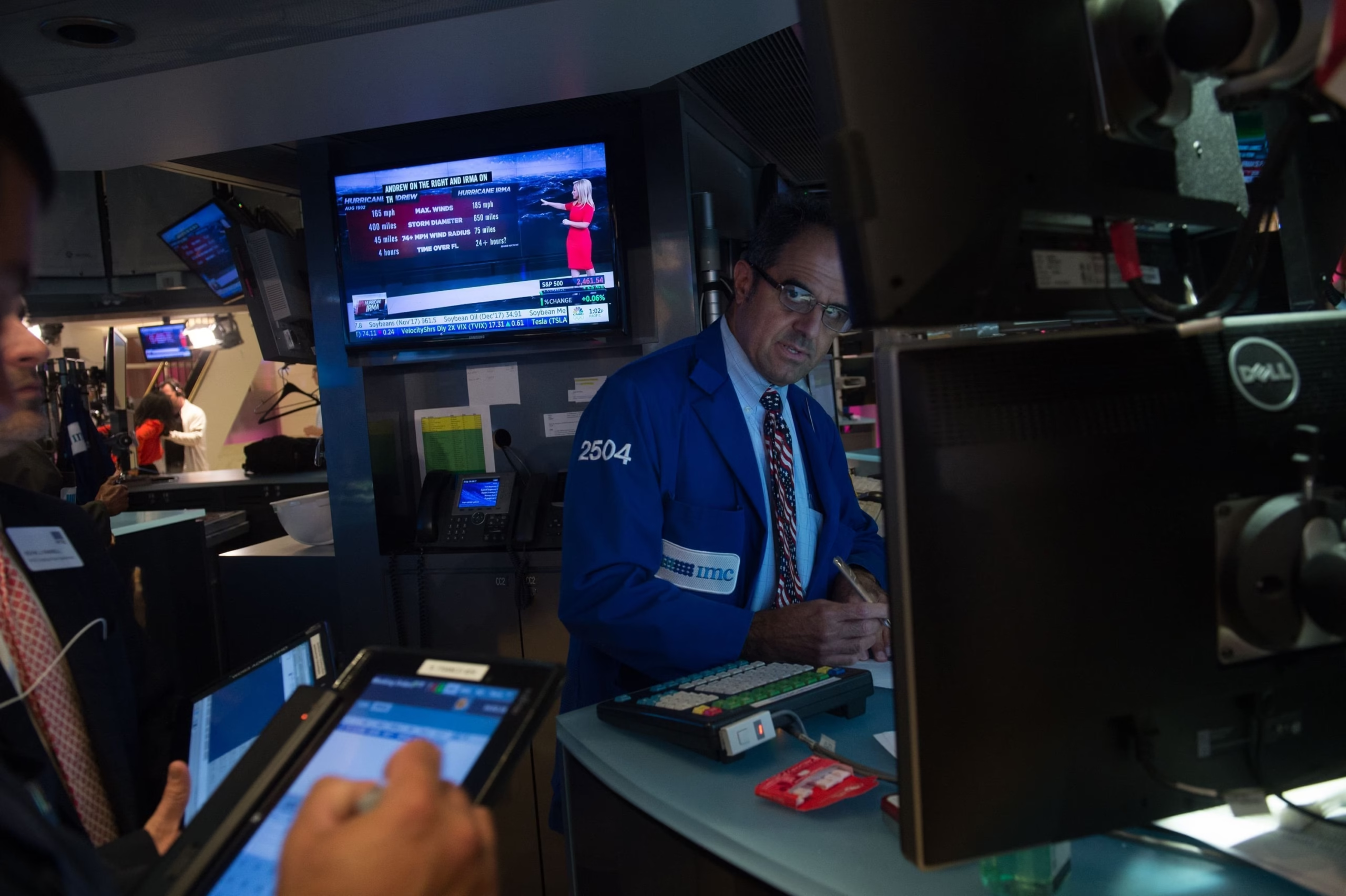
Despite the growing activity, analysts emphasize that this is not speculative gambling. Most firms avoid novelty contracts, such as celebrity awards or unlikely geopolitical hypotheticals. Instead, they focus on pure arbitrage, similar to high-frequency trading in equities or futures.
“The big guys are trading one market against another,” said Joseph Saluzzi, co-founder of Themis Trading. “They’re not throwing darts at a dartboard. In a market this new and fragmented, there are massive arbitrage opportunities.”
Not everyone is rushing in. Liquidity remains a concern for larger hedge funds accustomed to deploying billions of dollars. While prediction markets are growing fast, they remain small compared to traditional asset classes.
Boaz Weinstein, founder of Saba Capital, addressed the topic at a closed-door conference in October, highlighting prediction markets’ potential as hedging tools. Standing alongside Polymarket CEO Shayne Coplan, Weinstein pointed to striking discrepancies between markets.
“At one point, Polymarket was pricing a 50% chance of a recession, while credit markets implied closer to 2%,” he said. “That opens up an infinite number of pair trades you simply couldn’t do before.”
Still, a person familiar with Saba’s strategy said the firm has so far limited its involvement to observation rather than active deployment, citing liquidity constraints.
Market makers, however, are less cautious. Susquehanna, led by Jeff Yass, was Kalshi’s first official market maker and also partners with Robinhood on event-based contracts.
Kalshi offers market makers preferential terms, including lower fees and higher trading limits, though details remain private. Jump Trading and Amsterdam-based Flow Traders are also scaling up their Wall Street prediction desk operations.
As money flows in, scrutiny is increasing. In recent months, traders on Polymarket have drawn attention for highly profitable bets tied to sensitive geopolitical events and high-profile announcements. These incidents have raised questions about information asymmetry and insider access.
In response, U.S. Representative Ritchie Torres has proposed legislation that would prohibit insiders from trading on prediction markets. The bill would bar individuals with non-public information from engaging in “covered transactions involving prediction market contracts.”
As regulation catches up, firms are betting that professionalized trading infrastructure and compliance will give institutional players an edge. For now, the rise of the Wall Street prediction desk signals that prediction markets are no longer a fringe experiment—they are becoming a serious component of modern financial trading.



Copyright © 2025 - The Bit Gazette.