






• Trending
  • Comments
  • Latest
AI People joins Dubai’s innovation one — Declares war on the forgetting of humanity

AI People joins Dubai’s Innovation One program: Declares war on the forgetting of humanity

07/22/2025 - Updated On 07/23/2025
FBI nabs Nigerian ‘tech queen’ Sapphire Egemasi in multi-million dollar fraud scheme

FBI arrests Nigerian ‘tech queen’ Sapphire Egemasi in $1.3M heist targeting U.S. government

06/05/2025 - Updated On 06/17/2025
Crypto investor and wife found dead in Dubai as police investigate possible link to digital assets

Crypto investor and wife found dead in Dubai as police investigate possible link to digital assets

11/08/2025
Polygon Discord Channel Hacked, Throws Crypto Community in Turmoil

Polygon Discord Channel Hacked, Throws Crypto Community in Turmoil

2
Bitcoin reclaims $107,000 as Iran-Israel ceasefire cools market tensions

Bitcoin reclaims $107,000 as Iran-Israel ceasefire cools market tensions

2

Hello world!

1
Wyoming Crypto Bank petition headlines a rapidly intensifying legal confrontation that could reshape how crypto banks access the U.S. financial system. Wyoming-chartered Custodia Bank has formally petitioned the full Tenth Circuit Court of Appeals to review the Federal Reserve’s denial of its master account, escalating a five-year fight with sweeping implications for federal power, state banking authority, and digital asset innovation. Wyoming Crypto Bank petition filings submitted on December 15 request an en banc review, asking all active judges on the Tenth Circuit to reconsider an October panel ruling that upheld the Fed’s decision. Custodia argues the panel misread federal law and endorsed a system that grants regional Federal Reserve Banks unchecked discretion over legally eligible state-chartered institutions. Wyoming Crypto Bank Petition Challenges Fed’s Master Account Authority At the heart of the Wyoming Crypto Bank petition is the Federal Reserve’s refusal to grant Custodia access to a master account—an essential gateway to core payment rails such as wire transfers and automated clearinghouse (ACH) services. Without it, Custodia says its Wyoming-issued charter is effectively rendered meaningless. Custodia contends the ruling conflicts directly with the Monetary Control Act (MCA), which states that Federal Reserve services shall be available to nonmember depository institutions. The bank argues the Fed has transformed that mandate into what it calls an unconstitutional veto over state banking decisions. When the Fed denies a master account to a state-chartered financial institution, it effectively vetoes a bank charter that State regulators have approved, Custodia wrote in its petition. State Banking Authority Under Threat The Wyoming Crypto Bank petition also raises serious federalism concerns. Wyoming chartered Custodia in 2020 as a Special Purpose Depository Institution (SPDI), a regulatory framework specifically designed to attract digital asset firms while minimizing systemic risk through 100% reserve backing and a prohibition on lending. Custodia argues the Fed’s rejection undermines Wyoming’s carefully constructed regulatory regime and erodes states’ constitutional authority to charter banks. The petition warns that allowing the Fed such power could discourage innovation-driven state banking models nationwide. Constitutional Red Flags in the Wyoming Crypto Bank Petition Beyond federalism, the Wyoming Crypto Bank petition pushes into constitutional territory. Custodia’s legal team argues that if regional Federal Reserve Bank presidents possess unreviewable discretion over master accounts, they effectively function as “Officers of the United States” without proper constitutional appointment. Federal Reserve Bank presidents are selected by private bank directors and approved by the Board of Governors. Custodia says that structure violates the Appointments Clause if those officials wield significant executive authority. Judicial Split Deepens Over Wyoming Crypto Bank Petition The petition highlights a growing divide within the Tenth Circuit itself. Judge Timothy Tymkovich’s dissent in Custodia’s case aligns with Judge Robert Bacharach’s earlier opinion in Fourth Corner Credit Union v. Federal Reserve Bank of Kansas City, creating a 2-2 split among circuit judges. Tymkovich warned that the Fed’s interpretation grants “unreviewable discretion” that contradicts the plain language of the MCA and raises “thorny questions” under Article II of the Constitution. Fed’s Own Records Undermine Denial Rationale The Wyoming Crypto Bank petition also points to contradictions within the Federal Reserve’s own process. The Kansas City Fed denied Custodia’s application in January 2023 after a 27-month review, citing risks tied to “crypto-asset activities.” Yet internal documents show Fed staff initially found Custodia’s capital levels “adequate” and praised its leadership as “impressive.” Custodia says the decision only shifted after intervention by the Board of Governors. Federal Reserve Governor Christopher Waller later acknowledged publicly that the Fed has sufficient supervisory tools to manage risk without blanket denials. In an October interview, Waller said the Fed can “tailor” master account structures to fit a bank’s specific risk profile. Wyoming Crypto Bank Petition Lands Amid Crypto Debanking Reckoning The Wyoming Crypto Bank petition arrives as regulators face mounting scrutiny over crypto debanking. In December, the Office of the Comptroller of the Currency revealed that all nine of the largest U.S. banks imposed “inappropriate” restrictions on lawful businesses, including digital asset firms, between 2020 and 2023. Institutions such as JPMorgan Chase, Bank of America, Citibank, and Wells Fargo maintained internal policies that escalated or restricted entire sectors, reinforcing claims of systemic exclusion. If the full Tenth Circuit agrees to hear the Wyoming Crypto Bank petition, the outcome could redefine the balance of power between state banking regulators and the Federal Reserve—setting a precedent that reaches far beyond Custodia and Wyoming. For the crypto industry, the case may determine whether compliance-focused digital asset banks can ever gain equal footing within the U.S. financial system.Wyoming Crypto Bank Petition Sparks High-Stakes Legal Showdown as Fed Power Faces Fierce Constitutional Test

Wyoming-chartered Custodia Bank challenges Federal Reserve’s master account veto power

12/16/2025
DWF Labs is placing a bold bet on the transformative power of AI agents | Photo: freepik

Whale dumps AI agent tokens at 90%+ loss, exposing thin liquidity in niche markets

12/16/2025
Solana disinflation Ross Ulbricht Loses $12M in Solana Token Loss Due to Liquidity Error

Solana survives one of internet’s largest DDoS attacks with no downtime

12/16/2025
  • Trending
  • Comments
  • Latest
AI People joins Dubai’s innovation one — Declares war on the forgetting of humanity

AI People joins Dubai’s Innovation One program: Declares war on the forgetting of humanity

07/22/2025 - Updated On 07/23/2025
FBI nabs Nigerian ‘tech queen’ Sapphire Egemasi in multi-million dollar fraud scheme

FBI arrests Nigerian ‘tech queen’ Sapphire Egemasi in $1.3M heist targeting U.S. government

06/05/2025 - Updated On 06/17/2025
Crypto investor and wife found dead in Dubai as police investigate possible link to digital assets

Crypto investor and wife found dead in Dubai as police investigate possible link to digital assets

11/08/2025
Polygon Discord Channel Hacked, Throws Crypto Community in Turmoil

Polygon Discord Channel Hacked, Throws Crypto Community in Turmoil

2
Bitcoin reclaims $107,000 as Iran-Israel ceasefire cools market tensions

Bitcoin reclaims $107,000 as Iran-Israel ceasefire cools market tensions

2

Hello world!

1
Wyoming Crypto Bank petition headlines a rapidly intensifying legal confrontation that could reshape how crypto banks access the U.S. financial system. Wyoming-chartered Custodia Bank has formally petitioned the full Tenth Circuit Court of Appeals to review the Federal Reserve’s denial of its master account, escalating a five-year fight with sweeping implications for federal power, state banking authority, and digital asset innovation. Wyoming Crypto Bank petition filings submitted on December 15 request an en banc review, asking all active judges on the Tenth Circuit to reconsider an October panel ruling that upheld the Fed’s decision. Custodia argues the panel misread federal law and endorsed a system that grants regional Federal Reserve Banks unchecked discretion over legally eligible state-chartered institutions. Wyoming Crypto Bank Petition Challenges Fed’s Master Account Authority At the heart of the Wyoming Crypto Bank petition is the Federal Reserve’s refusal to grant Custodia access to a master account—an essential gateway to core payment rails such as wire transfers and automated clearinghouse (ACH) services. Without it, Custodia says its Wyoming-issued charter is effectively rendered meaningless. Custodia contends the ruling conflicts directly with the Monetary Control Act (MCA), which states that Federal Reserve services shall be available to nonmember depository institutions. The bank argues the Fed has transformed that mandate into what it calls an unconstitutional veto over state banking decisions. When the Fed denies a master account to a state-chartered financial institution, it effectively vetoes a bank charter that State regulators have approved, Custodia wrote in its petition. State Banking Authority Under Threat The Wyoming Crypto Bank petition also raises serious federalism concerns. Wyoming chartered Custodia in 2020 as a Special Purpose Depository Institution (SPDI), a regulatory framework specifically designed to attract digital asset firms while minimizing systemic risk through 100% reserve backing and a prohibition on lending. Custodia argues the Fed’s rejection undermines Wyoming’s carefully constructed regulatory regime and erodes states’ constitutional authority to charter banks. The petition warns that allowing the Fed such power could discourage innovation-driven state banking models nationwide. Constitutional Red Flags in the Wyoming Crypto Bank Petition Beyond federalism, the Wyoming Crypto Bank petition pushes into constitutional territory. Custodia’s legal team argues that if regional Federal Reserve Bank presidents possess unreviewable discretion over master accounts, they effectively function as “Officers of the United States” without proper constitutional appointment. Federal Reserve Bank presidents are selected by private bank directors and approved by the Board of Governors. Custodia says that structure violates the Appointments Clause if those officials wield significant executive authority. Judicial Split Deepens Over Wyoming Crypto Bank Petition The petition highlights a growing divide within the Tenth Circuit itself. Judge Timothy Tymkovich’s dissent in Custodia’s case aligns with Judge Robert Bacharach’s earlier opinion in Fourth Corner Credit Union v. Federal Reserve Bank of Kansas City, creating a 2-2 split among circuit judges. Tymkovich warned that the Fed’s interpretation grants “unreviewable discretion” that contradicts the plain language of the MCA and raises “thorny questions” under Article II of the Constitution. Fed’s Own Records Undermine Denial Rationale The Wyoming Crypto Bank petition also points to contradictions within the Federal Reserve’s own process. The Kansas City Fed denied Custodia’s application in January 2023 after a 27-month review, citing risks tied to “crypto-asset activities.” Yet internal documents show Fed staff initially found Custodia’s capital levels “adequate” and praised its leadership as “impressive.” Custodia says the decision only shifted after intervention by the Board of Governors. Federal Reserve Governor Christopher Waller later acknowledged publicly that the Fed has sufficient supervisory tools to manage risk without blanket denials. In an October interview, Waller said the Fed can “tailor” master account structures to fit a bank’s specific risk profile. Wyoming Crypto Bank Petition Lands Amid Crypto Debanking Reckoning The Wyoming Crypto Bank petition arrives as regulators face mounting scrutiny over crypto debanking. In December, the Office of the Comptroller of the Currency revealed that all nine of the largest U.S. banks imposed “inappropriate” restrictions on lawful businesses, including digital asset firms, between 2020 and 2023. Institutions such as JPMorgan Chase, Bank of America, Citibank, and Wells Fargo maintained internal policies that escalated or restricted entire sectors, reinforcing claims of systemic exclusion. If the full Tenth Circuit agrees to hear the Wyoming Crypto Bank petition, the outcome could redefine the balance of power between state banking regulators and the Federal Reserve—setting a precedent that reaches far beyond Custodia and Wyoming. For the crypto industry, the case may determine whether compliance-focused digital asset banks can ever gain equal footing within the U.S. financial system.Wyoming Crypto Bank Petition Sparks High-Stakes Legal Showdown as Fed Power Faces Fierce Constitutional Test

Wyoming-chartered Custodia Bank challenges Federal Reserve’s master account veto power

12/16/2025
DWF Labs is placing a bold bet on the transformative power of AI agents | Photo: freepik

Whale dumps AI agent tokens at 90%+ loss, exposing thin liquidity in niche markets

12/16/2025
Solana disinflation Ross Ulbricht Loses $12M in Solana Token Loss Due to Liquidity Error

Solana survives one of internet’s largest DDoS attacks with no downtime

12/16/2025
Tuesday, December 16, 2025
  • Login
The Bit Gazette
  • Home
  • Crypto News
  • Expert Analysis
  • Finance
  • Tech
  • Sponsored
  • Press Release
  • Opinion
No Result
View All Result
The Bit Gazette
No Result
View All Result
Home Opinion

Why Africa is beating the West at crypto regulation: what it means for the global financial order

Ten African nations have passed comprehensive crypto laws while processing $205 billion in transactions—as Western regulators still debate jurisdiction

by Ayuba Haruna
2 months ago
in Opinion
Reading Time: 7 mins read
0
Why Africa is beating the West at crypto regulation—and what it means for the global financial order

Why Africa is beating the West at crypto regulation—and what it means for the global financial order

Share on FacebookShare on Twitter

Ten African nations have enacted comprehensive digital asset laws. Ghana will become the eleventh by December. Meanwhile, the United States still can’t decide if Ethereum is a security.

Between July 2024 and June 2025, Sub-Saharan Africa processed $205 billion in on-chain transactions—ranking third globally in crypto economy growth.

This isn’t speculative frenzy. It’s structural transformation driven by real economic need: 48 million people using crypto to send remittances at one-tenth the traditional cost, developers building DeFi protocols to unlock $800 billion in illiquid land assets, and governments racing to create regulatory frameworks before, not after, adoption explodes.

While Western regulators spent 2024 fighting territorial battles between the SEC and CFTC, African policymakers asked a simpler question: How do we harness this technology to solve our biggest problems?

The answer is reshaping the continent’s financial architecture—and forcing a reckoning about who leads the next wave of financial innovation.


The regulatory leaders: South Africa, Mauritius, and the licensed economy

South Africa set the standard in 2022 when its Financial Sector Conduct Authority classified crypto as financial products, creating a licensing regime that has since authorized over 100 service providers. The result: a projected R12 billion ($680 million) market by year-end, with 5.8 million users representing 10% of the population.

In October 2025, Absa Bank partnered with Ripple to offer institutional custody services—the kind of mainstream banking integration that remains rare even in crypto-friendly jurisdictions like Singapore. Scan to Pay, a payments platform, now enables Bitcoin transactions at 650,000 retail locations across the country. Twenty-five percent of South African mobile transactions now involve stablecoins.

This isn’t just regulatory tolerance. It’s active economic strategy. South Africa’s FSCA Crypto Assets Regulatory Working Group is developing frameworks for tokenized securities, positioning Johannesburg as the continent’s digital asset capital.
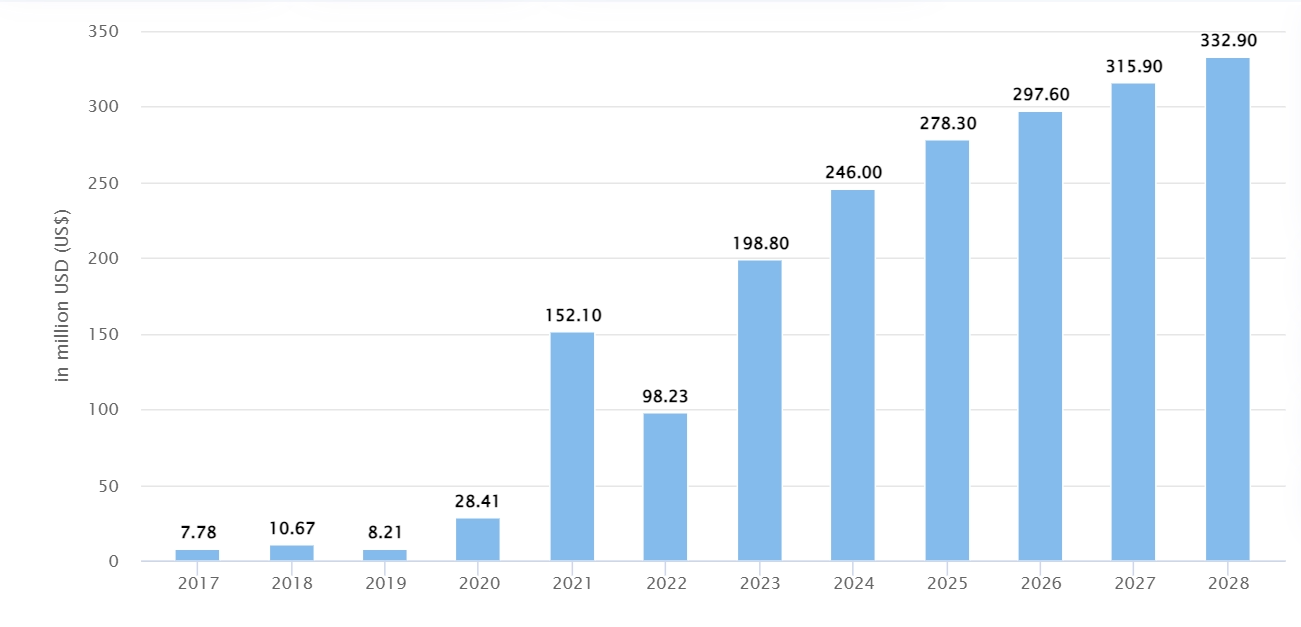
The South African crypto industry is expected to grow by nearly 8% by 2028. Source: Statista

Mauritius took a different approach with its 2022 Virtual Asset and Initial Token Offering Services Act, creating a zero-capital-gains-tax environment that has attracted 23,000+ crypto holders despite a population of just 1.3 million. The island nation now ranks first in Africa for licensed crypto firms and has pulled in $500 million in related investment since 2023.

The Financial Services Commission runs regulatory sandboxes that allow DeFi protocols to test products—like tokenized real estate yielding 8% APY for diaspora investors—without the compliance burden that would kill similar experiments in New York or London.

Rwanda entered the regulatory arena in March 2025 with draft legislation from its Capital Markets Authority and National Bank that licenses virtual asset service providers while capping retail exposure at 10% of net worth.

Kigali’s Innovation City now hosts blockchain accelerators that have drawn $150 million in foreign direct investment, positioning Rwanda as East Africa’s crypto laboratory.


Namibia passed its VASP Act in 2024. Botswana issued exchange guidelines in 2025. Tanzania reversed its 2019 ban in July 2025, immediately unlocking cross-border crypto flows that had been operating in the shadows.
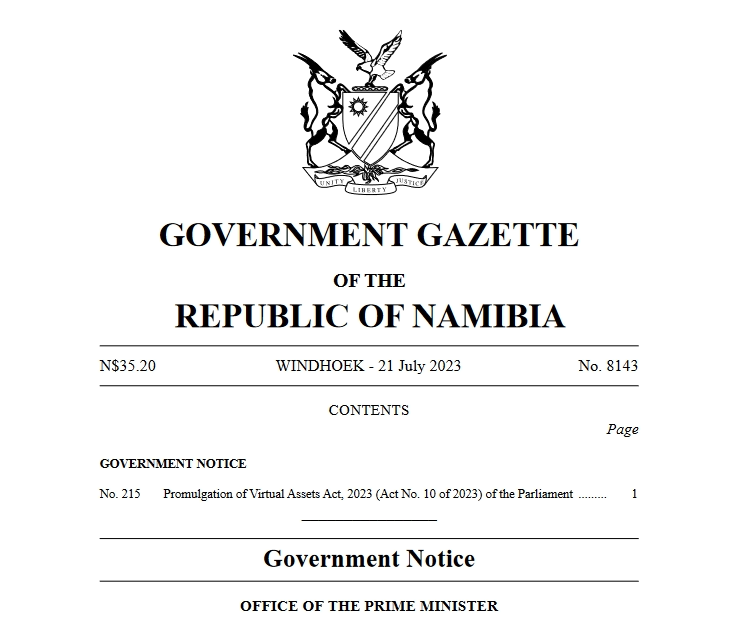
The law was published in the Gazette of the Republic of Namibia. Source: Namibia government

Seychelles updated its 2020 Virtual Asset Service Providers Act in 2025 to include tokenized securities, capturing 15% of Africa’s offshore crypto volume with 50+ licensed firms operating DeFi hubs.

The pattern is clear: countries that move first with sensible regulation attract capital, talent, and infrastructure. Those that ban or delay watch their citizens use crypto anyway—just without consumer protections or tax revenue.

The second wave: Ghana, Kenya, and Nigeria join the regulatory race

Ghana’s central bank announcement on October 24, 2025 put a timeline on what had been years of deliberation: full cryptocurrency regulations, including VASP licensing and stablecoin sandboxes, will be in place by December 2025, making Ghana Africa’s tenth fully regulated crypto market.

With 3% of the population (roughly 900,000 people) already holding digital assets and Google Trends data showing Ghana among the top-20 countries globally for crypto-related searches, the regulatory framework aims to channel existing activity into legal structures rather than suppress it.

Proposed sandboxes for tokenized agricultural commodities could allow cocoa farmers to hedge against the 29% inflation that has eroded local purchasing power—turning crypto from speculative asset into economic tool.
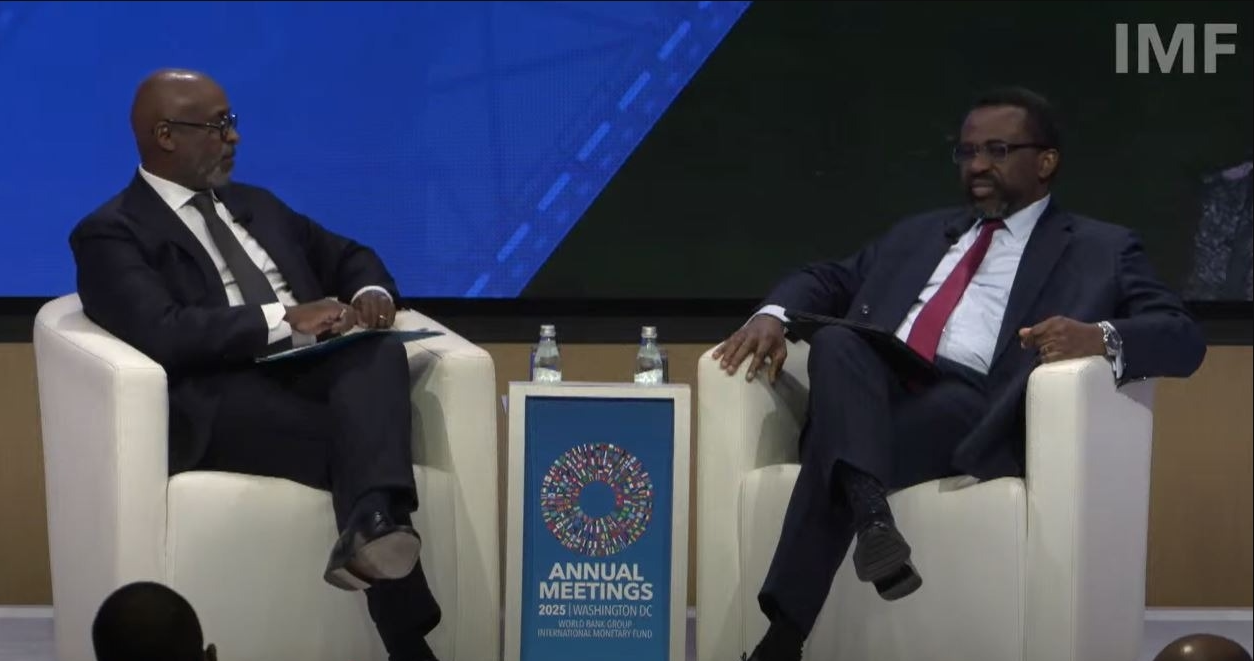
Asiama (right) spoke with the IMF’s Africa Department director, Abebe Salassie (left). Source: IMF

Kenya signed its Virtual Assets and Digital Assets Bill into law on October 15, 2025, transforming the Central Bank’s 2015 warnings into a comprehensive VASP framework. With 5.1% of adults holding crypto and 74 merchants accepting digital payments (61 added in 2024 alone), Kenya ranks 21st globally in adoption.

The legislation creates pathways for central bank digital currency pilots integrated with M-Pesa, the mobile money platform used by 30 million Kenyans. Finance Committee Chair Kuria Kimani called it “Africa’s gateway to digital finance,” though critics worry that 19% of young Kenyans trading crypto lack basic financial literacy.

Nigeria formalized cryptocurrency in April 2025 through amendments to its Investment and Securities Act, recognizing digital assets as legitimate financial instruments for the first time since the central bank’s 2021 trading ban.

With 33% of adults reporting crypto ownership in recent surveys and $59 billion in annual transaction volume, Nigeria dominates African crypto markets.

The country now hosts an estimated 300,000 blockchain developers—45% of the continent’s total—and processes more peer-to-peer crypto volume than any nation except the United States.

Nigerian policymakers are actively debating whether to establish a strategic Bitcoin reserve to hedge against naira volatility, which has seen the currency lose 70% of its dollar value since 2023.

Yet Nigeria also illustrates crypto’s double-edged nature in African markets. The same peer-to-peer networks that enable $59 billion in legitimate commerce also facilitate capital flight, with an estimated $6 billion leaving the country annually through unregulated channels.

Brain drain compounds the problem: Nigerian crypto developers increasingly relocate to Dubai, Portugal, or remote-work arrangements, building products for global markets while their home economy struggles with 28% inflation and chronic dollar shortages.

The use case that matters: remittances and the $48 billion opportunity

Strip away the speculation and price charts, and African crypto adoption is driven by a simple economic reality: traditional remittance channels are extractive and broken.

Africans abroad sent $48 billion home in 2024, according to World Bank data. Traditional services like Western Union and MoneyGram charge average fees of 9%—$4.3 billion extracted annually from some of the world’s poorest communities.

Crypto-based remittance platforms charge under 1%.

This isn’t marginal improvement. For a Ghanaian nurse in London sending £200 monthly to family in Accra, crypto saves £216 annually—more than a week’s wages. Scaled across 12.4 million African crypto users, the efficiency gain represents billions of dollars staying in local economies rather than enriching intermediaries.

Chainalysis data shows that 8% of African crypto transactions are under $10,000, compared to 6% globally—evidence that adoption is driven by practical need rather than institutional speculation.

Sources: Investors King

DeFi platforms like Xend Finance enable Nigerians to tokenize property deeds and access dollar-denominated credit without local bank approval. Rally allows Kenyan women to stake idle smartphone processing power for stablecoin income.

This is crypto’s actual killer app in Africa: reducing friction in cross-border money movement for populations systematically underserved by traditional finance.

The risks are real: scams, volatility, and the infrastructure gap

Romanticizing African crypto adoption ignores serious dangers. Ponzi schemes and fraudulent exchanges drain an estimated $1 billion annually from African users, according to blockchain analytics firms tracking illicit flows.

Young adopters chasing price pumps often lack basic understanding of private key security, smart contract risks, or market manipulation.

The Central African Republic’s disastrous Bitcoin legal tender experiment illustrates policy failure. President Faustin-Archange Touadéra declared Bitcoin legal tender alongside the CFA franc in 2022, despite 90% of citizens lacking internet access.

The government’s Sango Coin—supposedly backed by natural resources—was widely viewed as a state-sponsored scam. The IMF pressured CAR to effectively abandon the policy within months, but early adopters had already lost 40% of their investment to volatility.

Six African countries maintain outright crypto bans: Cameroon, Ethiopia, Egypt (until 2024), Morocco, Algeria, and Tunisia. These prohibitions haven’t stopped adoption—they’ve just pushed it into unregulated shadows where scams proliferate and users have zero legal recourse.

Infrastructure gaps compound risks. Forty-three percent of Sub-Saharan Africa lacks reliable internet access. Power grids remain unstable in many countries, making cryptocurrency mining uneconomical except in South Africa and select regions with hydroelectric or geothermal capacity.

The $800 billion infrastructure investment deficit cited by the African Development Bank means even successful crypto businesses struggle with basic operational challenges like consistent connectivity.

Regulatory fragmentation creates forum shopping, where companies choose the most lenient jurisdiction regardless of where their users live. Mauritius and Seychelles have attracted legitimate businesses, but also raised concerns about inadequate oversight of money laundering risks.

What comes next: the case for coordinated African crypto policy

Africa’s crypto regulatory patchwork has created momentum, but fragmentation threatens long-term sustainability. Ghana’s December 2025 framework won’t align with Kenya’s October law, which differs from South Africa’s 2022 model, creating compliance burdens for any platform operating regionally.

The continent needs coordinated policy architecture—not to stifle innovation, but to prevent a race to the bottom where the least regulated jurisdictions attract the most problematic actors.

A Pan-African Crypto Framework could build on the African Continental Free Trade Area’s approach to harmonization: establish minimum standards for consumer protection, anti-money laundering, and licensing requirements, while allowing individual countries flexibility in implementation.

Specific elements could include:

Mutual recognition of licenses: A crypto exchange licensed in South Africa could passport services across participating countries, similar to the EU’s MiCA framework.

Shared infrastructure investment: Pooled resources for blockchain developer training hubs in Lagos, Nairobi, Kigali, and Johannesburg, preventing brain drain by creating African centers of excellence.

Coordinated CBDC pilots: Rather than 15 countries each building separate central bank digital currencies, coordinate interoperable pilots that enable cross-border settlement.

Strategic Bitcoin reserves: Countries experiencing chronic currency instability—Zimbabwe with its hyperinflation legacy, Nigeria with naira collapse—could explore modest Bitcoin reserve holdings as insurance against further depreciation, following Fidelity’s 2025 analysis of Bitcoin as sovereign treasury diversification.

Tokenized commodity platforms: Coordinate frameworks for tokenizing cocoa (Ghana), coffee (Ethiopia, Rwanda), minerals (DRC, Zambia), allowing farmers and miners to hedge production and access international financing.

Critics will argue that African Union initiatives rarely succeed, pointing to decades of stalled continental integration projects. Fair enough. But crypto adoption isn’t waiting for bureaucratic consensus—it’s happening now, through peer-to-peer networks and grassroots adoption that will hit $300 billion in annual volume within two years at current growth rates.

The question is whether policy keeps pace, or whether African crypto markets develop the same fragmented, contradictory regulatory environment that has plagued Western digital asset policy.

Source: Akaunting

Why this matters beyond Africa

When mobile money emerged in the 2000s, Western observers dismissed M-Pesa as a novelty for “unbanked Africans”—until the model revolutionized digital payments globally and influenced everything from Venmo to China’s WeChat Pay.

African crypto adoption is following a similar trajectory. The innovations being built in Lagos and Nairobi—stablecoin remittances, peer-to-peer trading networks, mobile-first DeFi platforms—aren’t “emerging market experiments.” They’re the future of how billions of people will interact with digital finance.

Africa’s 54 countries represent 1.4 billion people, with median age of 19. By 2050, one in four humans will be African. The financial infrastructure being built now—whether blockchain-based or traditional—will shape global commerce for decades.

Western policymakers spent 2024 debating whether crypto is currency, commodity, or security. African policymakers spent 2024 building regulatory frameworks to channel crypto toward remittances, trade finance, and financial inclusion.

Ten countries have comprehensive laws. Another dozen are drafting frameworks. $205 billion flows through the system annually, growing at 19% year-over-year.

This isn’t the frontier. This is the future arriving faster than expected, in places Washington and Brussels weren’t watching closely enough.

The continent that leapfrogged landline telephone networks for mobile, and bank branches for M-Pesa, is now leapfrogging Western financial infrastructure entirely.

Anyone still calling it “emerging” isn’t paying attention.

Tags: Africabitcoin reservesblockchain policyCentral African Republiccross-border paymentscrypto infrastructurecrypto regulationcryptocurrency adoptiondefidigital assetsemerging marketsfinancial inclusionGhanaglobal financeinflation hedginginstitutional adoptionKenyaM-PesaMauritiusmobile moneynigeriaPan-African policypeer-to-peer tradingregulatory frameworksremittancesRwandaSEC vs CFTCSouth AfricastablecoinsVASP licensing
Share197Tweet123
Ayuba Haruna

Ayuba Haruna

Ayuba Haruna is an editor with experience vast experience. He specializes in regulatory enforcement, DeFi protocols, and market analysis, delivering rigorous, well-sourced journalism. His editorial philosophy: let the facts speak for themselves. Specific figures, named sources, and balanced perspectives over sensationalism. When he's not editing breaking news, Ayuba enjoys watching films.

  • Trending
  • Comments
  • Latest
AI People joins Dubai’s innovation one — Declares war on the forgetting of humanity

AI People joins Dubai’s Innovation One program: Declares war on the forgetting of humanity

07/22/2025 - Updated On 07/23/2025
FBI nabs Nigerian ‘tech queen’ Sapphire Egemasi in multi-million dollar fraud scheme

FBI arrests Nigerian ‘tech queen’ Sapphire Egemasi in $1.3M heist targeting U.S. government

06/05/2025 - Updated On 06/17/2025
Crypto investor and wife found dead in Dubai as police investigate possible link to digital assets

Crypto investor and wife found dead in Dubai as police investigate possible link to digital assets

11/08/2025
Polygon Discord Channel Hacked, Throws Crypto Community in Turmoil

Polygon Discord Channel Hacked, Throws Crypto Community in Turmoil

2
Bitcoin reclaims $107,000 as Iran-Israel ceasefire cools market tensions

Bitcoin reclaims $107,000 as Iran-Israel ceasefire cools market tensions

2

Hello world!

1
Wyoming Crypto Bank petition headlines a rapidly intensifying legal confrontation that could reshape how crypto banks access the U.S. financial system. Wyoming-chartered Custodia Bank has formally petitioned the full Tenth Circuit Court of Appeals to review the Federal Reserve’s denial of its master account, escalating a five-year fight with sweeping implications for federal power, state banking authority, and digital asset innovation. Wyoming Crypto Bank petition filings submitted on December 15 request an en banc review, asking all active judges on the Tenth Circuit to reconsider an October panel ruling that upheld the Fed’s decision. Custodia argues the panel misread federal law and endorsed a system that grants regional Federal Reserve Banks unchecked discretion over legally eligible state-chartered institutions. Wyoming Crypto Bank Petition Challenges Fed’s Master Account Authority At the heart of the Wyoming Crypto Bank petition is the Federal Reserve’s refusal to grant Custodia access to a master account—an essential gateway to core payment rails such as wire transfers and automated clearinghouse (ACH) services. Without it, Custodia says its Wyoming-issued charter is effectively rendered meaningless. Custodia contends the ruling conflicts directly with the Monetary Control Act (MCA), which states that Federal Reserve services shall be available to nonmember depository institutions. The bank argues the Fed has transformed that mandate into what it calls an unconstitutional veto over state banking decisions. When the Fed denies a master account to a state-chartered financial institution, it effectively vetoes a bank charter that State regulators have approved, Custodia wrote in its petition. State Banking Authority Under Threat The Wyoming Crypto Bank petition also raises serious federalism concerns. Wyoming chartered Custodia in 2020 as a Special Purpose Depository Institution (SPDI), a regulatory framework specifically designed to attract digital asset firms while minimizing systemic risk through 100% reserve backing and a prohibition on lending. Custodia argues the Fed’s rejection undermines Wyoming’s carefully constructed regulatory regime and erodes states’ constitutional authority to charter banks. The petition warns that allowing the Fed such power could discourage innovation-driven state banking models nationwide. Constitutional Red Flags in the Wyoming Crypto Bank Petition Beyond federalism, the Wyoming Crypto Bank petition pushes into constitutional territory. Custodia’s legal team argues that if regional Federal Reserve Bank presidents possess unreviewable discretion over master accounts, they effectively function as “Officers of the United States” without proper constitutional appointment. Federal Reserve Bank presidents are selected by private bank directors and approved by the Board of Governors. Custodia says that structure violates the Appointments Clause if those officials wield significant executive authority. Judicial Split Deepens Over Wyoming Crypto Bank Petition The petition highlights a growing divide within the Tenth Circuit itself. Judge Timothy Tymkovich’s dissent in Custodia’s case aligns with Judge Robert Bacharach’s earlier opinion in Fourth Corner Credit Union v. Federal Reserve Bank of Kansas City, creating a 2-2 split among circuit judges. Tymkovich warned that the Fed’s interpretation grants “unreviewable discretion” that contradicts the plain language of the MCA and raises “thorny questions” under Article II of the Constitution. Fed’s Own Records Undermine Denial Rationale The Wyoming Crypto Bank petition also points to contradictions within the Federal Reserve’s own process. The Kansas City Fed denied Custodia’s application in January 2023 after a 27-month review, citing risks tied to “crypto-asset activities.” Yet internal documents show Fed staff initially found Custodia’s capital levels “adequate” and praised its leadership as “impressive.” Custodia says the decision only shifted after intervention by the Board of Governors. Federal Reserve Governor Christopher Waller later acknowledged publicly that the Fed has sufficient supervisory tools to manage risk without blanket denials. In an October interview, Waller said the Fed can “tailor” master account structures to fit a bank’s specific risk profile. Wyoming Crypto Bank Petition Lands Amid Crypto Debanking Reckoning The Wyoming Crypto Bank petition arrives as regulators face mounting scrutiny over crypto debanking. In December, the Office of the Comptroller of the Currency revealed that all nine of the largest U.S. banks imposed “inappropriate” restrictions on lawful businesses, including digital asset firms, between 2020 and 2023. Institutions such as JPMorgan Chase, Bank of America, Citibank, and Wells Fargo maintained internal policies that escalated or restricted entire sectors, reinforcing claims of systemic exclusion. If the full Tenth Circuit agrees to hear the Wyoming Crypto Bank petition, the outcome could redefine the balance of power between state banking regulators and the Federal Reserve—setting a precedent that reaches far beyond Custodia and Wyoming. For the crypto industry, the case may determine whether compliance-focused digital asset banks can ever gain equal footing within the U.S. financial system.Wyoming Crypto Bank Petition Sparks High-Stakes Legal Showdown as Fed Power Faces Fierce Constitutional Test

Wyoming-chartered Custodia Bank challenges Federal Reserve’s master account veto power

12/16/2025
DWF Labs is placing a bold bet on the transformative power of AI agents | Photo: freepik

Whale dumps AI agent tokens at 90%+ loss, exposing thin liquidity in niche markets

12/16/2025
Solana disinflation Ross Ulbricht Loses $12M in Solana Token Loss Due to Liquidity Error

Solana survives one of internet’s largest DDoS attacks with no downtime

12/16/2025
No Result
View All Result
  • Home
  • Crypto News
  • Expert Analysis
  • Finance
  • Tech
  • Sponsored
  • Press Release
  • Opinion

Copyright © 2025 - The Bit Gazette.

Are you sure want to unlock this post?
Unlock left : 0
Are you sure want to cancel subscription?