






- Trending
- Comments
- Latest

Women represent just 31% of crypto holders despite accounting for roughly half the global population, yet research suggests they trade less frequently and hold positions longer than male counterparts.
This behavioral difference—combined with rapid growth in female participation across several regions—is starting to resemble a classic early-adoption curve, prompting some analysts and fund managers to view the gender gap not as a social problem but as a structural market opportunity worth monitoring.
The numbers behind crypto gender gap investing are stark. Surveys indicate that while awareness of cryptocurrency among women is extremely high, understanding and participation remain low. In one study, 94% of women had heard of crypto, but only 9% felt confident in their knowledge.
This disconnect is critical. It suggests that the crypto gender gap investing trend is not driven by lack of interest, but by barriers such as education, confidence, and access.
“Crypto remains a space with low female participation,” analysts note, pointing to structural and cultural factors that continue to shape the market.

From an investor’s perspective, that kind of gap often signals untapped demand rather than permanent exclusion.
Understanding crypto gender gap investing requires looking beyond surface-level statistics. Several factors contribute to the disparity.
First is risk perception. Studies consistently show that women tend to approach investing more cautiously than men, often prioritizing long-term stability over speculative gains.
Second is confidence. Traditional finance data shows that women are less likely to invest not because they lack ability, but because they feel less informed or prepared.
Third is representation. The crypto industry has historically been male-dominated, which can discourage participation and reinforce the crypto gender gap investing cycle.
Yet these same factors may ultimately reshape the market.
What makes crypto gender gap investing particularly interesting is how women invest once they enter the space.
Research shows that female crypto investors are just as likely as men to hold assets long term, with around 40% maintaining positions for over a year.
Other reports suggest women trade less frequently but achieve similar returns, pointing to more disciplined investment strategies.
This behavior challenges the stereotype that higher activity equals better performance and strengthens the argument that crypto gender gap investing could represent not just a participation gap, but a strategic edge waiting to scale.
From a market perspective, crypto gender gap investing resembles early-stage adoption curves seen in other financial sectors.
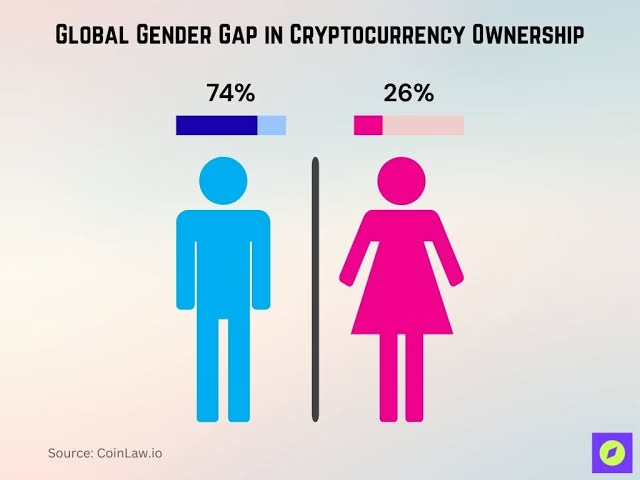
When large demographic groups are underrepresented, it often signals future expansion. As barriers to entry decrease through education, better UX, and community-driven onboarding participation tends to rise.
Evidence of this shift is already emerging. In some regions, female participation in crypto is growing rapidly, with one report noting a surge of over 100% in new women investors within a single year.
If this trend continues, crypto gender gap investing could evolve from a disparity into one of the industry’s most important growth drivers.
The implications of crypto gender gap investing go beyond inclusion they directly impact market dynamics.
A more diverse investor base typically leads to more balanced decision-making, reduced volatility, and longer-term capital allocation. Women’s tendency toward long-term holding could help stabilize markets that are often driven by short-term speculation.
At the same time, new participants bring fresh capital. If even a fraction of the currently underrepresented female population enters the market, it could significantly increase liquidity and demand.

In that sense, crypto gender gap investing is not just a social issue it’s a structural factor that could influence the next phase of market expansion.
The crypto gender gap investing story is often framed as a problem to solve. But from another angle, it’s also a signal.
A large, underrepresented group with growing interest, proven investment discipline, and increasing entry rates represents something markets rarely ignore for long.
As education improves and access widens, the gap is likely to narrow. And when it does, crypto gender gap investing may shift from being a statistic to becoming one of the most important catalysts for the industry’s next wave of adoption. Smart investors are already paying attention.



Copyright © 2025 - The Bit Gazette.