






- Trending
- Comments
- Latest

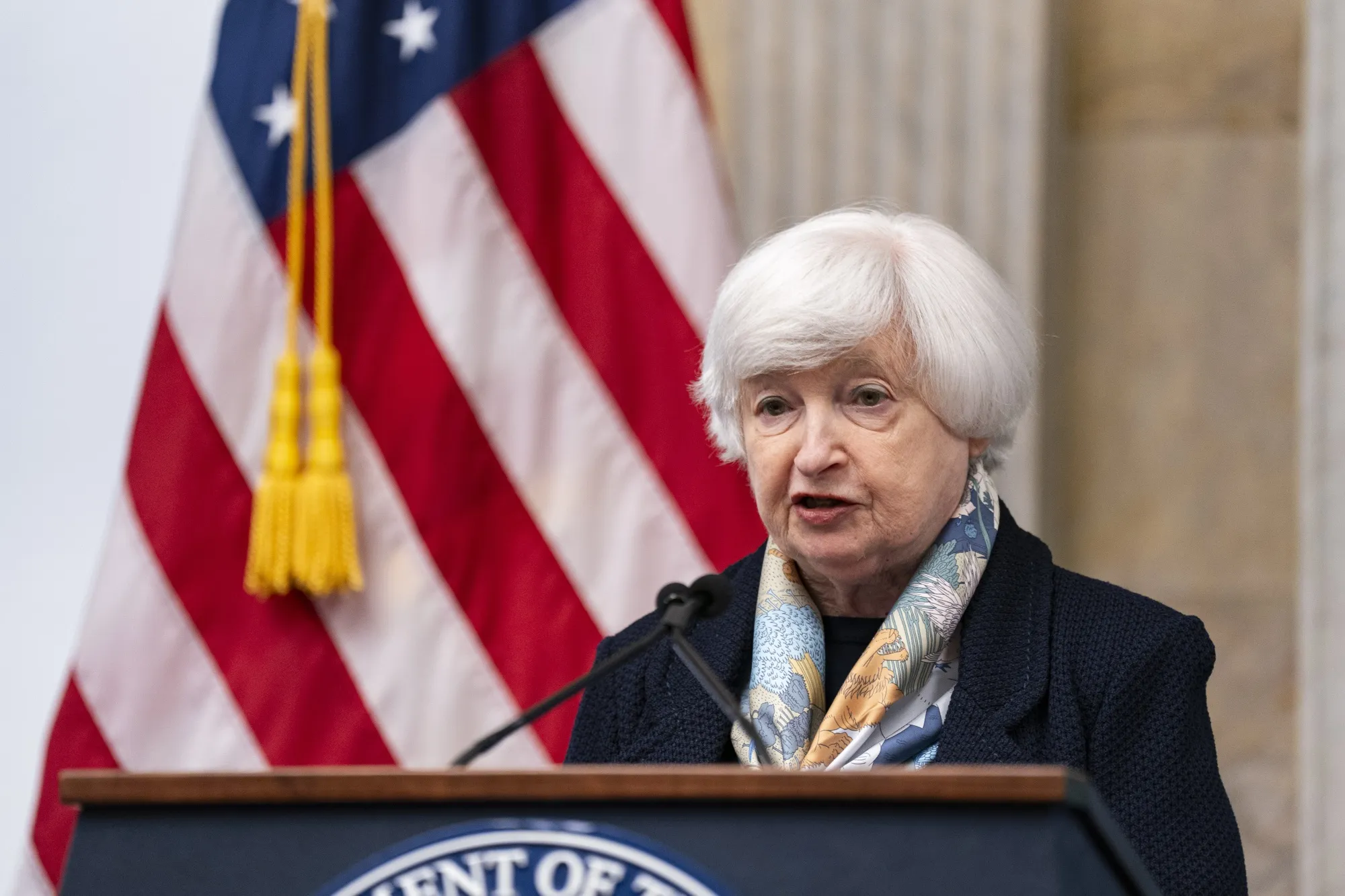
Former U.S. Treasury Secretary Janet Yellen warned Tuesday that escalating U.S.-Iran tensions could force the Federal Reserve to delay rate cuts, citing the risk of sustained oil price spikes and renewed inflation pressure. Speaking at a Long Beach conference, Yellen said the recent developments have made the Fed ‘even more reluctant to cut rates than they were before.’
Her remarks, first reported by Bloomberg, suggest that a Fed rate cut could be postponed if geopolitical tensions push oil prices higher and sustain inflationary pressure.
“I think the recent Iran situation puts the Fed even more on hold, more reluctant to cut rates than they were before this happened,” — Janet Yellen, former U.S. Treasury Secretary.
At the center of the concern is the Strait of Hormuz, a critical artery for global oil shipments. Any prolonged disruption there could keep energy prices elevated. Higher oil prices typically translate into higher transportation and production costs, which feed into consumer
inflation — a dynamic that complicates the path to a Fed rate cut.
Inflation is already running roughly one percentage point above the Federal Reserve’s target, leaving policymakers little room for error. In such an environment, a Fed rate cut could risk reigniting price pressures just as the central bank is attempting to anchor expectations.
The latest geopolitical shock arrives at a delicate moment for U.S. monetary policy. Minutes from the Federal Open Market Committee’s January meeting showed that several policymakers were increasingly wary of persistent inflation. Some participants even suggested that additional rate hikes could not be ruled out if inflation fails to cool.
Against that backdrop, expectations for a Fed rate cut had already been tempered. The renewed oil shock linked to Iran further complicates that outlook. Energy-driven inflation can squeeze household purchasing power while simultaneously dampening growth — a difficult trade-off for central bankers.
Yellen acknowledged the uncertainty surrounding the duration of the conflict. If oil prices remain elevated for more than a few days, she suggested, the Federal Reserve may have to remain cautious longer than markets previously anticipated. That caution would likely translate into a delayed Fed rate cut.
Financial markets responded with mixed signals. The SPDR S&P 500 ETF (SPY) gained approximately 0.36%, while the Invesco QQQ Trust (QQQ) rose about 0.4%. In contrast, the SPDR Dow Jones Industrial Average ETF (DIA) slipped roughly 0.34%. Retail sentiment toward the S&P 500 remained broadly bullish, even as uncertainty over the next Fed rate cut increased.
While Yellen emphasized caution, Arthur Hayes, chief investment officer of Maelstrom, offered a different perspective. In his view, geopolitical conflict could ultimately pave the way for a Fed rate cut rather than delay it.
Hayes argues that major U.S. military engagements in the Middle East historically lead to higher government spending, which eventually pressures the Federal Reserve to loosen policy to stabilize markets and support growth. He pointed to examples such as the 1990 Gulf War and the post-9/11 period, when monetary easing followed heightened geopolitical stress.
“The cure, as always, is cheaper and more plentiful money,” — Arthur Hayes, CIO, Maelstrom.
According to Hayes, prolonged military engagement tends to expand federal outlays significantly. Sustaining that fiscal expansion, he contends, often results in a Fed rate cut and broader liquidity injections into the financial system.
In that scenario, Hayes expects risk assets to benefit, particularly cryptocurrencies. Bitcoin is currently trading near $66,000, well below its prior peak of $126,000. Hayes maintains that once the Federal Reserve shifts from holding rates steady to implementing a Fed rate cut, the next major crypto rally could begin.
For now, investors remain caught between two competing narratives. On one side are inflation concerns tied to rising oil prices and geopolitical instability — factors that could delay a Fed rate cut. On the other is the historical pattern highlighted by Hayes, suggesting that sustained conflict and fiscal expansion may ultimately force policymakers to ease.
The Federal Reserve has not formally signaled an immediate policy shift. However, the renewed uncertainty surrounding energy markets and inflation expectations places the next Fed rate cut squarely at the center of market debate.
Whether the conflict proves short-lived or prolonged will likely determine the direction of monetary policy. If oil prices stabilize quickly, the Fed rate cut timeline could remain intact. If disruptions persist, policymakers may opt to keep rates higher for longer.
In the meantime, financial markets are adjusting to a landscape shaped by geopolitical risk and monetary ambiguity. The trajectory of inflation — and the timing of the next Fed rate cut — now hinges not only on domestic data but also on developments far beyond U.S. borders.



Copyright © 2025 - The Bit Gazette.

