


- Trending
- Comments
- Latest

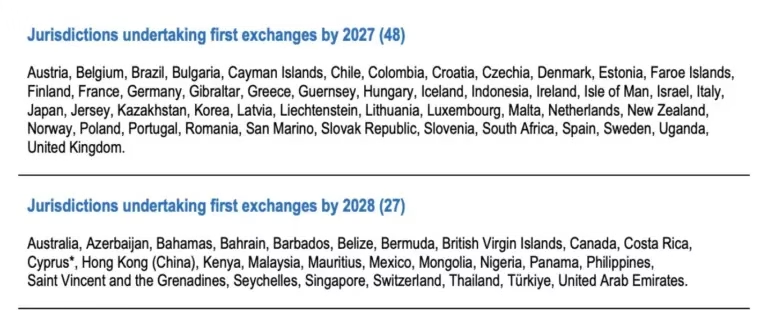
Crypto exchanges and brokers in 48 countries began collecting detailed user transaction data on Jan. 1 under the OECD’s Crypto-Asset Reporting Framework, marking the start of coordinated global tax enforcement three years ahead of the framework’s official 2027 launch.
The early data collection requires platforms to record customer identities, holdings, transactions, and capital gains throughout 2026 for automatic sharing between tax authorities beginning in 2027.
Tax officials say the preemptive approach will close reporting gaps and prevent investors from retroactively concealing taxable activity before cross-border information exchanges begin.
The CARF initiative was developed by the Organisation for Economic Co-operation and Development (OECD) to address long-standing transparency issues in the crypto sector. In June 2023, the OECD convened regulators from major economies, warning that digital asset markets had grown faster than existing tax reporting systems.
“With respect to transparency for tax purposes, the OECD, working with G20 countries, completed and published the Crypto-Asset Reporting Framework for the reporting and automatic exchange of information in relation to crypto-assets,” the OECD said in an October report.
CARF establishes standardized Crypto tax data collection rules, including customer due diligence, transaction reporting requirements, and classification standards for Reporting Crypto-Asset Service Providers (RCASPs). These measures are intended to align crypto reporting with traditional financial account disclosures.
Participating jurisdictions must translate CARF into domestic law, setting penalties for non-compliant platforms and defining how collected data is transmitted to tax authorities.
Beyond domestic legislation, CARF relies heavily on international cooperation. Countries must establish legal mechanisms for the automatic exchange of Crypto tax data collection records between tax authorities.
Some jurisdictions will use the Convention on Mutual Administrative Assistance in Tax Matters, which already supports the Common Reporting Standard. Others are expected to rely on bilateral tax treaties, Tax Information Exchange Agreements, or regional arrangements such as the European Union’s coordinated reporting system.

The OECD estimates that more than 50 jurisdictions will be fully prepared when automatic exchanges begin in 2027. Political backing continues to strengthen. G20 finance officials have endorsed the framework and tasked the Global Forum on Transparency and Exchange of Information for Tax Purposes with supporting implementation.
Currently, 59 countries have signed a joint statement committing to CARF compliance, signaling broad international alignment behind standardized Crypto tax data collection.
The first group of 48 jurisdictions will collect data throughout 2026 for exchange in 2027. A second wave of 27 countries—including Australia, Canada, Mexico, Switzerland, and Hong Kong—is expected to begin reporting in 2028.
Hong Kong has already initiated consultations. In a government statement, the city confirmed it opened a public forum in early December to gather feedback on CARF implementation and updates to tax reporting standards.
The United Kingdom has moved quickly to operationalize CARF-style oversight. According to the BBC, the UK government has introduced new rules requiring crypto buyers to provide detailed account information to HM Revenue & Customs (HMRC).
Under the updated framework, crypto platforms must submit accurate data on user identities, holdings, transactions, and realized gains. Platforms that fail to comply face penalties, while investors are now subject to significantly expanded Crypto tax data collection.
 Crypto tax data collection has begun in 48 jurisdictions as regulators move ahead of the OECD’s CARF rollout in 2027, reshaping global crypto tax compliance.
HMRC is expected to use the data to identify substantial amounts of previously unpaid taxes. Officials believe the new rules will limit the ability of high-value investors to conceal gains generated during volatile market conditions.
“HMRC has been concerned for some time about high levels of non-compliance among crypto investors,” Dawn Register, a tax dispute resolution partner at BDO, told the BBC. “HMRC is running a disclosure facility where taxpayers can come clean on undeclared gains and unpaid tax.”
The enforcement push follows years of extreme crypto market volatility. Bitcoin, the largest digital asset by market capitalization, experienced sharp price swings in 2025, creating taxable gains for traders who bought during downturns and sold into rallies.
As Crypto tax data collection becomes embedded across jurisdictions, regulators are signaling a clear message: digital asset profits will increasingly be treated no differently from gains in equities, commodities, or foreign exchange.
For crypto platforms and investors alike, Crypto tax data collection is no longer theoretical—it is now a defining feature of the global regulatory environment.



Copyright © 2025 - The Bit Gazette.