







- Trending
- Comments
- Latest


Advocacy groups and Bitcoin policy organizations are urging President Donald Trump to pardon Samourai Wallet developers Keonne Rodriguez and William Lonergan Hill before the two men enter federal prison in January 2026 for operating an unlicensed money-transmitting business.
The case has ignited a national debate over whether building non-custodial privacy software should be treated as a financial crime, with critics warning the conviction threatens open-source development and free speech protections across the crypto industry.
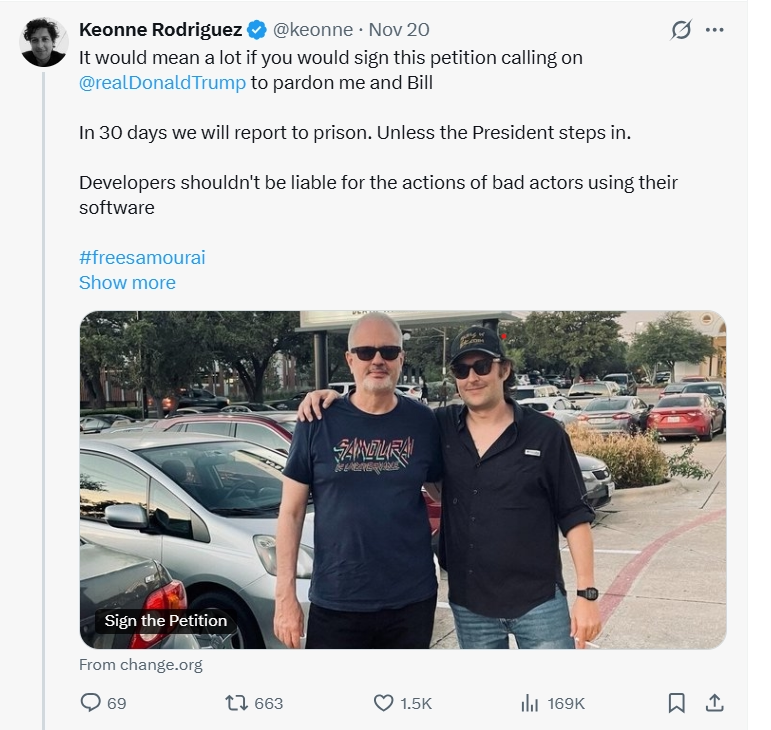
On Dec. 2, the Bitcoin Policy Institute (BPI) released a detailed argument emphasizing why the Samourai Wallet developers should be pardoned, asserting that the prosecution misapplies longstanding federal money-transmission definitions.
According to BPI, non-custodial software has historically been treated as distinct from financial intermediaries, a separation they believe the Samourai convictions undermine.
From BPI’s perspective, “A pardon would correct a clear misapplication of federal law, protect the integrity of long-standing distinctions in financial regulation, and reaffirm that publishing non-custodial software is not — and should not become — a criminal act.”
BPI legal analyst Zack Shapiro argued that treating the Samourai Wallet developers as money transmitters “erases the long-standing legal distinction between software publishers and financial intermediaries,” warning that letting the convictions stand could chill innovation in privacy-preserving tools across the U.S.
The think tank also noted that Rodriguez and Hill pleaded guilty only to the conspiracy charge, with the laundering allegation dropped as part of a plea agreement — a detail policymakers and advocacy groups say further complicates the legal rationale behind the case.
The campaign to secure a pardon for the Samourai Wallet developers has gathered momentum across the Bitcoin ecosystem, with more than 3,200 signatories supporting the petition at the time of publication. Advocates argue that the case sets a dangerous precedent for anyone writing privacy-related software, regardless of its custodial structure.
Walker America, host of The Bitcoin Podcast, posted:
“President Trump should pardon the Samourai Wallet developers. If @realDonaldTrump truly wants America to be the Bitcoin capital of the world, then our government must not unjustly incarcerate Bitcoin developers while turning a blind eye to Big Bankers’ crimes.”
Veteran broadcaster Max Keiser echoed the urgency, tagging Eric Trump and urging intervention as the case gained visibility among Trump-aligned influencers. The Libertarian Party of Oregon also lent its voice to the campaign, asserting that “Code IS speech!” — framing the prosecution of the Samourai Wallet developers as a threat to freedom of expression.
The mounting public pressure has turned the case into a national debate, merging regulatory uncertainty with constitutional questions about speech, technology, and the role of developers in decentralized financial systems.
President Trump has previously issued several crypto-adjacent pardons, including clemency for Silk Road founder Ross Ulbricht and Binance founder Changpeng “CZ” Zhao.
While those actions strengthened Trump’s reputation within parts of the crypto community, they also drew criticism about uneven treatment between high-profile industry figures and open-source developers such as the Samourai Wallet developers.
Bitcoin researcher Kyle Torpey commented that “The perceived corruption associated with the CZ pardon will look even worse if the Samourai Wallet devs aren’t pardoned for similar charges. How much of World Liberty Financial’s USD1 stablecoin does one need to hold to receive a pardon?”
Advocates argue that the contrast highlights a troubling imbalance: a billionaire exchange founder received clemency, while two privacy-focused coders face years in federal prison.
For many in the policy and crypto communities, the resolution of the Samourai Wallet developers case will send a defining signal about how the U.S. intends to handle privacy-related software in the coming decade.
With both men scheduled to report to prison in early 2026, supporters say the countdown carries implications that extend far beyond the individuals involved. What happens next, they argue, could influence the trajectory of open-source development, privacy rights, and the legal boundaries that govern non-custodial tools.
As the petition continues to grow, the fate of the Samourai Wallet developers has become a symbolic test of America’s commitment to innovation, civil liberties, and fair regulatory enforcement.



Copyright © 2025 - The Bit Gazette.

