Gold crushes Bitcoin in 2025 as investors choose history over hype
As gold breaks historic highs driven by central bank demand and geopolitical risk, bitcoin’s failure to reclaim $100,000 is forcing investors to rethink the “digital gold” narrative.
As 2025 draws to a close, global markets are witnessing one of the most consequential asset divergences of the decade.
Gold, the world’s oldest store of value, has surged to record highs between $4,480 and $4,520 per ounce, according to spot and futures data, marking one of its strongest annual performances on record.
U.S. gold futures for February delivery settled 0.8% higher at $4,505.7.
Performance golsilplat
Meanwhile, bitcoin (BTC)—long marketed as “digital gold”—is trading around $87,000–$88,000, having failed multiple attempts to reclaim the psychologically important $90,000–$100,000 range.
This divergence is not cosmetic. It reflects a deeper shift in how investors define safe havens, monetary hedges, and risk assets in an era of geopolitical instability and debt saturation.
Why gold is rewriting the record books
1. Central banks are buying gold at historic scale
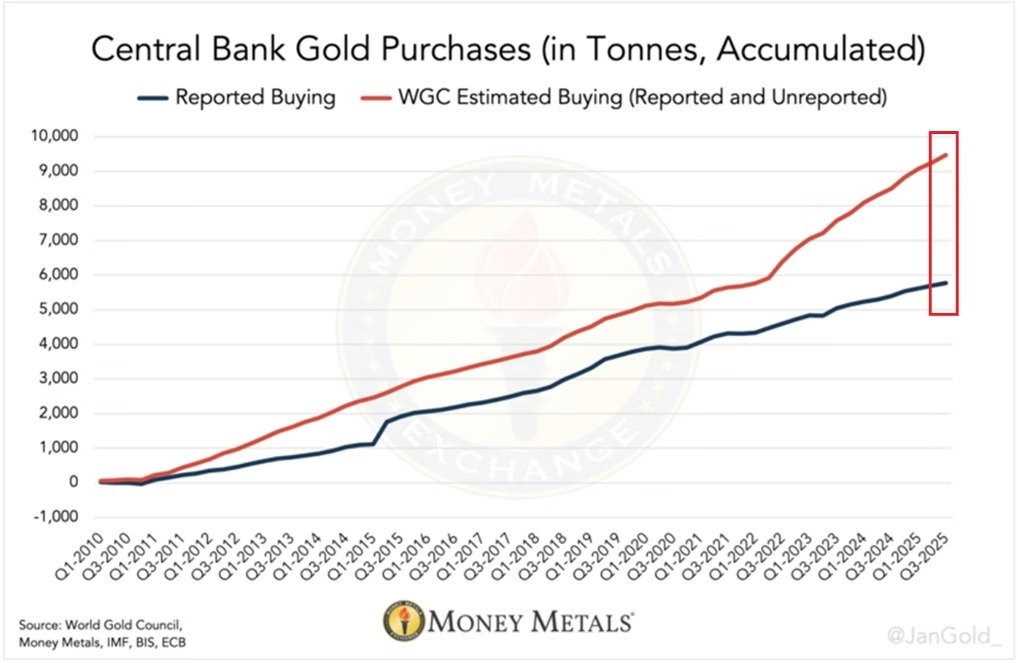
Central bank demand has become the backbone of gold’s rally. According to World Gold Council and Reuters data, global central banks have purchased more than 1,000 tonnes of gold annually since 2022, with no sign of slowing.
Countries seeking to reduce exposure to the US dollar—including China, India, Russia, and several Eastern European states—have been aggressively accumulating physical bullion. Poland alone added over 80 tonnes in recent buying cycles.
This structural demand provides gold with something few assets enjoy: a permanent institutional buyer of last resort.
Central bank gold purchases (2010–2025) Data Source: World Gold Council.
2. Geopolitical risk is back—permanently
From persistent Middle East conflicts and US-China trade tensions to election uncertainty across major economies, 2025 has reinforced a simple truth: geopolitical risk is no longer episodic—it is structural.
In periods of genuine uncertainty, investors historically gravitate toward assets with:
No counterparty risk
Deep liquidity
Global recognition
Gold meets all three criteria. Crypto, for now, does not.
3. Debt, deficits, and currency debasement fears
US federal debt has surpassed $36 trillion, while fiscal deficits remain entrenched despite higher interest rates. Inflation may have cooled, but confidence in fiat discipline has not fully returned.
Gold’s appeal is brutally simple:
It cannot be printed
It does not depend on software
It has survived every monetary system before it
That narrative has regained dominance in 2025.
Why bitcoin is underperforming
Bitcoin entered 2025 with what many considered a perfect macro setup:
Multiple Federal Reserve rate cuts since late 2024
A more crypto-friendly regulatory tone in Washington
Yet prices failed to sustain momentum.
Bitcoin is trading like a tech stock, not a hedge
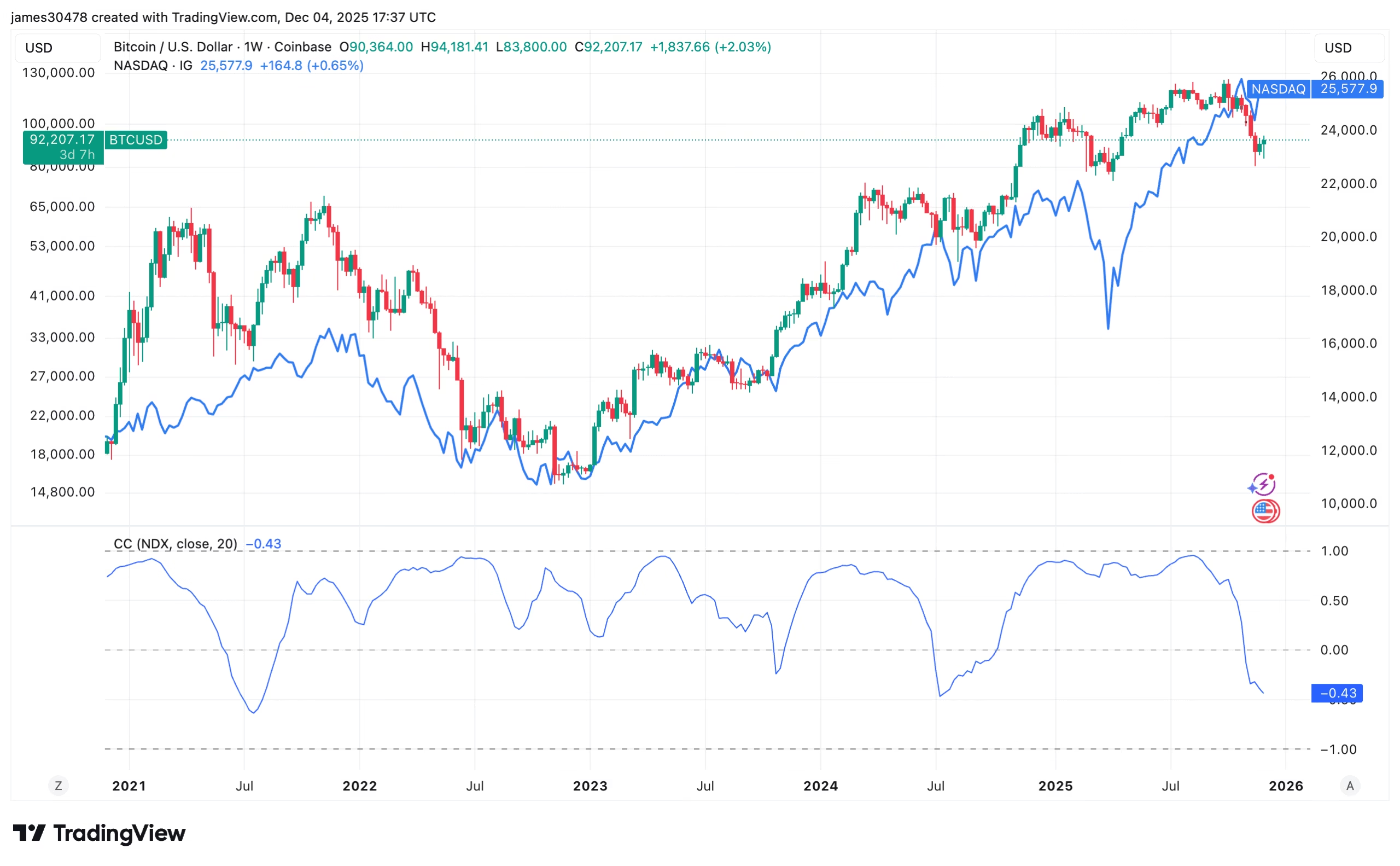
According to market data providers, bitcoin’s correlation with the Nasdaq 100 has risen to approximately 0.85–0.87, while gold’s correlation with equities remains near zero.
This means when risk appetite fades, bitcoin falls with equities instead of protecting against them.
The extended negative correlation between bitcoin and the Nasdaq 100 mirrors past periods such as July 2021, September 2023 and August 2024, all of which aligned with significant bitcoin lows- Coindesk BTCUSD vs Nasdaq 100 (TradingView)
Analyst warning: a potential crypto winter
Jurien Timmer, Director of Global Macro at Fidelity and a long-time bitcoin bull, has cautioned that crypto may be entering a prolonged consolidation phase.
“Bitcoin may well be facing another year-long crypto winter. Key support lies in the $65,000 to $75,000 range.”
— Jurien Timmer, Fidelity
On-chain data supports the caution. According to Glassnode, over 7 million BTC are currently held at a loss, a condition historically associated with early bear-market phases.
Technical analysis: one bullish signal remains
Technically, bitcoin remains fragile:
RSI: hovering in neutral-to-bearish territory
Key resistance: $90,000–$93,000
Trend: lower highs since October peak
However, one contrarian signal has emerged: miner capitulation.
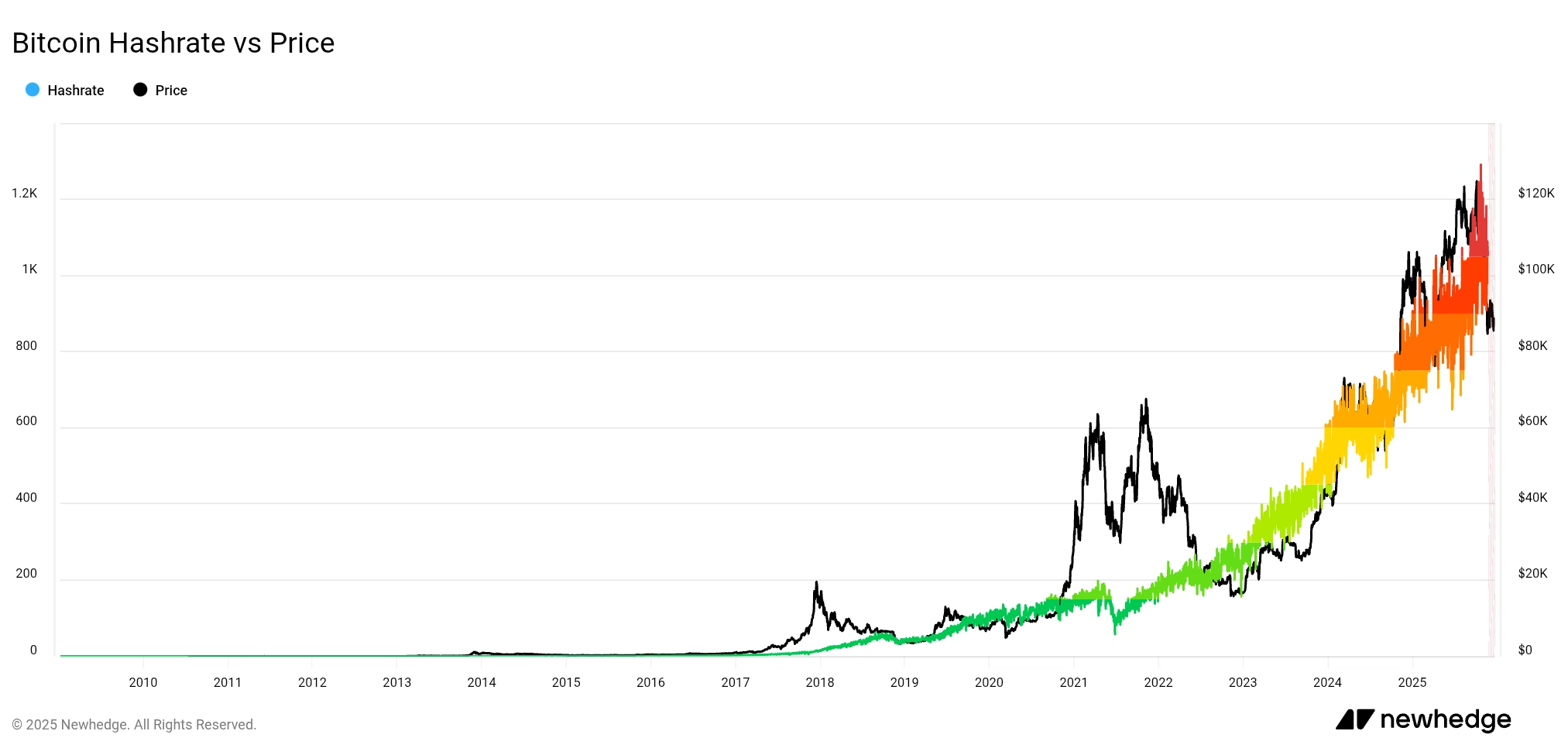
Bitcoin’s hashrate has fallen from recent highs, reflecting profitability stress as hash price dropped toward five-year lows. Historically, miner capitulation has often preceded long-term bottoms.
The viral gold bar moment: bitcoin vs gold, face-to-face
The philosophical clash between bitcoin and gold reached a viral moment in December at Binance Blockchain Week in Dubai, when Changpeng Zhao (CZ) presented a gold bar to economist Peter Schiff and asked: “Is it real?”
Schiff acknowledged that without laboratory testing, purity could not be verified—highlighting gold’s reliance on trust and intermediaries.
CZ countered:
“Every satoshi can be verified instantly, anywhere, with zero trust.”
Schiff responded with performance data:
“Bitcoin is down roughly 40% when priced in gold.”
The exchange ignited renewed interest in tokenized gold, with platforms like PAX Gold and Tether Gold seeing a short-term spike in trading volume.
How investors are allocating for 2026
Institutional portfolios are increasingly adopting dual-asset exposure instead of choosing sides.
Conservative allocation (4–10%)
Gold: 7–9%
Bitcoin: 1–2%
Aggressive allocation (15–25%)
Gold: 10–15%
Bitcoin: 5–10%
BlackRock continues to describe a 1–2% bitcoin allocation as the “Goldilocks zone” for diversification—small enough to limit volatility, large enough to capture upside.
Bull and bear cases for 2026
Bitcoin bulls argue:
ETF inflows could resume
Regulatory clarity may unlock new institutional demand
Long-term scarcity thesis remains intact
Some banks project targets above $140,000 under favorable conditions.
Bears counter:
The four-year halving cycle may be broken
Bitcoin failed to hold $100,000 despite ideal conditions
Correlation with tech weakens its hedge narrative
For gold, momentum remains firmly intact, though some analysts warn of overextension after a historic rally.
Final verdict: markets have spoken—credibility beats narrative in 2025
Gold decisively won 2025.
As the year closes, the market’s message is no longer subtle. While gold surged to historic highs near $4,500—supported by central bank accumulation, geopolitical risk, and balance-sheet stress—bitcoin entered year-end under pressure, slipping below $88,000 amid tax-loss selling, thinning liquidity, and broad weakness across crypto-related equities.
The divergence is observable in capital flows.
According to CoinDesk’s Dec. 23 market update, bitcoin’s late-year softness has coincided with sharp declines in crypto stocks and digital asset treasury firms—the very vehicles meant to institutionalize crypto exposure.
Analysts at QCP Capital and Wincent point to tax-loss harvesting, falling derivatives open interest, and holiday-thinned liquidity as catalysts, but the deeper signal is structural: when risk is reduced, crypto is still treated as a risk asset, not a refuge.
Gold, by contrast, is behaving exactly as a safe haven should.
Even as U.S. equities edged higher and economic data showed a “hot” economy, investors continued to rotate into precious metals rather than digital assets. That choice underscores a sobering reality for crypto advocates: in moments of uncertainty, trust gravitates toward history, not innovation.
Bitcoin’s long-term thesis is not broken—but it has been postponed.
Moses Edozie is a writer and storyteller with a deep interest in cryptocurrency, blockchain innovation, and Web3 culture. Passionate about DeFi, NFTs, and the societal impact of decentralized systems, he creates clear, engaging narratives that connect complex technologies to everyday life.