
- Trending
- Comments
- Latest

South Korea AI ambitions faced a major test this week after a government-backed competition to build a fully domestic artificial intelligence model was rocked by revelations that a majority of its finalists relied, at least in part, on foreign technology.
The controversy comes at a sensitive moment for South Korea AI policy, as the government ramps up record spending to position artificial intelligence as a cornerstone of national economic competitiveness and security.
The issue emerged during a flagship three-year contest launched last June to develop an advanced AI model built exclusively with Korean-developed technology.
The initiative is part of a broader effort to reduce dependence on American and Chinese AI systems that currently dominate global markets.
However, of the five companies selected as finalists, three were found to have incorporated elements of foreign-developed code into their submissions, raising questions about whether South Korea AI sovereignty is achievable under current technological realities.
South Korea has placed one of the largest public-sector bets on artificial intelligence anywhere in the world.
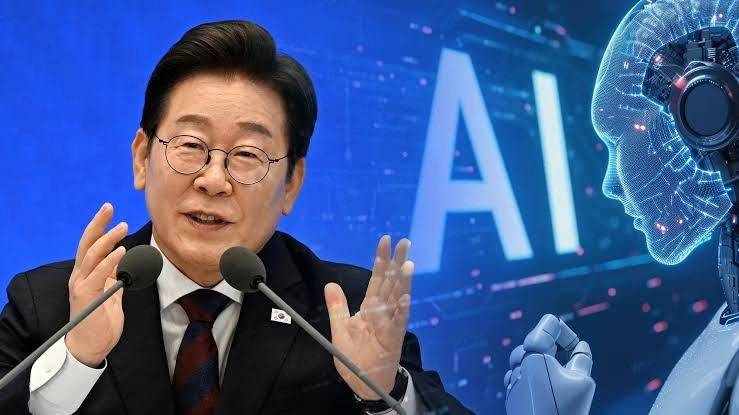
Parliament approved a ₩727.9 trillion ($495.8 billion) national budget for 2026, with President Lee Jae Myung more than tripling AI-specific funding to ₩10.1 trillion ($6.9 billion).
Officials have framed South Korea AI leadership as essential not only for economic growth, but also for national defense and long-term strategic autonomy.
Yet the unfolding controversy highlights a fundamental challenge: modern AI development is deeply globalized.
Advanced systems are rarely built in isolation, relying instead on shared open-source tools, pretrained models, and international research collaboration.
Gu-Yeon Wei, a professor of electrical engineering at Harvard University familiar with the competition, said the expectation of complete technological isolation is unrealistic.
“To forgo open-source software, you’re leaving on the table this huge amount of benefit,” — Gu-Yeon Wei, Professor of Electrical Engineering, Harvard University.
The dispute has forced policymakers to confront whether South Korea AI independence should mean total technological purity or control over core systems while selectively using global tools.
The controversy first erupted around Upstage, one of the five finalists. Ko Suk-hyun, CEO of rival firm Sionic AI, alleged that Upstage’s model closely resembled an open-source system developed by China-based Zhipu AI.
He further claimed that Zhipu AI copyright notices remained visible in parts of Upstage’s codebase.
“It’s deeply regrettable that a model suspected to be a fine-tuned copy of a Chinese model was submitted to a project funded by taxpayers’ money,” — Ko Suk-hyun, CEO, Sionic AI.
Upstage responded by livestreaming a technical verification session, presenting development logs and training records to demonstrate that its core model had been built from scratch.
The company acknowledged using open-source inference code derived from Zhipu AI but argued this was standard practice across the global AI industry. Ko later issued a public apology after reviewing the evidence.
Attention then widened to other finalists. Naver was accused of using visual and audio encoders resembling technology from Alibaba and OpenAI, while SK Telecom faced scrutiny over inference code similarities linked to China’s DeepSeek.
Both companies defended their approaches, emphasizing that their core training architectures were independently developed.
The competition’s rules did not explicitly prohibit the use of foreign open-source components, a gap that has become central to the debate.
The Ministry of Science and ICT, which oversees the program, has so far declined to issue revised guidance, allowing the discussion to unfold publicly.
Science Minister Bae Kyung-hoon struck a notably optimistic tone, framing the dispute as evidence of a healthy and maturing ecosystem.
“As I watched the technological debates currently stirring our AI industry, I actually saw a bright future for South Korean AI,” — Bae Kyung-hoon, Minister of Science and ICT.
Under the program’s structure, two winners will be selected by 2027. Their models must perform at least as well as 95% of leading global AI systems developed by companies such as OpenAI or Google.
Winners will receive government funding for data acquisition, talent recruitment, and access to high-performance computing chips procured by the state.
For South Korea AI policy makers, the episode underscores the difficulty of drawing clean lines between domestic innovation and global collaboration.
While concerns about security and technological dependence are legitimate, critics warn that overly rigid definitions of sovereignty could slow progress and isolate domestic firms.
As governments worldwide race to build national AI capabilities, South Korea AI now finds itself at the center of a broader global dilemma: how to balance openness with independence in a technology that thrives on shared knowledge.
What happens next will likely shape not only the outcome of the competition, but also the future direction of South Korea AI strategy determining whether the country prioritizes absolute self-reliance or pragmatic leadership in an interconnected AI landscape.



Copyright © 2025 - The Bit Gazette.