





- Trending
- Comments
- Latest

Crypto exchange Backpack has launched an invite-only beta for prediction market trading, allowing users to speculate on events while simultaneously hedging positions across other crypto instruments within a single margin account.
The move marks a major expansion for Backpack, founded by former FTX and Alameda Research employees, and puts the exchange in direct competition with platforms like Polymarket and Kalshi as prediction markets gain mainstream traction.
Prediction markets have surged in popularity over the past two years, driven by interest in elections, sports, and macroeconomic events. Yet Ferrante argues that the sector remains structurally inefficient, largely because capital is siloed.
“Prediction markets are notoriously inefficient,” Ferrante said, explaining that users are typically forced to lock up funds for the entire duration of an event. That constraint limits flexibility, prevents dynamic hedging, and reduces capital efficiency—problems the Unified Prediction Portfolio aims to solve.
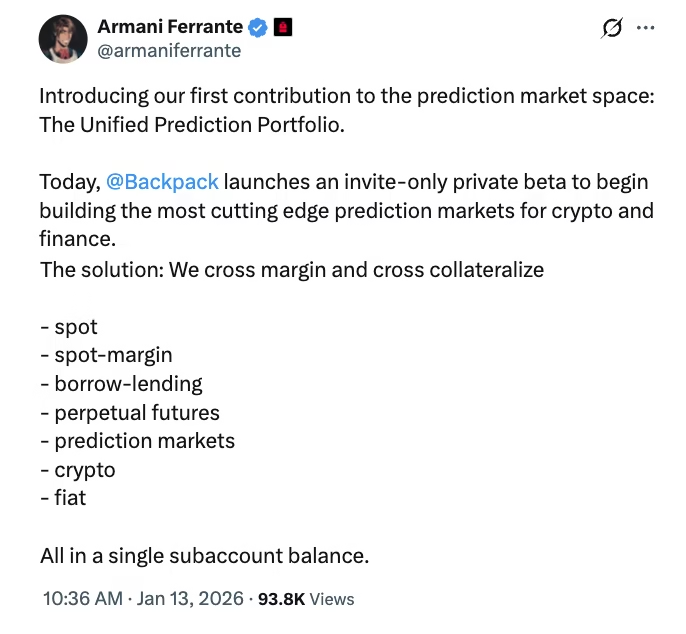
Under Backpack’s model, traders can deploy capital across prediction contracts while simultaneously maintaining exposure to other instruments on the exchange. Positions can be quoted, filled, and immediately hedged using perpetual futures, all within a single margin account powered by the Unified Prediction Portfolio.
At the core of Backpack’s new platform is its risk engine, which treats prediction contracts as part of a broader portfolio rather than isolated bets. Ferrante said this allows traders to dynamically manage risk without fragmenting balances across separate products or platforms.
By integrating prediction markets directly with derivatives infrastructure, the Unified Prediction Portfolio enables strategies that would otherwise require multiple platforms and manual fund transfers. Traders can adjust exposure in real time, hedge outcomes instantly, and respond to market movements without waiting for events to resolve.
Initial testing is focused on validating the portfolio’s risk mechanics and ensuring that margin calculations behave correctly across correlated positions. Ferrante said the beta will expand gradually, with additional features and markets rolled out as the system matures and the Unified Prediction Portfolio proves stable under live conditions.
Backpack’s move comes at a sensitive moment for prediction markets. Platforms like Polymarket have faced increased regulatory attention and public scrutiny following allegations of insider trading tied to political and macroeconomic wagers. In the United States, lawmakers have begun examining whether stricter oversight is needed to prevent misuse of non-public information.
Against that backdrop, Backpack has not yet disclosed which markets will be available at launch or how regulatory compliance will be handled across jurisdictions. The company did not immediately respond to questions regarding oversight and licensing, leaving some uncertainty around how the Unified Prediction Portfolio will operate within evolving regulatory frameworks.
Still, industry observers say Backpack’s integrated approach could appeal to professional traders seeking more sophisticated tools than those currently offered by standalone prediction platforms.
Backpack is not alone in pushing into prediction markets. In November 2025, Coinbase launched a prediction market product in partnership with Kalshi, bringing event-based trading to one of the largest regulated crypto platforms in the world. MetaMask has also partnered with Polymarket, allowing users to trade prediction contracts directly from a self-custodial wallet.
What sets Backpack apart, however, is its attempt to build prediction markets directly into a broader trading ecosystem. Rather than treating predictions as a separate product, the Unified Prediction Portfolio positions them as just another instrument within a multi-asset trading environment.
That design choice reflects a broader trend in crypto markets toward capital efficiency and portfolio-level risk management—an approach already common in traditional derivatives trading.
Ferrante has framed the Unified Prediction Portfolio as a structural upgrade rather than a speculative gimmick. By eliminating the need to lock up funds and allowing continuous hedging, Backpack is betting that prediction markets can evolve from novelty products into serious trading venues.

Whether that vision gains traction will depend on execution, liquidity, and regulatory clarity. But as prediction markets continue to attract both retail interest and institutional attention, platforms offering deeper integration and better risk controls may gain an edge.
For now, Backpack’s invite-only beta signals a cautious but ambitious entry into the space. If successful, the Unified Prediction Portfolio could reshape how traders interact with prediction markets—turning isolated wagers into components of a fully integrated crypto portfolio.
As Ferrante put it, the goal is simple: make prediction markets behave like real markets. And with the Unified Prediction Portfolio, Backpack is placing a calculated bet that traders are ready for exactly that.



Copyright © 2025 - The Bit Gazette.